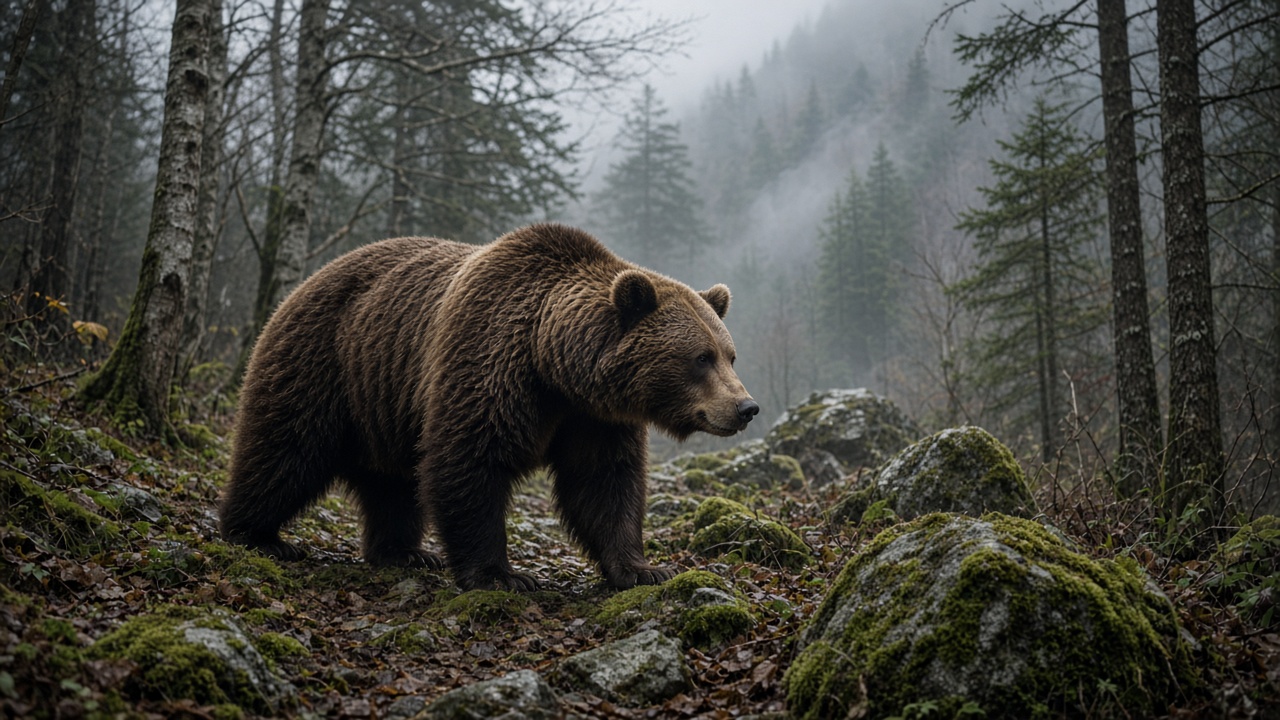
Brown Bear
Ursus arctosBrown Bear (Ursus arctos): coexistence sheet across its documented range — presence, biology and prudence, without an invented hunting status.
Seen in: Austria · Bulgaria · Croatia · Czechia · Estonia
Overview
Brown Bear (Ursus arctos) is a coexistence sheet across its documented range: presence, biology and prudence — not a hunting status claim.
Classification: order Carnivora, family Ursidae, genus Ursus. Common names: Brown Bear in English, Ours brun in French, Oso pardo in Spanish.
Identification
The brown bear is one of the largest living carnivores: 1 to 2.8 m from head to rump, 90 to 150 cm at the shoulder and a tail of 6.5 to 21 cm. It weighs from 80 to more than 600 kg, with males on average 8 to 10% larger than females. Size varies greatly by region: the largest live on the coast of southern Alaska, and bears get smaller towards the north and east. The fur is usually dark brown but ranges from cream to almost black; in the Rocky Mountains, white-tipped hairs give a grizzled look.
An omnivore, it follows the seasons: grasses, sedges, roots, moss and bulbs, then fruit, berries, nuts and tubers in summer and autumn, with insects and fungi all year; it also digs out rodents and marmots and eats carrion. Mating takes place from May to July, but the embryo does not implant until November, when the female enters her winter sleep. The 2 or 3 cubs, weighing 340 to 680 g, are born from January to March in the den and stay with their mother for two to four years. This winter lethargy, from October–December to March–May, is not true hibernation.
Habitats and range
MDD lists it across much of Eurasia – Europe including France, Spain, Italy, Scandinavia, the Balkans and the Carpathians, the Caucasus, the Middle East, Central Asia, the Himalaya, China, Mongolia, Russia and Hokkaido – as well as Alaska, Canada and the north-western United States. It uses a wide range of habitats, from desert edges to mountain forests. In Europe, populations are mostly confined to mountain woodland; its main requirement is dense cover in which to shelter by day.
The countries where the species’ presence is established are shown in the tags on this sheet.
Field signs
It can be active at any hour but feeds mainly in the morning and evening and rests in cover by day, sometimes in a shallow scrape it digs to lie in. It scratches and rubs against trees to signal its presence and breeding condition, and sometimes moans while feeding. Its den, dug on a sheltered slope under a large rock or among the roots of a tree, may be reused year after year.
Conservation
For conservation status of Ursus arctos, consult the current IUCN assessment, then cross with French monitoring programmes when they exist (OFB portal and related publications). Never turn a global IUCN category into a departmental hunting rule. GBIF occurrences help situate documented distribution but remain effort-biased.
The IUCN lists it as Least Concern, but status varies by population, and some are clearly endangered. ADW cites habitat destruction (logging, mining, roads, resorts), persecution and the trade in body parts such as gall bladders for traditional medicine as threats. Females breed only every two to four years and reach sexual maturity at 4 to 6 years.
Limits
This sheet on the Brown Bear covers presence and biology. A species being present in a country does not mean it may be hunted, and no season or quota is published here.
Local densities and management plans are not covered here: they are a matter for the managers of each area.
Sources
Sources consulted for this sheet:
- IUCN Red List — species search (consulted 2026-11-01)
- ASM Mammal Diversity Database — Ursus arctos (consulted 2026-11-01)
- GBIF — species search (consulted 2026-11-01)
- Animal Diversity Web — Ursus arctos (brown bear) (consulted 2026-11-04)
Conclusion
In short: use the scientific name Ursus arctos to cross-check sources, confirm taxonomy and conservation status on the institutional portals listed above, and relate every field sign to the habitat where it was actually found.
Identification
Ursus arctos
Ours brun · preferred
Oso pardo · preferred
Brown Bear · preferred
Grizzly Bear
Kodiak Bear
Classification
Class : Mammalia
Order : Carnivora
Family : Ursidae
Genus : Ursus
Conservation
IUCN : LC
CITES : —
iucn · LC (global)
Habitat
Frequently asked questions
How do I recognise Brown Bear?
Use Ursus arctos as the scientific anchor. The brown bear is one of the largest living carnivores: 1 to 2.8 m from head to rump, 90 to 150 cm at the shoulder and a tail of 6.5 to 21 cm. It weighs from 80 to more than 600 kg, with males on average 8 to 10% larger than females. Size varies greatly by region: the largest liv...
Where does Brown Bear typically live?
MDD lists it across much of Eurasia – Europe including France, Spain, Italy, Scandinavia, the Balkans and the Carpathians, the Caucasus, the Middle East, Central Asia, the Himalaya, China, Mongolia, Russia and Hokkaido – as well as Alaska, Canada and the north-western United States. It uses a wide range of habitats, from desert edges to mountain forests. In...
What field signs help confirm Brown Bear?
It can be active at any hour but feeds mainly in the morning and evening and rests in cover by day, sometimes in a shallow scrape it digs to lie in. It scratches and rubs against trees to signal its presence and breeding condition, and sometimes moans while feeding. Its den, dug on a sheltered slope under a large rock or among the roots of a tree, may be reu...