Bushpig
Potamochoerus larvatusBushpig (Potamochoerus larvatus): biology, habitats and field signs across its documented range, hunting-context reading.
Seen in: Namibia · South Africa
Overview
Bushpig (Potamochoerus larvatus) is presented here in a hunting-context reading across its documented range: biology, habitats and field signs useful to observers — without publishing season, quota or authorisation.
Classification: order Artiodactyla, family Suidae, genus Potamochoerus. Common names: Bushpig in English, Potamochère in French, Potamoquero in Spanish.
Identification
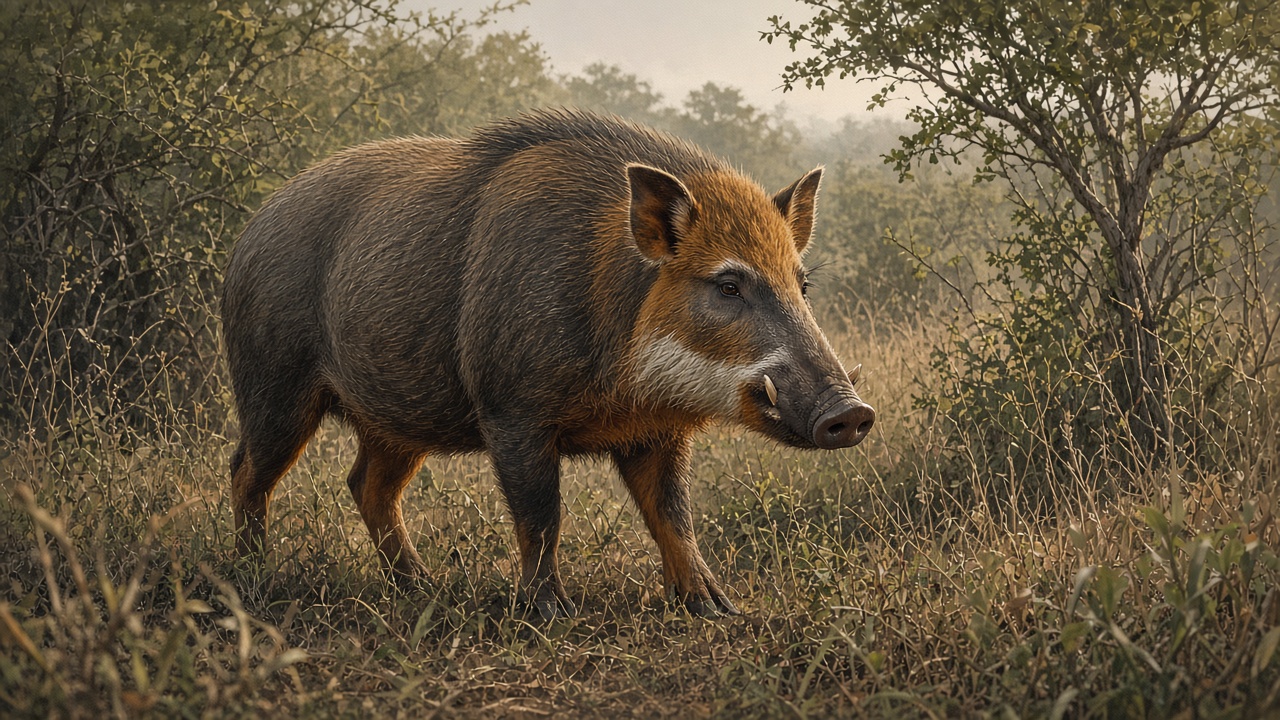
A stocky wild pig with a rounded body on fairly short legs, 100 to 150 cm long and 54 to 115 kg. The shaggy coat ranges from light reddish-brown to grey-brown or almost black, and the head is often a different shade from the body; a mane of long, erectile bristles runs from between the ears to the rump. The ears have short tassels, much shorter than in the red river hog. The tail is long and ends in a tuft. Males have a bony ridge and warts on the snout; the sharp lower tusks reach 7 cm. Piglets are striped brown and yellow.
An omnivore, it roots in the soil for roots, rhizomes, bulbs, tubers, fruit and insect larvae, and also eats invertebrates, small vertebrates and carrion; it sometimes follows fruit-eating monkeys to pick up dropped fruit. Mostly nocturnal, it is more active by day in cool weather. It lives in sounders of up to 12 animals led by a dominant male and female. Mating takes place in May and June; after 120 to 127 days, 1 to 4 young are born in a nest, mostly from September to November, and the boar helps protect them. Leopards, lions, spotted hyenas and pythons are among its predators.
Habitats and range
According to MDD, it lives in eastern and southern Africa: Ethiopia, Somalia, South Sudan, Kenya, Uganda, Rwanda, Burundi, Tanzania, eastern and southern DR Congo, Angola, Zambia, Malawi, Mozambique, Zimbabwe, Botswana, Namibia, Eswatini and South Africa; its presence on Madagascar and the Comoros is thought to result from introduction. It uses a wide range of habitats from sea level to montane forest (up to 4,000 m on Kilimanjaro): gallery or flooded forest, swamps, woodland, scrub and farmland.
The countries where the species’ presence is established are shown in the tags on this sheet.
Field signs
Its most visible signs are ground turned over by rooting and raided crops (potatoes, maize, tomatoes, sugar cane). It likes to wallow and shelters in dense vegetation, where it sometimes builds nests during rain or cold spells. It grunts often, sometimes squeals, and its alarm call is a long, resonant growl. It travels 0.5 to 5 km a day.
Conservation
For conservation status of Potamochoerus larvatus, consult the current IUCN assessment and cross with national monitoring programmes in countries of documented presence. Never turn a global IUCN category into a local hunting rule. GBIF occurrences help situate distribution but remain effort-biased.
The IUCN lists it as Least Concern; the conversion of forest to secondary scrub and farmland has even increased its numbers in places. Said to cause more crop damage than any other species in DR Congo and Malawi, it can also host tick-borne diseases, including African swine fever. On Madagascar and the Comoros it threatens native wildlife; a study cited by MDD (Balboa et al., 2023) concludes that it appeared on Madagascar at the same time as humans.
Limits
This sheet on the Bushpig publishes no season, quota, hunting method or fee: those rules differ between countries and territories and must be checked in official texts. Being described here does not mean a species may be hunted.
Local densities and management plans are not covered here: they are a matter for the managers of each area.
Sources
Sources consulted for this sheet:
- IUCN Red List — species search (consulted 2026-11-02)
- ASM Mammal Diversity Database — Potamochoerus larvatus (consulted 2026-11-02)
- GBIF — species search (consulted 2026-11-02)
- Animal Diversity Web — Potamochoerus larvatus (bushpig) (consulted 2026-11-04)
Conclusion
In short: use the scientific name Potamochoerus larvatus to cross-check sources, confirm taxonomy and conservation status on the institutional portals listed above, and relate every field sign to the habitat where it was actually found.
Identification
Potamochoerus larvatus
Bushpig · preferred
Potamochère · preferred
Potamoquero · preferred
Classification
Class : Mammalia
Order : Artiodactyla
Family : Suidae
Genus : Potamochoerus
Conservation
IUCN : LC
CITES : —
iucn · LC (global)
Frequently asked questions
How do I recognise Bushpig?
Use Potamochoerus larvatus as the scientific anchor. A stocky wild pig with a rounded body on fairly short legs, 100 to 150 cm long and 54 to 115 kg. The shaggy coat ranges from light reddish-brown to grey-brown or almost black, and the head is often a different shade from the body; a mane of long, erectile bristles runs from betwe...
Where does Bushpig typically live?
According to MDD, it lives in eastern and southern Africa: Ethiopia, Somalia, South Sudan, Kenya, Uganda, Rwanda, Burundi, Tanzania, eastern and southern DR Congo, Angola, Zambia, Malawi, Mozambique, Zimbabwe, Botswana, Namibia, Eswatini and South Africa; its presence on Madagascar and the Comoros is thought to result from introduction. It uses a wide range...
What field signs help confirm Bushpig?
Its most visible signs are ground turned over by rooting and raided crops (potatoes, maize, tomatoes, sugar cane). It likes to wallow and shelters in dense vegetation, where it sometimes builds nests during rain or cold spells. It grunts often, sometimes squeals, and its alarm call is a long, resonant growl. It travels 0.5 to 5 km a day.