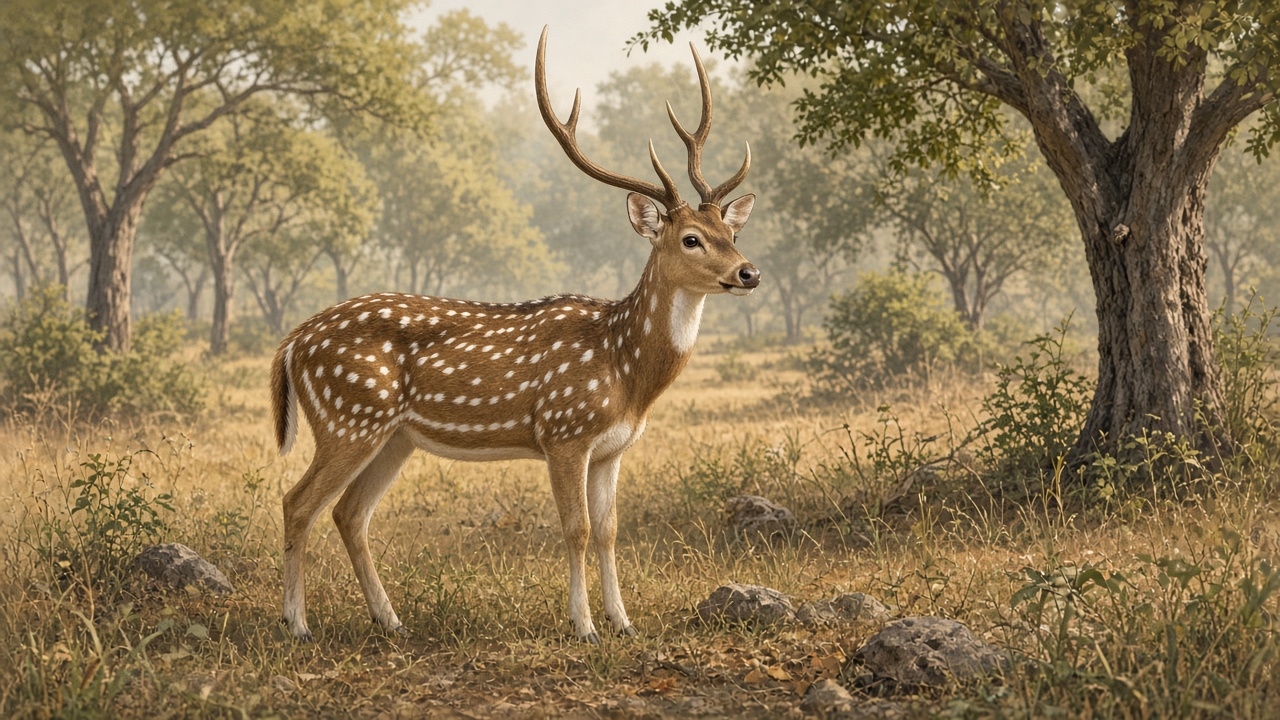
Chital
Axis axisChital (Axis axis): biology, habitats and field signs across its documented range, hunting-context reading.
Seen in: Argentina · Australia
Overview
Chital (Axis axis) is presented here in a hunting-context reading across its documented range: biology, habitats and field signs useful to observers — without publishing season, quota or authorisation.
Classification: order Artiodactyla, family Cervidae, genus Axis. Common names: Chital in English, Axis in French, Chital in Spanish.
Identification
The chital, or axis deer, is a medium-sized deer: 0.6 to 1 m at the shoulder, about 1.5 m long and 27 to 45 kg. Its reddish coat is marked, in both sexes and throughout life, with white spots set in longitudinal rows; a dark stripe runs along the back. The belly, inner legs and the underside of the short tail are white. Males are darker, with black facial markings and three-tined antlers that can reach almost a metre in length.
Diurnal and social, it lives in several kinds of herds: matriarchal groups of adult females with their young of the current and previous year, bachelor herds of less active males, and nursery herds of females with fawns under eight weeks old. Males follow a dominance hierarchy based on age and size. It grazes mainly on grasses, but also eats flowers and fruit dropped from trees, and mushrooms in sal forest. The rut, marked by bellowing males, takes place in April and May; after about 7.5 months, one to three fawns are born.
Habitats and range
Native to India (including Sikkim), Nepal, Sri Lanka, Bangladesh and Bhutan, it has been introduced to the Andaman Islands, Australia, Argentina, Uruguay, Brazil, the United States (Texas, Florida, Hawaii), Armenia, Croatia, Moldova and Ukraine, among others (MDD). It uses grasslands, especially short ones where predators such as tigers find little cover, and rarely enters dense jungle. In Bardia National Park, Nepal, it relies on riverine forest for shade and cover in the dry season: it needs both open and wooded ground.
The countries where the species’ presence is established are shown in the tags on this sheet.
Field signs
Herds graze by day in open country, and the white spots kept in adulthood set it apart from the other deer in its range. When alarmed, or on spotting an unusual object, females and young give a bark that is passed back and forth; a fawn separated from its mother squeals, and males moan during aggressive displays or at rest. Bellowing males announce the rut.
Conservation
For conservation status of Axis axis, consult the current IUCN assessment and cross with national monitoring programmes in countries of documented presence. Never turn a global IUCN category into a local hunting rule. GBIF occurrences help situate distribution but remain effort-biased.
The IUCN lists it as Least Concern. MDD lists it as introduced in many countries, several of them in eastern Europe. In the United States, where it has done well, most animals live on private land, some ranging freely, and it adapts very well to captivity. Described by Erxleben in 1777 as Cervus axis, it has also been named Axis maculatus or Axis major, now synonyms.
Limits
This sheet on the Chital publishes no season, quota, hunting method or fee: those rules differ between countries and territories and must be checked in official texts. Being described here does not mean a species may be hunted.
Local densities and management plans are not covered here: they are a matter for the managers of each area.
Sources
Sources consulted for this sheet:
- IUCN Red List — species search (consulted 2026-11-02)
- ASM Mammal Diversity Database — Axis axis (consulted 2026-11-02)
- GBIF — species search (consulted 2026-11-02)
- Animal Diversity Web — Axis axis (chital) (consulted 2026-11-04)
Conclusion
In short: use the scientific name Axis axis to cross-check sources, confirm taxonomy and conservation status on the institutional portals listed above, and relate every field sign to the habitat where it was actually found.
Identification
Axis axis
Chital · preferred
Axis · preferred
Chital · preferred
Axis Deer
Indian Spotted Deer
Classification
Class : Mammalia
Order : Artiodactyla
Family : Cervidae
Genus : Axis
Conservation
IUCN : LC
CITES : —
iucn · LC (global)
Frequently asked questions
How do I recognise Chital?
Use Axis axis as the scientific anchor. The chital, or axis deer, is a medium-sized deer: 0.6 to 1 m at the shoulder, about 1.5 m long and 27 to 45 kg. Its reddish coat is marked, in both sexes and throughout life, with white spots set in longitudinal rows; a dark stripe runs along the back. The belly, inner legs and t...
Where does Chital typically live?
Native to India (including Sikkim), Nepal, Sri Lanka, Bangladesh and Bhutan, it has been introduced to the Andaman Islands, Australia, Argentina, Uruguay, Brazil, the United States (Texas, Florida, Hawaii), Armenia, Croatia, Moldova and Ukraine, among others (MDD). It uses grasslands, especially short ones where predators such as tigers find little cover, an...
What field signs help confirm Chital?
Herds graze by day in open country, and the white spots kept in adulthood set it apart from the other deer in its range. When alarmed, or on spotting an unusual object, females and young give a bark that is passed back and forth; a fawn separated from its mother squeals, and males moan during aggressive displays or at rest. Bellowing males announce the rut.