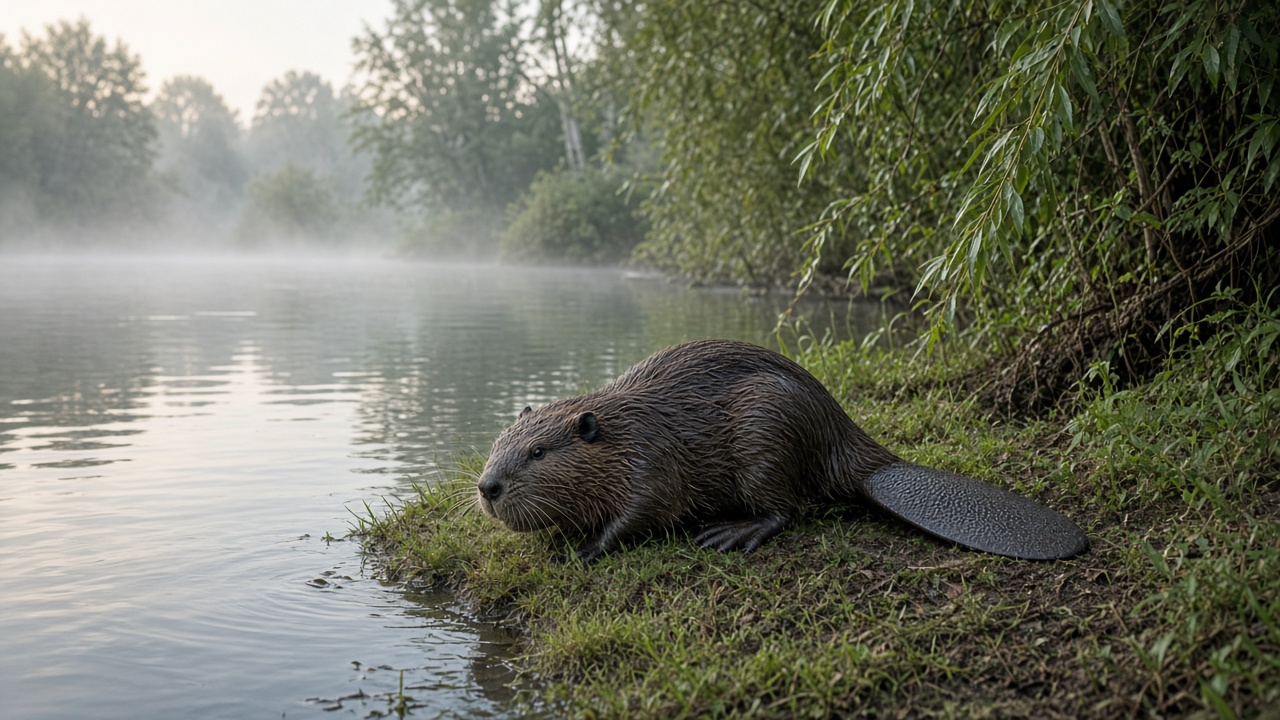
Eurasian Beaver
Castor fiberEurasian Beaver (Castor fiber): coexistence sheet across its documented range — presence, biology and prudence, without an invented hunting status.
Seen in: Austria · Belgium · Croatia · Czechia · Denmark
Overview
Eurasian Beaver (Castor fiber) is a coexistence sheet across its documented range: presence, biology and prudence — not a hunting status claim.
Classification: order Rodentia, family Castoridae, genus Castor. Common names: Eurasian Beaver in English, Castor d'Eurasie in French, Castor europeo in Spanish.
Identification
The Eurasian beaver weighs 13 to 35 kg and measures 73 to 135 cm. Its fur has two layers: a soft, dense, dark greyish underfur and long, stiff, reddish-brown guard hairs, darker in northern populations. The muzzle is blunt, the ears small and the legs short; ears and nostrils close under water and the eyes have nictitating membranes. The naked, black, scaly tail is broad, oval and flattened. The hind feet are webbed. The incisors have orange enamel. The sexes look alike; compared with the North American beaver, its tail is narrower and its skull smaller.
A herbivore, in summer it eats aquatic plants, shoots, twigs, bark, leaves, buds and roots, preferring herbaceous food when available; in winter it relies on woody plants, especially willow, aspen and birch under 10 cm in diameter, stored under water in autumn. It re-ingests some of its droppings. Only the dominant pair in a colony of up to 12 animals breeds; mating takes place in January–February, usually in the water. The 1 to 3 young, occasionally up to 6, weigh 230 to 630 g and are weaned at about 6 weeks.
Habitats and range
MDD lists it throughout northern Eurasia, including France, Germany, Poland, Scandinavia, Russia, Mongolia and China, noting that it had died out in many of these countries and has been reintroduced. Semi-aquatic, it lives on lakes, ponds, rivers and streams, usually in wooded country, but also in marshes and swamps. It needs permanent access to deep, still or slow water, which it creates by damming if necessary, and willow, aspen, birch or alder nearby. In the warmer months its territory extends over 1 to 5 km of shoreline.
The countries where the species’ presence is established are shown in the tags on this sheet.
Field signs
It lives in burrows dug into the bank or, where the bank is unsuitable, in lodges of sticks and mud built away from the shore; its dams and lodges are smaller than those of the North American beaver. On the shore it builds mounds of mud and vegetation scented with castoreum to mark its territory. When frightened it slaps the water with its tail as it dives. Felled trees and flooded ground also betray its presence. It is mainly nocturnal.
Conservation
For conservation status of Castor fiber, consult the current IUCN assessment, then cross with French monitoring programmes when they exist (OFB portal and related publications). Never turn a global IUCN category into a departmental hunting rule. GBIF occurrences help situate documented distribution but remain effort-biased.
The IUCN lists it as Least Concern, with increasing populations. Hunted and trapped for its fur, meat and castoreum, and hit by habitat loss, it was reduced to about 1,300 wild beavers by the early 20th century. Reintroductions have brought it back, but Asian populations remain small, and the US Fish and Wildlife Service considers the Mongolian beaver (C. f. birulai) endangered. Poaching, entanglement in nets and road accidents are the leading human-related causes of death.
Limits
This sheet on the Eurasian Beaver covers presence and biology. A species being present in a country does not mean it may be hunted, and no season or quota is published here.
Local densities and management plans are not covered here: they are a matter for the managers of each area.
Sources
Sources consulted for this sheet:
- IUCN Red List — species search (consulted 2026-11-01)
- ASM Mammal Diversity Database — Castor fiber (consulted 2026-11-01)
- GBIF — species search (consulted 2026-11-01)
- Animal Diversity Web — Castor fiber (Eurasian beaver) (consulted 2026-11-05)
Conclusion
In short: use the scientific name Castor fiber to cross-check sources, confirm taxonomy and conservation status on the institutional portals listed above, and relate every field sign to the habitat where it was actually found.
Identification
Castor fiber
Castor d'Eurasie · preferred
Castor europeo · preferred
Eurasian Beaver · preferred
European Beaver
Classification
Class : Mammalia
Order : Rodentia
Family : Castoridae
Genus : Castor
Conservation
IUCN : LC
CITES : —
iucn · LC (global)
Habitat
Frequently asked questions
How do I recognise Eurasian Beaver?
Use Castor fiber as the scientific anchor. The Eurasian beaver weighs 13 to 35 kg and measures 73 to 135 cm. Its fur has two layers: a soft, dense, dark greyish underfur and long, stiff, reddish-brown guard hairs, darker in northern populations. The muzzle is blunt, the ears small and the legs short; ears and nostrils clo...
Where does Eurasian Beaver typically live?
MDD lists it throughout northern Eurasia, including France, Germany, Poland, Scandinavia, Russia, Mongolia and China, noting that it had died out in many of these countries and has been reintroduced. Semi-aquatic, it lives on lakes, ponds, rivers and streams, usually in wooded country, but also in marshes and swamps. It needs permanent access to deep, still...
What field signs help confirm Eurasian Beaver?
It lives in burrows dug into the bank or, where the bank is unsuitable, in lodges of sticks and mud built away from the shore; its dams and lodges are smaller than those of the North American beaver. On the shore it builds mounds of mud and vegetation scented with castoreum to mark its territory. When frightened it slaps the water with its tail as it dives....