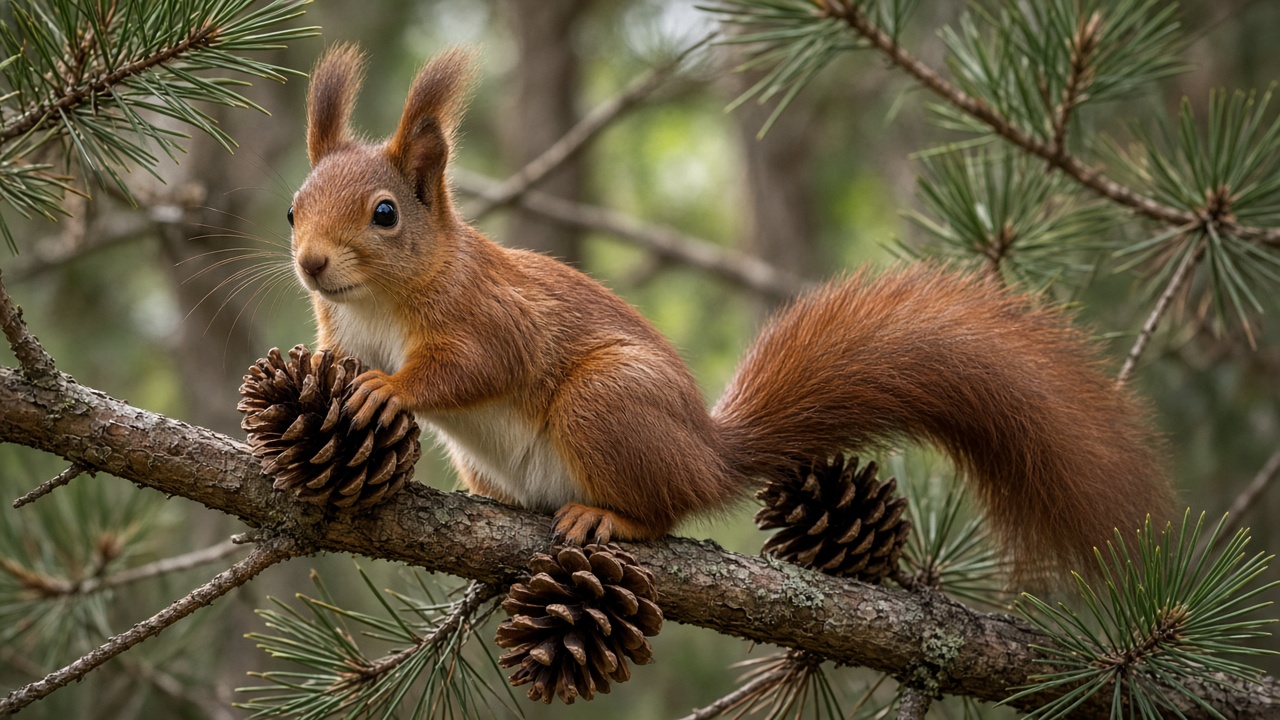
Eurasian Red Squirrel
Sciurus vulgarisEurasian Red Squirrel (Sciurus vulgaris): ecology sheet across its documented range — natural history and habitats, without hunting framing.
Seen in: Austria · Belgium · Bulgaria · Croatia · Czechia
Overview
Eurasian Red Squirrel (Sciurus vulgaris) is an ecology sheet across its documented range: natural history and habitats, without any hunting framing.
Classification: order Rodentia, family Sciuridae, genus Sciurus. Common names: Eurasian Red Squirrel in English, Écureuil roux in French, Ardilla roja in Spanish.
Identification
The Eurasian red squirrel weighs about 600 g on average. Few Palearctic mammals have such a variable coat: the head and back range from light red to black, and several shades often occur in the same population, as in central Europe, whereas in Great Britain all are red. The belly is white or cream, except in fully melanistic animals. It has long ear tufts and a long, bushy tail. The body moults twice a year and the tail once; the winter coat is thicker, with longer ear tufts and more fur on the soles. The sexes look alike.
It feeds on conifer seeds, beechnuts, acorns and other nuts, which it opens in a few seconds with its lower incisors; depending on region and season it also eats fungi, birds’ eggs and sap, peeling bark from conifers to reach it. It buries food or hides it in bark. Solitary and not territorial, it does not hibernate. Females usually have two litters a year, in February–March and from May to August, averaging 5 to 7 young after 38 to 39 days of gestation; they are independent at 8 to 10 weeks. Large birds of prey and the pine marten are its main predators.
Habitats and range
MDD lists it in the forested regions of the Palearctic, from Iberia and Great Britain to Kamchatka and Sakhalin, and south to the Mediterranean, the Black Sea, northern Mongolia and western and north-eastern China. It lives in broadleaf and conifer forests and favours large, mature trees that supply seeds or acorns. It nests in tree cavities and always keeps several nests as refuges from predators.
The countries where the species’ presence is established are shown in the tags on this sheet.
Field signs
Arboreal and diurnal, it is most active in the morning and late afternoon; in spring and summer it rests in the nest during the hottest hours. It comes down to the ground to forage or bury acorns and nuts. In storms or strong winds it stays in its nest. It gives warning calls and can be noisy when nesting in buildings.
Conservation
For conservation status of Sciurus vulgaris, consult the current IUCN assessment, then cross with French monitoring programmes when they exist (OFB portal and related publications). Never turn a global IUCN category into a departmental hunting rule. GBIF occurrences help situate documented distribution but remain effort-biased.
MDD gives its IUCN status as Least Concern, but ADW describes sharp local declines: in Great Britain the introduced North American grey squirrel (Sciurus carolinensis) has led to its disappearance from much of the country, and in the former Soviet Union overharvesting for fur reduced some populations. MDD notes a proposed revision of the tribe Sciurini that would leave only S. vulgaris and a few close relatives in Sciurus.
Limits
This sheet on the Eurasian Red Squirrel covers biology and ecology only; it publishes no hunting season, quota or authorisation.
Local densities and management plans are not covered here: they are a matter for the managers of each area.
Sources
Sources consulted for this sheet:
- IUCN Red List — species search (consulted 2026-11-01)
- ASM Mammal Diversity Database — Sciurus vulgaris (consulted 2026-11-01)
- GBIF — species search (consulted 2026-11-01)
- Animal Diversity Web — Sciurus vulgaris (Eurasian red squirrel) (consulted 2026-11-04)
Conclusion
In short: use the scientific name Sciurus vulgaris to cross-check sources, confirm taxonomy and conservation status on the institutional portals listed above, and relate every field sign to the habitat where it was actually found.
Identification
Sciurus vulgaris
Écureuil roux · preferred
Ardilla roja · preferred
Eurasian Red Squirrel · preferred
Classification
Class : Mammalia
Order : Rodentia
Family : Sciuridae
Genus : Sciurus
Conservation
IUCN : LC
CITES : —
iucn · LC (global)
Habitat
Frequently asked questions
How do I recognise Eurasian Red Squirrel?
Use Sciurus vulgaris as the scientific anchor. The Eurasian red squirrel weighs about 600 g on average. Few Palearctic mammals have such a variable coat: the head and back range from light red to black, and several shades often occur in the same population, as in central Europe, whereas in Great Britain all are red. The belly...
Where does Eurasian Red Squirrel typically live?
MDD lists it in the forested regions of the Palearctic, from Iberia and Great Britain to Kamchatka and Sakhalin, and south to the Mediterranean, the Black Sea, northern Mongolia and western and north-eastern China. It lives in broadleaf and conifer forests and favours large, mature trees that supply seeds or acorns. It nests in tree cavities and always keeps...
What field signs help confirm Eurasian Red Squirrel?
Arboreal and diurnal, it is most active in the morning and late afternoon; in spring and summer it rests in the nest during the hottest hours. It comes down to the ground to forage or bury acorns and nuts. In storms or strong winds it stays in its nest. It gives warning calls and can be noisy when nesting in buildings.