European Polecat
Mustela putoriusEuropean Polecat (Mustela putorius): biology, habitats and field signs across its documented range, hunting-context reading.
Seen in: Austria · Belgium · Bulgaria · Croatia · Czechia
Overview
European Polecat (Mustela putorius) is presented here in a hunting-context reading across its documented range: biology, habitats and field signs useful to observers — without publishing season, quota or authorisation.
Classification: order Carnivora, family Mustelidae, genus Mustela. Common names: European Polecat in English, Putois d'Europe in French, Turón europeo in Spanish.
Identification
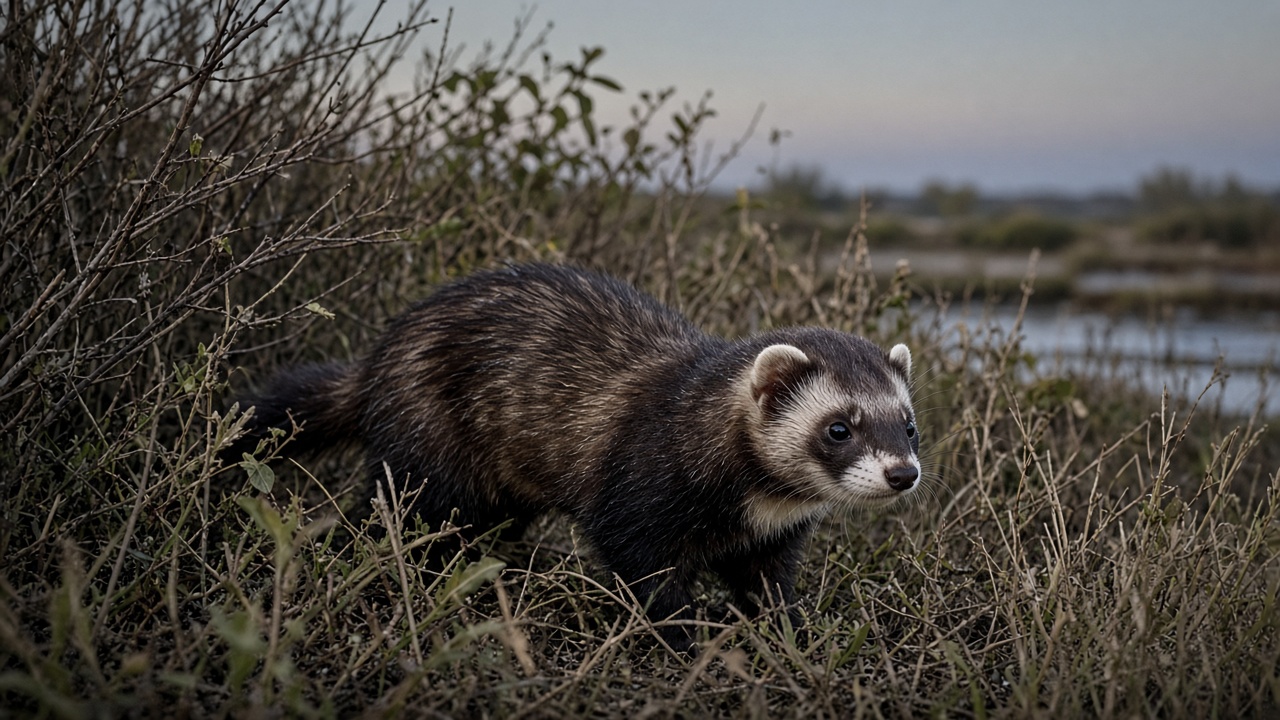
The European polecat is a slender, short-legged mustelid that moves with a bounding gait. It weighs 205 to 1,710 g, and sexual dimorphism is extreme: males can be twice as heavy as females and a third or more longer. Creamy underfur is overlaid with black guard hairs; thick and glossy in winter, the coat turns thin and faded in summer after the moult. A dark, mask-like band surrounds the eyes, set in a white face with white-tipped ears. Its face looks more like a mink’s than a weasel’s.
A carnivore, it preys mainly on rodents and rabbits and can kill a rabbit much larger than itself; birds, eggs, amphibians and reptiles are also taken, and it eats insects and fruit when food is scarce. It hunts mostly by smell, as its eyesight is poor. Solitary and territorial, it is chiefly nocturnal. Females come into heat in late winter and usually raise one litter a year, 3 to 7 young after a 42-day gestation; weaned at about one month, they reach adult size at around three months.
Habitats and range
MDD lists it across most of Europe, from Iberia, France and the United Kingdom to Scandinavia, the Baltic states, Ukraine, Russia, the Balkans and Turkey, and also in Morocco. ADW describes it as rare in the British Isles because of human pressure, though increasing in recent years; it has been introduced to New Zealand. It lives along fresh water, in wetlands and marshes, on forest edges and in grassland with patches of scrub.
The countries where the species’ presence is established are shown in the tags on this sheet.
Field signs
Nocturnal and solitary, it is seldom seen, although females with young sometimes forage by day. When excited or threatened it releases a strong-smelling secretion from its anal glands. Its low build, bounding gait and facial mask are the best features. In a henhouse it may kill more birds than it eats and drag the rest away.
Conservation
For conservation status of Mustela putorius, consult the current IUCN assessment, then cross with French monitoring programmes when they exist (OFB portal and related publications). Never turn a global IUCN category into a departmental hunting rule. GBIF occurrences help situate documented distribution but remain effort-biased.
The IUCN lists it as Least Concern, and ADW describes it as common throughout Europe. It has been taken for its fur, valued less than mink. It can carry rabies and distemper. According to MDD, it is the wild form of the ferret (Mustela furo), its domestic descendant.
Limits
This sheet on the European Polecat publishes no season, quota, hunting method or fee: those rules differ between countries and territories and must be checked in official texts. Being described here does not mean a species may be hunted.
Local densities and management plans are not covered here: they are a matter for the managers of each area.
Sources
Sources consulted for this sheet:
- IUCN Red List — species search (consulted 2026-11-01)
- ASM Mammal Diversity Database — Mustela putorius (consulted 2026-11-01)
- GBIF — species search (consulted 2026-11-01)
- Animal Diversity Web — Mustela putorius (European polecat) (consulted 2026-11-04)
Conclusion
In short: use the scientific name Mustela putorius to cross-check sources, confirm taxonomy and conservation status on the institutional portals listed above, and relate every field sign to the habitat where it was actually found.
Identification
Mustela putorius
Putois d'Europe · preferred
Turón europeo · preferred
European Polecat · preferred
Classification
Class : Mammalia
Order : Carnivora
Family : Mustelidae
Genus : Mustela
Conservation
IUCN : LC
CITES : —
iucn · LC (global)
Habitat
Frequently asked questions
How do I recognise European Polecat?
Use Mustela putorius as the scientific anchor. The European polecat is a slender, short-legged mustelid that moves with a bounding gait. It weighs 205 to 1,710 g, and sexual dimorphism is extreme: males can be twice as heavy as females and a third or more longer. Creamy underfur is overlaid with black guard hairs; thick and g...
Where does European Polecat typically live?
MDD lists it across most of Europe, from Iberia, France and the United Kingdom to Scandinavia, the Baltic states, Ukraine, Russia, the Balkans and Turkey, and also in Morocco. ADW describes it as rare in the British Isles because of human pressure, though increasing in recent years; it has been introduced to New Zealand. It lives along fresh water, in wetlan...
What field signs help confirm European Polecat?
Nocturnal and solitary, it is seldom seen, although females with young sometimes forage by day. When excited or threatened it releases a strong-smelling secretion from its anal glands. Its low build, bounding gait and facial mask are the best features. In a henhouse it may kill more birds than it eats and drag the rest away.