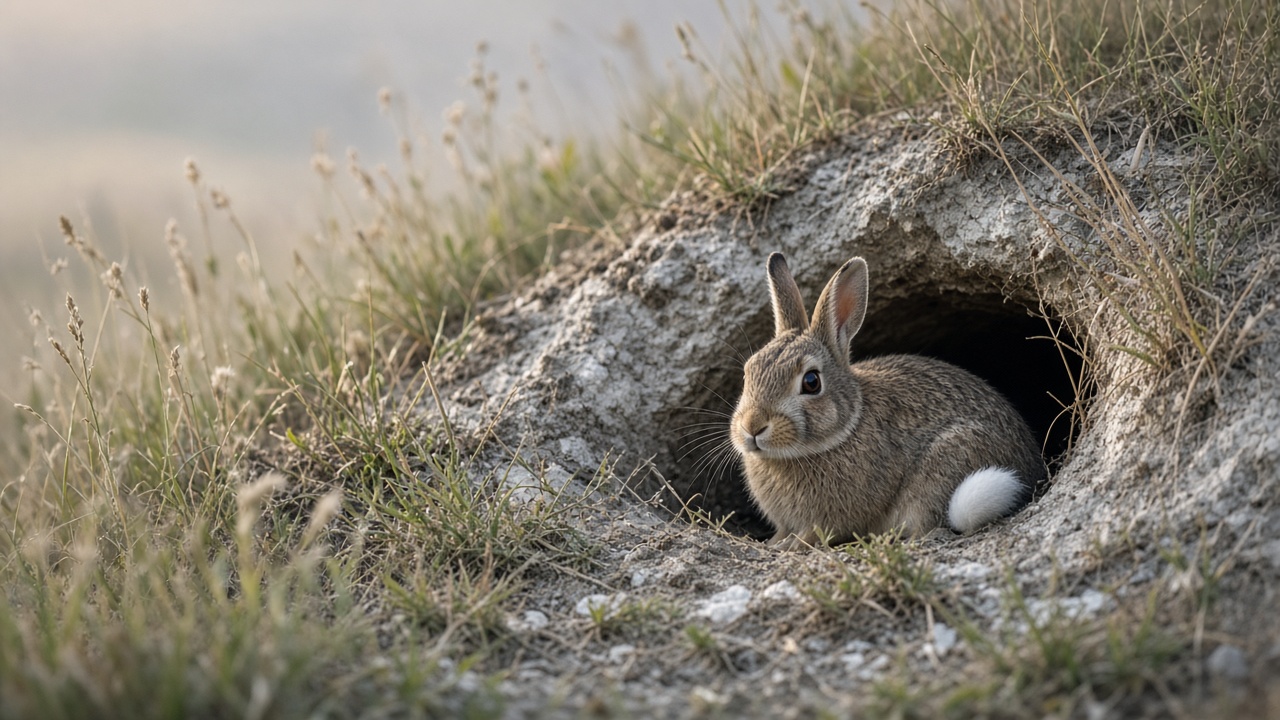
European Rabbit
Oryctolagus cuniculusEuropean Rabbit (Oryctolagus cuniculus): biology, habitats and field signs across its documented range, hunting-context reading.
Seen in: Argentina · Australia · Austria · Belgium · Bulgaria
Overview
European Rabbit (Oryctolagus cuniculus) is presented here in a hunting-context reading across its documented range: biology, habitats and field signs useful to observers — without publishing season, quota or authorisation.
Classification: order Lagomorpha, family Leporidae, genus Oryctolagus. Common names: European Rabbit in English, Lapin de garenne in French, Conejo europeo in Spanish.
Identification
In the wild, the European rabbit weighs 1.5 to 2.5 kg and measures 38 to 50 cm; domestic rabbits may be larger. The coat is greyish, flecked with black and brown and sometimes red; the belly is paler grey and the underside of the tail white. Melanistic animals are not unusual. Compared with hares, it has smaller ears and shorter, less powerful legs. It is the ancestor of all domestic rabbit breeds, about eighty of them, which vary greatly in size, fur and colour.
A generalist herbivore, it eats grasses, leaves, buds, bark and roots, as well as cultivated vegetables and grain. It practises caecotrophy, re-ingesting some of its droppings to obtain nutrients produced by bacteria in its caecum. It can breed all year, mostly in the first half; ovulation is induced by mating, gestation lasts about 30 days and litters average 5 to 6 young. Born naked and blind, they are weaned at four weeks. Its predators include canids, cats, mustelids, hawks and owls.
Habitats and range
According to MDD, its original post-glacial range was probably limited to southern France, Iberia and north-west Africa; it now occupies western and southern Europe and the Mediterranean region to Morocco and northern Algeria, and has been introduced to every continent except Asia and Antarctica. It favours dry, low-lying areas with soft, sandy soil that is easy to dig and brushy fields for cover, but also lives in forest and, in central Europe, in parks, cemeteries and gardens.
The countries where the species’ presence is established are shown in the tags on this sheet.
Field signs
It lives in colonies of six to ten adults in warrens, large networks of burrows. Mainly nocturnal, it spends the day underground and feeds from evening to morning. When danger threatens it thumps its hind feet on the ground; frightened or injured, it can give loud screams. Its home range, larger in males, often covers less than a hectare and is usually under 20 ha.
Conservation
For conservation status of Oryctolagus cuniculus, consult the current IUCN assessment, then cross with French monitoring programmes when they exist (OFB portal and related publications). Never turn a global IUCN category into a departmental hunting rule. GBIF occurrences help situate documented distribution but remain effort-biased.
MDD gives its IUCN status as Endangered. ADW reports that myxomatosis, introduced in the 1950s, cut some populations by more than 90% and still causes periodic epidemics. Conversely, where it has been introduced, notably in Australia, it causes heavy damage to crops and to native plants and animals. One island form in the Atlantic and Mediterranean may be at risk.
Limits
This sheet on the European Rabbit publishes no season, quota, hunting method or fee: those rules differ between countries and territories and must be checked in official texts. Being described here does not mean a species may be hunted.
Local densities and management plans are not covered here: they are a matter for the managers of each area.
Sources
Sources consulted for this sheet:
- IUCN Red List — species search (consulted 2026-11-01)
- ASM Mammal Diversity Database — Oryctolagus cuniculus (consulted 2026-11-01)
- GBIF — species search (consulted 2026-11-01)
- Animal Diversity Web — Oryctolagus cuniculus (European rabbit) (consulted 2026-11-04)
Conclusion
In short: use the scientific name Oryctolagus cuniculus to cross-check sources, confirm taxonomy and conservation status on the institutional portals listed above, and relate every field sign to the habitat where it was actually found.
Identification
Oryctolagus cuniculus
Lapin de garenne · preferred
Conejo europeo · preferred
European Rabbit · preferred
Domestic Rabbit
Wild Rabbit
Classification
Class : Mammalia
Order : Lagomorpha
Family : Leporidae
Genus : Oryctolagus
Conservation
IUCN : EN
CITES : —
iucn · EN (global)
Habitat
Practices
Frequently asked questions
How do I recognise European Rabbit?
Use Oryctolagus cuniculus as the scientific anchor. In the wild, the European rabbit weighs 1.5 to 2.5 kg and measures 38 to 50 cm; domestic rabbits may be larger. The coat is greyish, flecked with black and brown and sometimes red; the belly is paler grey and the underside of the tail white. Melanistic animals are not unusual. Co...
Where does European Rabbit typically live?
According to MDD, its original post-glacial range was probably limited to southern France, Iberia and north-west Africa; it now occupies western and southern Europe and the Mediterranean region to Morocco and northern Algeria, and has been introduced to every continent except Asia and Antarctica. It favours dry, low-lying areas with soft, sandy soil that is...
What field signs help confirm European Rabbit?
It lives in colonies of six to ten adults in warrens, large networks of burrows. Mainly nocturnal, it spends the day underground and feeds from evening to morning. When danger threatens it thumps its hind feet on the ground; frightened or injured, it can give loud screams. Its home range, larger in males, often covers less than a hectare and is usually under...