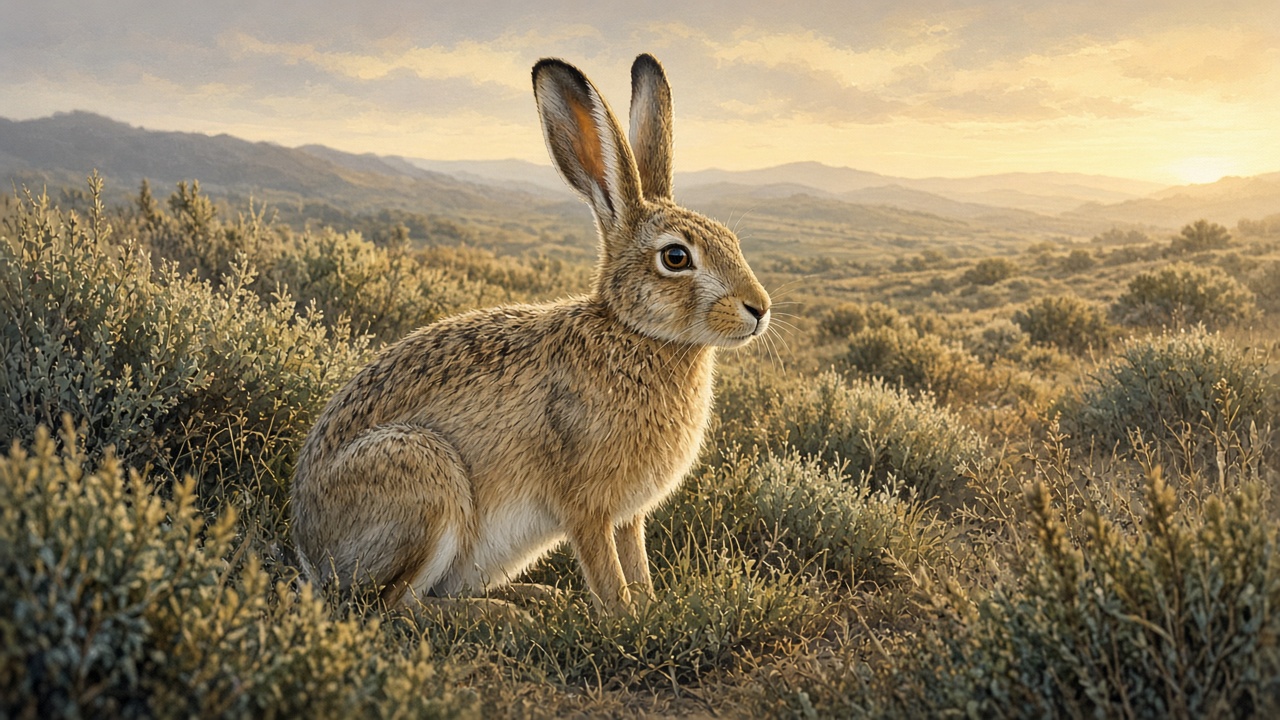
Iberian Hare
Lepus granatensisIberian Hare (Lepus granatensis): biology, habitats and field signs across its documented range, hunting-context reading.
Seen in: Portugal · Spain
Overview
Iberian Hare (Lepus granatensis) is presented here in a hunting-context reading across its documented range: biology, habitats and field signs useful to observers — without publishing season, quota or authorisation.
Classification: order Lagomorpha, family Leporidae, genus Lepus. Common names: Iberian Hare in English, Lièvre ibérique in French, Liebre ibérica in Spanish.
Identification
The Iberian hare has the typical hare shape, with disproportionately long ears of about 100 mm. Total length is 600 to 750 mm, with no notable size difference between males and females. The back ranges from brown to reddish-brown or grey depending on the individual, the belly is white, and the face and muzzle are short and broad. At the edges of its range it meets two other hares: the European hare in north-eastern Spain and the broom hare in parts of the Cantabrian Mountains.
A herbivore, it eats crops and visits vineyards; in wooded areas it takes buds, twigs and bark, especially in winter. Although nocturnal, it is often seen in daylight. It is solitary except when mating and raising young. Courtship takes place in spring, with leaps and twists in the air. It does not dig burrows: leverets are born in a form, fully furred and with their eyes open, usually fewer than five per litter, and a female can produce up to seven litters a year.
Habitats and range
Endemic to the Iberian Peninsula (Spain and Portugal according to MDD), it is common there except in the far north-east, where the European hare takes over, and in pockets of the Cantabrian Mountains held by the broom hare. It is most abundant in the northern Iberian Mountains, where the climate is milder, and favours farmland, but also uses forest, scrubland and grassland. It is scarcer in the Ebro Depression and the southern Iberian Mountains, with very low rainfall and harsh winters.
The countries where the species’ presence is established are shown in the tags on this sheet.
Field signs
The most telling sign is the form, a shallow scrape in the soil sheltered by brush or a log that grows larger with use; the hare lies in it with its hindquarters facing out. Usually silent, like other hares it may give a high-pitched scream in distress and thump the ground hard with its hind legs to warn of danger. In spring, chases with leaps and twists give away courting animals.
Conservation
For conservation status of Lepus granatensis, consult the current IUCN assessment and cross with national monitoring programmes in countries of documented presence. Never turn a global IUCN category into a local hunting rule. GBIF occurrences help situate distribution but remain effort-biased.
The IUCN lists it as Least Concern. ADW nonetheless considers it probably extinct on Mallorca and around Galicia and Asturias, while numbers are rising in many other areas. MDD places several described forms in the species, including gallaecius (A Coruña), solisi (Mallorca) and lilfordi (Seville). Where it is abundant it can damage crops; it also hosts the cysticercus stage of Taenia pisiformis, which can reduce its ability to escape.
Limits
This sheet on the Iberian Hare publishes no season, quota, hunting method or fee: those rules differ between countries and territories and must be checked in official texts. Being described here does not mean a species may be hunted.
Local densities and management plans are not covered here: they are a matter for the managers of each area.
Sources
Sources consulted for this sheet:
- IUCN Red List — species search (consulted 2026-11-02)
- ASM Mammal Diversity Database — Lepus granatensis (consulted 2026-11-02)
- GBIF — species search (consulted 2026-11-02)
- Animal Diversity Web — Lepus granatensis (Granada hare) (consulted 2026-11-04)
Conclusion
In short: use the scientific name Lepus granatensis to cross-check sources, confirm taxonomy and conservation status on the institutional portals listed above, and relate every field sign to the habitat where it was actually found.
Identification
Lepus granatensis
Iberian Hare · preferred
Lièvre ibérique · preferred
Liebre ibérica · preferred
Granada Hare
Classification
Class : Mammalia
Order : Lagomorpha
Family : Leporidae
Genus : Lepus
Conservation
IUCN : LC
CITES : —
iucn · LC (global)
Habitat
Frequently asked questions
How do I recognise Iberian Hare?
Use Lepus granatensis as the scientific anchor. The Iberian hare has the typical hare shape, with disproportionately long ears of about 100 mm. Total length is 600 to 750 mm, with no notable size difference between males and females. The back ranges from brown to reddish-brown or grey depending on the individual, the belly is...
Where does Iberian Hare typically live?
Endemic to the Iberian Peninsula (Spain and Portugal according to MDD), it is common there except in the far north-east, where the European hare takes over, and in pockets of the Cantabrian Mountains held by the broom hare. It is most abundant in the northern Iberian Mountains, where the climate is milder, and favours farmland, but also uses forest, scrublan...
What field signs help confirm Iberian Hare?
The most telling sign is the form, a shallow scrape in the soil sheltered by brush or a log that grows larger with use; the hare lies in it with its hindquarters facing out. Usually silent, like other hares it may give a high-pitched scream in distress and thump the ground hard with its hind legs to warn of danger. In spring, chases with leaps and twists giv...