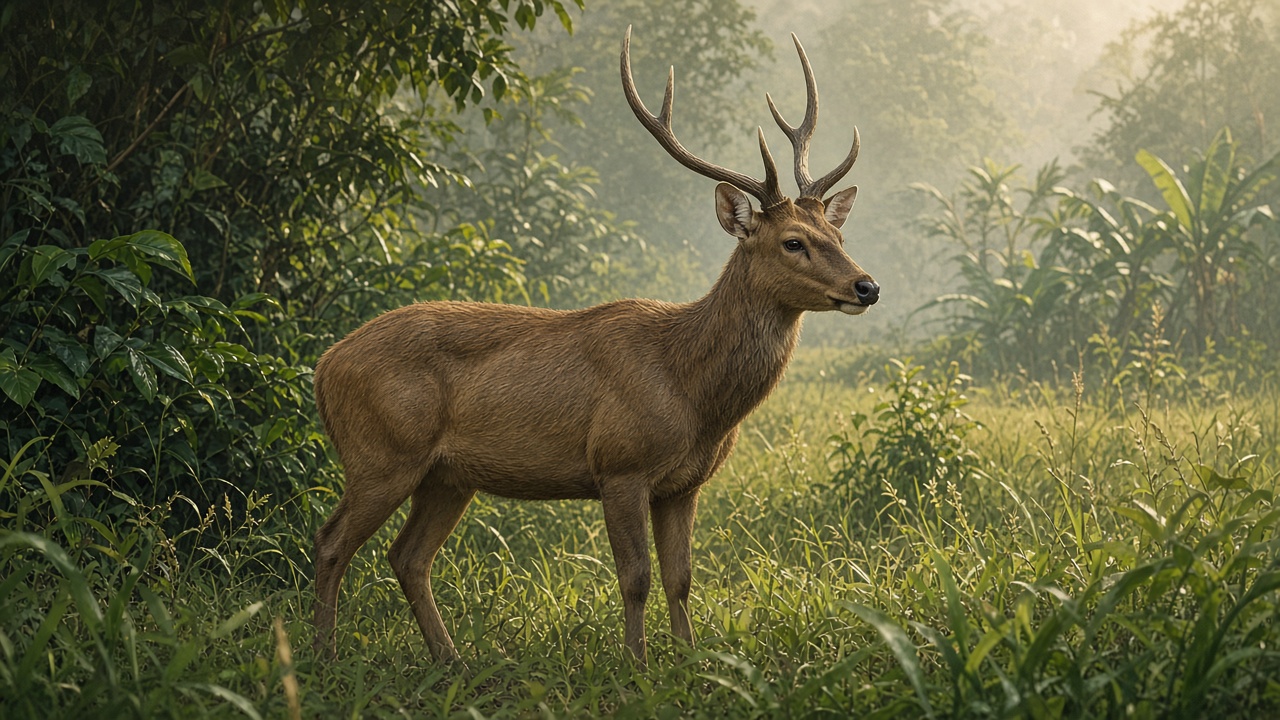
Javan Deer (Rusa timorensis): biology, habitats and field signs across its documented range, hunting-context reading.
Seen in: Australia
Overview
Javan Deer (Rusa timorensis) is presented here in a hunting-context reading across its documented range: biology, habitats and field signs useful to observers — without publishing season, quota or authorisation.
Classification: order Artiodactyla, family Cervidae, genus Rusa. Common names: Javan Deer in English, Cerf rusa in French, Ciervo de Java in Spanish.
Identification
The Javan rusa is the largest member of the genus Rusa. Sexual dimorphism is marked: males usually weigh about 152 kg and females about 74 kg, within an overall range of 74 to 160 kg, and the length given is 83 to 110 cm. Both sexes have a rough, coarse greyish-brown coat and broad, rounded ears. Relatively short legs make it look short and stocky. Only males carry lyre-shaped, three-tined antlers weighing about 2.5 kg.
Mainly nocturnal, it also browses and grazes by day. It eats chiefly grass and leaves and hardly drinks at all, getting its water from the vegetation. The mating system is polygynous. Breeding occurs all year round, peaking from July to September; after an eight-month gestation a single calf, rarely two, is born, stays with its mother and is weaned at 6 to 8 months. Sexual maturity comes at 18 to 24 months. Crocodiles, pythons and Komodo dragons are its main predators.
Habitats and range
MDD treats it as native to Java and Bali. It was probably introduced in antiquity to the Lesser Sunda Islands, the Moluccas (including Buru and Seram), Sulawesi and Timor, and since the 17th century to Borneo (possibly now extinct there), New Guinea, New Britain, the Aru Islands, Mauritius, the Comoros, Madagascar (possibly extinct), Australia, New Zealand and New Caledonia. It uses mainly deciduous forest, plantations and grassland, with a clear preference for forest edges.
The countries where the species’ presence is established are shown in the tags on this sheet.
Field signs
Active mostly at night and at dusk, it lives in herds, with males and females kept apart outside the mating period. At that time, males become very vocal and aggressive towards each other and decorate their antlers with grass and twigs to attract females and intimidate rivals. Antlers are cast between October and February. Near fields, grazed crops can betray its presence.
Conservation
For conservation status of Rusa timorensis, consult the current IUCN assessment and cross with national monitoring programmes in countries of documented presence. Never turn a global IUCN category into a local hunting rule. GBIF occurrences help situate distribution but remain effort-biased.
The IUCN lists it as Vulnerable (MDD, ADW). ADW describes competition with livestock for pasture, especially in Indonesia, crop damage and the spread of weeds. It is farmed in Australia: in Queensland, half of all farmed deer are rusa. Long known as Cervus timorensis, it is placed in Rusa by MDD, which notes that some authors still keep it in Cervus.
Limits
This sheet on the Javan Deer publishes no season, quota, hunting method or fee: those rules differ between countries and territories and must be checked in official texts. Being described here does not mean a species may be hunted.
Local densities and management plans are not covered here: they are a matter for the managers of each area.
Sources
Sources consulted for this sheet:
- IUCN Red List — species search (consulted 2026-11-02)
- ASM Mammal Diversity Database — Rusa timorensis (consulted 2026-11-02)
- GBIF — species search (consulted 2026-11-02)
- Animal Diversity Web — Rusa timorensis (Javan rusa) (consulted 2026-11-04)
Conclusion
In short: use the scientific name Rusa timorensis to cross-check sources, confirm taxonomy and conservation status on the institutional portals listed above, and relate every field sign to the habitat where it was actually found.
Identification
Rusa timorensis
Cerf rusa · preferred
Ciervo de Java · preferred
Javan Deer · preferred
Maned Sambar
Rusa Deer
Sunda Sambar
Timor Deer
Classification
Class : Mammalia
Order : Artiodactyla
Family : Cervidae
Genus : Rusa
Conservation
IUCN : VU
CITES : —
iucn · VU (global)
Frequently asked questions
How do I recognise Javan Deer?
Use Rusa timorensis as the scientific anchor. The Javan rusa is the largest member of the genus Rusa. Sexual dimorphism is marked: males usually weigh about 152 kg and females about 74 kg, within an overall range of 74 to 160 kg, and the length given is 83 to 110 cm. Both sexes have a rough, coarse greyish-brown coat and bro...
Where does Javan Deer typically live?
MDD treats it as native to Java and Bali. It was probably introduced in antiquity to the Lesser Sunda Islands, the Moluccas (including Buru and Seram), Sulawesi and Timor, and since the 17th century to Borneo (possibly now extinct there), New Guinea, New Britain, the Aru Islands, Mauritius, the Comoros, Madagascar (possibly extinct), Australia, New Zealand a...
What field signs help confirm Javan Deer?
Active mostly at night and at dusk, it lives in herds, with males and females kept apart outside the mating period. At that time, males become very vocal and aggressive towards each other and decorate their antlers with grass and twigs to attract females and intimidate rivals. Antlers are cast between October and February. Near fields, grazed crops can betra...