Jungle Cat
Felis chausNo solid country presence documented yet.
Jungle Cat (Felis chaus): coexistence sheet across its documented range — presence, biology and prudence, without an invented hunting status.
Overview
Jungle Cat (Felis chaus) is a coexistence sheet across its documented range: presence, biology and prudence — not a hunting status claim.
Classification: order Carnivora, family Felidae, genus Felis. Common names: Jungle Cat in English, Chat des jungles in French, Gato de la jungla in Spanish.
Identification
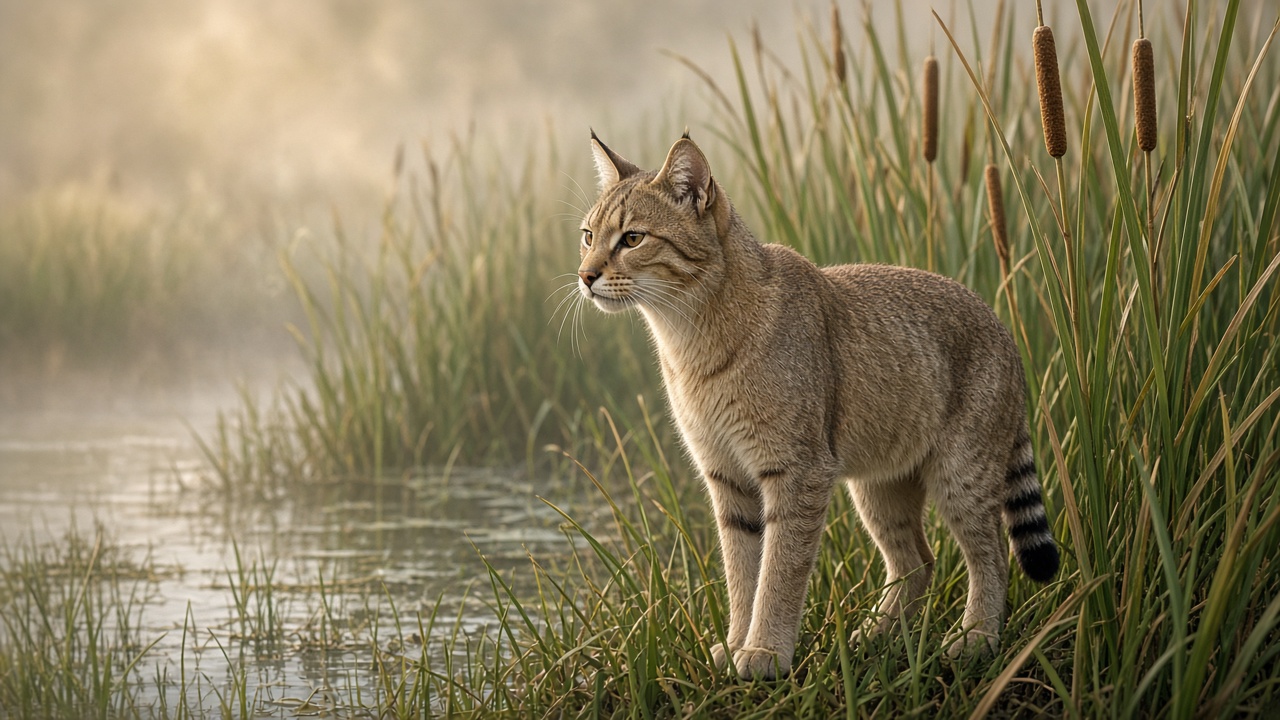
A wild cat 70 to 120 cm long and 35 to 38 cm at the shoulder, weighing 4 to 16 kg; males are larger and heavier than females, and weight varies strongly across the range. The face is long and slim, with white lines above and below the bright yellow eyes. The long, rounded ears carry a small tuft of hair at the tip. The tail, about a third of total length, has several dark rings and a black tip. The coat ranges from reddish or sandy brown to tawny grey; black jungle cats are regularly seen in Pakistan and India.
It hunts mainly prey under 1 kg: rodents, which supply up to 70% of its daily energy, plus lizards, snakes, frogs, birds, hares, fish and insects, sometimes poultry and even fruit in winter; it has been known to kill wild boar and chital fawns. It breeds once or twice a year: 3 to 6 kittens after 63 to 66 days of gestation, weaned at about 15 weeks and independent at 8 to 9 months. Leopards and large snakes prey on it, but humans are its main predator.
Habitats and range
MDD and ADW describe a range from Egypt and the Middle East to the Caucasus, the Caspian Sea and the Volga delta, then through Central Asia to Afghanistan, Pakistan, India, Sri Lanka, South-East Asia and south-western China. It prefers habitats near water with dense cover: tall grass, thick brush, riverside swamps and reed beds, but also oases, grassland, dry woodland and farmland. It reaches 2,500 m but is more common in lowlands.
The countries where the species’ presence is established are shown in the tags on this sheet.
Field signs
Most often seen at dusk, it travels 5 to 6 km a night and rests by day in dense cover, sometimes sunbathing on cold winter days. Unlike most cats, it likes water, swims well and dives to catch fish with its mouth. In the breeding season males shriek and fight; it marks its territory with urine and by cheek rubbing.
Conservation
For conservation status of Felis chaus, consult the current IUCN assessment and cross with national monitoring programmes in countries of documented presence. Never turn a global IUCN category into a local hunting rule. GBIF occurrences help situate distribution but remain effort-biased.
The IUCN lists it as Least Concern, but ADW reports declining numbers. The threats described are the conversion of its habitat to farmland and persecution: poultry farmers kill or poison it, and it is poached for its fur, with more than 3,000 skins seized worldwide in a decade. Its type locality is the Terek River, north of the Caucasus; ADW lists ten subspecies described on morphology.
Limits
This sheet on the Jungle Cat covers presence and biology. A species being present in a country does not mean it may be hunted, and no season or quota is published here.
Local densities and management plans are not covered here: they are a matter for the managers of each area.
Sources
Sources consulted for this sheet:
- IUCN Red List — species search (consulted 2026-11-02)
- ASM Mammal Diversity Database — Felis chaus (consulted 2026-11-02)
- GBIF — species search (consulted 2026-11-02)
- Animal Diversity Web — Felis chaus (jungle cat) (consulted 2026-11-04)
Conclusion
In short: use the scientific name Felis chaus to cross-check sources, confirm taxonomy and conservation status on the institutional portals listed above, and relate every field sign to the habitat where it was actually found.
Identification
Felis chaus
Jungle Cat · preferred
Chat des jungles · preferred
Gato de la jungla · preferred
Swamp Cat
Reed Cat
Classification
Class : Mammalia
Order : Carnivora
Family : Felidae
Genus : Felis
Conservation
IUCN : LC
CITES : —
iucn · LC (global)
Frequently asked questions
How do I recognise Jungle Cat?
Use Felis chaus as the scientific anchor. A wild cat 70 to 120 cm long and 35 to 38 cm at the shoulder, weighing 4 to 16 kg; males are larger and heavier than females, and weight varies strongly across the range. The face is long and slim, with white lines above and below the bright yellow eyes. The long, rounded ears ca...
Where does Jungle Cat typically live?
MDD and ADW describe a range from Egypt and the Middle East to the Caucasus, the Caspian Sea and the Volga delta, then through Central Asia to Afghanistan, Pakistan, India, Sri Lanka, South-East Asia and south-western China. It prefers habitats near water with dense cover: tall grass, thick brush, riverside swamps and reed beds, but also oases, grassland, dr...
What field signs help confirm Jungle Cat?
Most often seen at dusk, it travels 5 to 6 km a night and rests by day in dense cover, sometimes sunbathing on cold winter days. Unlike most cats, it likes water, swims well and dives to catch fish with its mouth. In the breeding season males shriek and fight; it marks its territory with urine and by cheek rubbing.