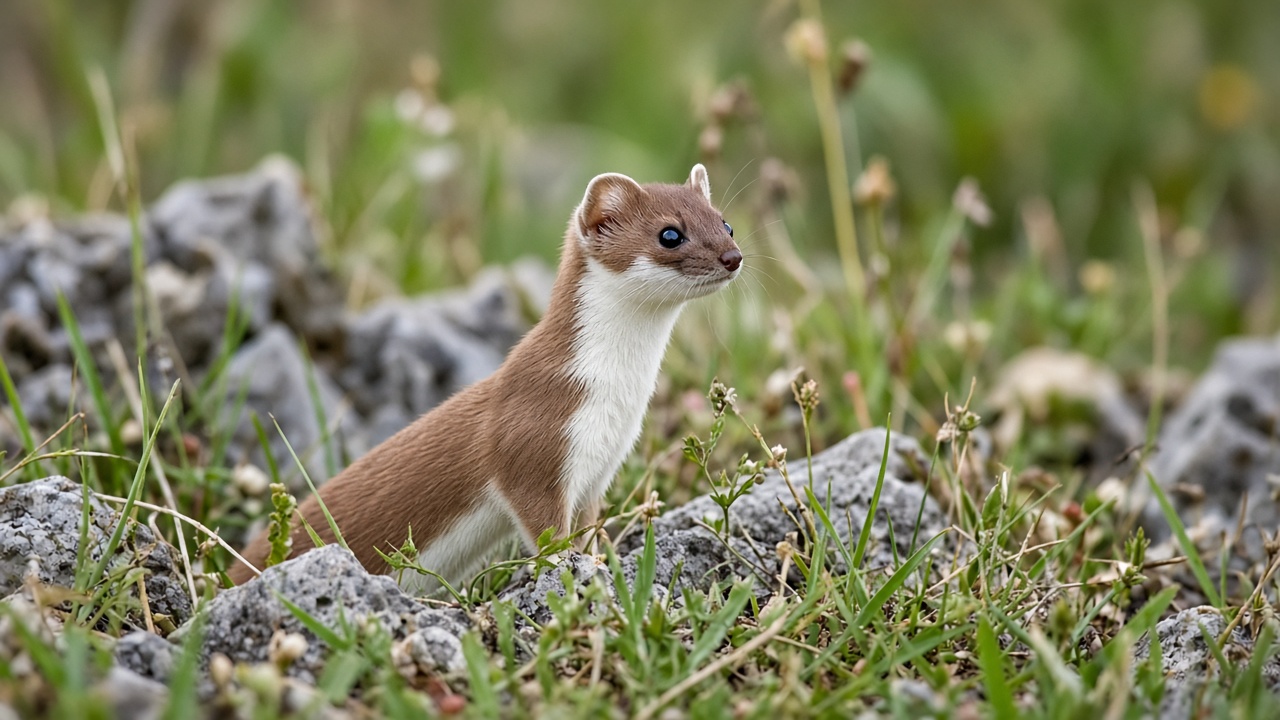
Least Weasel
Mustela nivalisLeast Weasel (Mustela nivalis): biology, habitats and field signs across its documented range, hunting-context reading.
Seen in: Austria · Belgium · Bulgaria · Croatia · Czechia
Overview
Least Weasel (Mustela nivalis) is presented here in a hunting-context reading across its documented range: biology, habitats and field signs useful to observers — without publishing season, quota or authorisation.
Classification: order Carnivora, family Mustelidae, genus Mustela. Common names: Least Weasel in English, Belette d'Europe in French, Comadreja in Spanish.
Identification
The smallest carnivore in the world, the least weasel has the long, tubular mustelid body, short limbs and a short tail less than a quarter of head-and-body length. The skull is long and flat, the ears short and round, the eyes large and dark, the paws white. In summer the back is rusty chocolate-brown and the belly white; in northern populations the coat turns pure white in winter, always lacking the black tail tip of the stoat. It weighs 30 to 100 g and measures 165 to 217 mm including the tail; males are larger than females.
A rodent specialist, in the south of its range it feeds mainly on voles and wood mice; when these are scarce it takes birds’ eggs, lizards, amphibians, small fish, invertebrates and sometimes carrion. It can eat more than half its body weight a day and caches surplus prey. Solitary, it forages at all hours, day or night. Breeding is concentrated from March to June: after about 35 days of gestation, an average of four or five kits are born, becoming independent at nine to ten weeks. Tawny owls, other birds of prey, foxes and snakes are among its predators.
Habitats and range
Circumboreal, it ranges across North America, Europe (except Ireland and Iceland) and much of Asia; MDD also lists it in North Africa and Japan, and it has been introduced to New Zealand, the Azores, Crete and Malta among other islands. It uses grassland, coniferous and deciduous forest, tundra, taiga and farmland. It does not dig its own dens but takes over abandoned burrows of its prey, often at the base of trees, or shelters in brush or log piles and tall grass.
The countries where the species’ presence is established are shown in the tags on this sheet.
Field signs
It moves through leaf litter, underground tunnels and under the snow, but needs enough vegetation cover to hunt from ambush. Food caches and latrines are hidden around the den entrance, which it scent-marks with anal gland secretions; when startled it releases a foul-smelling fluid. It sometimes performs a “war dance” of leaps and twists, back arched and fur raised, with bark-like calls.
Conservation
For conservation status of Mustela nivalis, consult the current IUCN assessment, then cross with French monitoring programmes when they exist (OFB portal and related publications). Never turn a global IUCN category into a departmental hunting rule. GBIF occurrences help situate documented distribution but remain effort-biased.
The IUCN lists it as Least Concern; populations are considered stable, and it is more common in Europe and Asia than in North America. Introduced to New Zealand, it harms ground-nesting birds such as the brown kiwi. According to MDD, the species includes subpalmata, the Egyptian weasel; several Chinese and Southeast Asian forms are tentatively retained under it, while M. aistoodonnivalis has been recognised as a separate species.
Limits
This sheet on the Least Weasel publishes no season, quota, hunting method or fee: those rules differ between countries and territories and must be checked in official texts. Being described here does not mean a species may be hunted.
Local densities and management plans are not covered here: they are a matter for the managers of each area.
Sources
Sources consulted for this sheet:
- IUCN Red List — species search (consulted 2026-11-01)
- ASM Mammal Diversity Database — Mustela nivalis (consulted 2026-11-01)
- GBIF — species search (consulted 2026-11-01)
- Animal Diversity Web — Mustela nivalis (least weasel) (consulted 2026-11-04)
Conclusion
In short: use the scientific name Mustela nivalis to cross-check sources, confirm taxonomy and conservation status on the institutional portals listed above, and relate every field sign to the habitat where it was actually found.
Identification
Mustela nivalis
Belette d'Europe · preferred
Comadreja · preferred
Least Weasel · preferred
Weasel
Classification
Class : Mammalia
Order : Carnivora
Family : Mustelidae
Genus : Mustela
Conservation
IUCN : LC
CITES : —
iucn · LC (global)
Habitat
Frequently asked questions
How do I recognise Least Weasel?
Use Mustela nivalis as the scientific anchor. The smallest carnivore in the world, the least weasel has the long, tubular mustelid body, short limbs and a short tail less than a quarter of head-and-body length. The skull is long and flat, the ears short and round, the eyes large and dark, the paws white. In summer the back i...
Where does Least Weasel typically live?
Circumboreal, it ranges across North America, Europe (except Ireland and Iceland) and much of Asia; MDD also lists it in North Africa and Japan, and it has been introduced to New Zealand, the Azores, Crete and Malta among other islands. It uses grassland, coniferous and deciduous forest, tundra, taiga and farmland. It does not dig its own dens but takes over...
What field signs help confirm Least Weasel?
It moves through leaf litter, underground tunnels and under the snow, but needs enough vegetation cover to hunt from ambush. Food caches and latrines are hidden around the den entrance, which it scent-marks with anal gland secretions; when startled it releases a foul-smelling fluid. It sometimes performs a “war dance” of leaps and twists, back arched and fur...