Leopard
Panthera pardusLeopard (Panthera pardus): coexistence sheet across its documented range — presence, biology and prudence, without an invented hunting status.
Seen in: Namibia · South Africa
Overview
Leopard (Panthera pardus) is a coexistence sheet across its documented range: presence, biology and prudence — not a hunting status claim.
Classification: order Carnivora, family Felidae, genus Panthera. Common names: Leopard in English, Léopard in French, Leopardo in Spanish.
Identification
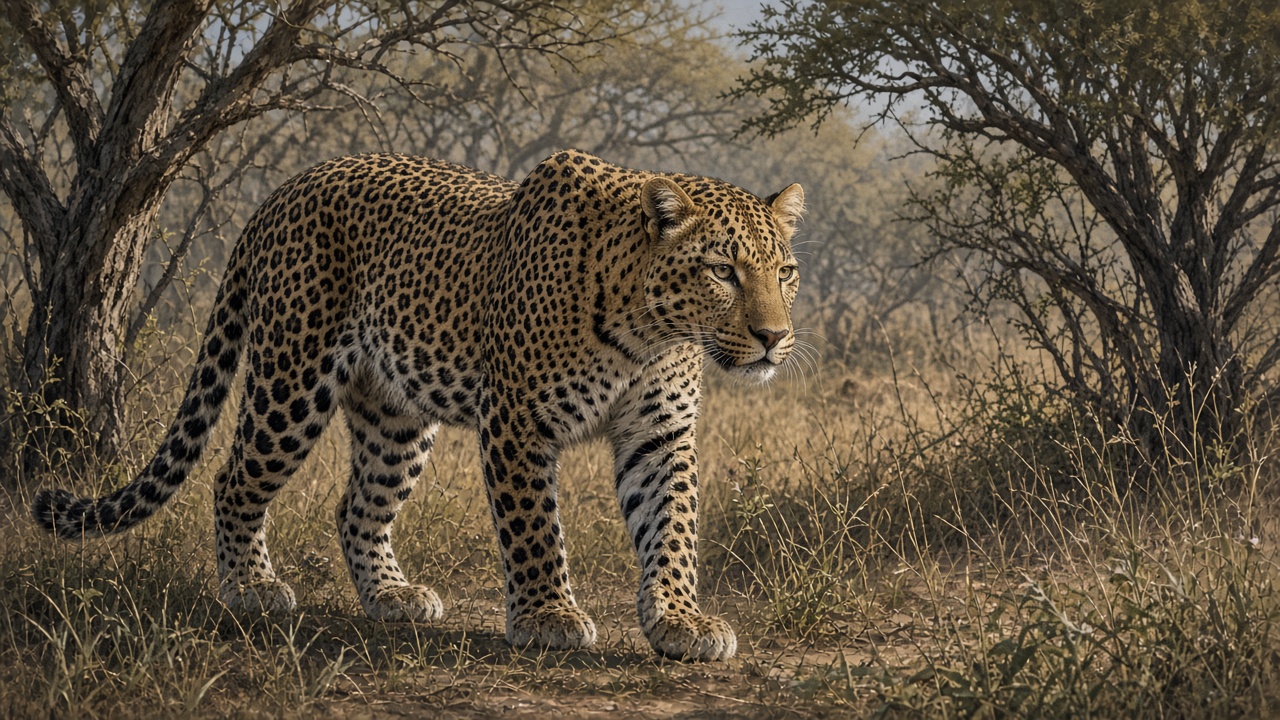
The leopard has a long body on short legs, a broad head with a massive skull and small round ears. The coat ranges from tawny or light yellow in dry habitats to reddish-orange in dense forest; it is covered in black rosettes, circular in East Africa and squarer in southern Africa, with solid spots on the chest, legs and face and rings on the tail. Each animal has a unique pattern. Males weigh 31 to 65 kg and measure 1.6 to 2.3 m, females 17 to 58 kg and 1.7 to 1.9 m. “Black panthers” are melanistic leopards, most frequent in humid forest.
Solitary and nocturnal, it is an ambush hunter, creeping to within 3 to 10 m before pouncing, with no long chase. It prefers prey of 10 to 40 kg (small antelopes, gazelles, deer, wild pigs, primates, livestock) but also takes birds, reptiles, rodents, arthropods and carrion. It often hauls its kill up a tree and caches food. Breeding occurs year-round with a peak in the rainy season; after 96 days of gestation, 2 or 3 cubs of under 1 kg are born and hidden in thickets, rock clefts or hollow trunks.
Habitats and range
MDD gives it across much of Africa and Asia: sub-Saharan and North Africa, the Arabian Peninsula, Turkey, the Caucasus, Iran, Central Asia, the Indian subcontinent, Sri Lanka, South-East Asia, Java, China, Korea and the Russian Far East. ADW recognises nine subspecies. It is most numerous in mesic woodland, grassland savanna and forest, but also uses mountains, scrub and desert; it favours trees everywhere and has been recorded at 5,638 m on Kilimanjaro. Home ranges are about 35 km² for males and 13 km² for females.
The countries where the species’ presence is established are shown in the tags on this sheet.
Field signs
A carcass wedged in a tree or covered with leaves and soil is a typical sign. It marks its territory with urine, scats and claw marks and announces itself with a repeated hoarse, rasping cough. It climbs down trees head first. Near settlements it is even less active by day.
Conservation
For conservation status of Panthera pardus, consult the current IUCN assessment and cross with national monitoring programmes in countries of documented presence. Never turn a global IUCN category into a local hunting rule. GBIF occurrences help situate distribution but remain effort-biased.
MDD gives its IUCN status as Vulnerable. ADW describes declines due to habitat loss and fragmentation, the skin trade and retaliatory killing by livestock farmers. Most African leopards live outside protected areas; in western Asia populations are too small to be self-sustaining, and five of the nine subspecies are Endangered or Critically Endangered.
Limits
This sheet on the Leopard covers presence and biology. A species being present in a country does not mean it may be hunted, and no season or quota is published here.
Local densities and management plans are not covered here: they are a matter for the managers of each area.
Sources
Sources consulted for this sheet:
- IUCN Red List — species search (consulted 2026-11-02)
- ASM Mammal Diversity Database — Panthera pardus (consulted 2026-11-02)
- GBIF — species search (consulted 2026-11-02)
- Animal Diversity Web — Panthera pardus (leopard) (consulted 2026-11-04)
Conclusion
In short: use the scientific name Panthera pardus to cross-check sources, confirm taxonomy and conservation status on the institutional portals listed above, and relate every field sign to the habitat where it was actually found.
Identification
Panthera pardus
Leopard · preferred
Léopard · preferred
Leopardo · preferred
Panther
Classification
Class : Mammalia
Order : Carnivora
Family : Felidae
Genus : Panthera
Conservation
IUCN : VU
CITES : —
iucn · VU (global)
Habitat
Frequently asked questions
How do I recognise Leopard?
Use Panthera pardus as the scientific anchor. The leopard has a long body on short legs, a broad head with a massive skull and small round ears. The coat ranges from tawny or light yellow in dry habitats to reddish-orange in dense forest; it is covered in black rosettes, circular in East Africa and squarer in southern Africa...
Where does Leopard typically live?
MDD gives it across much of Africa and Asia: sub-Saharan and North Africa, the Arabian Peninsula, Turkey, the Caucasus, Iran, Central Asia, the Indian subcontinent, Sri Lanka, South-East Asia, Java, China, Korea and the Russian Far East. ADW recognises nine subspecies. It is most numerous in mesic woodland, grassland savanna and forest, but also uses mountai...
What field signs help confirm Leopard?
A carcass wedged in a tree or covered with leaves and soil is a typical sign. It marks its territory with urine, scats and claw marks and announces itself with a repeated hoarse, rasping cough. It climbs down trees head first. Near settlements it is even less active by day.