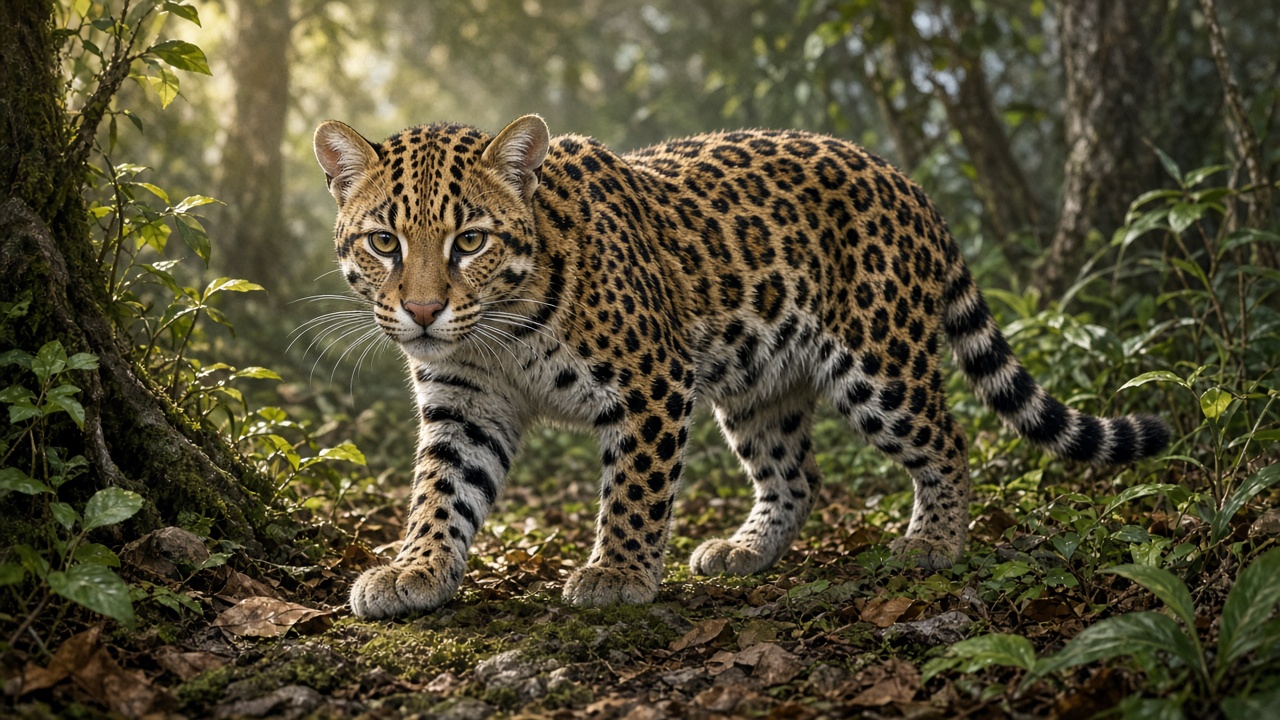
Mainland Leopard Cat
Prionailurus bengalensisNo solid country presence documented yet.
Mainland Leopard Cat (Prionailurus bengalensis): coexistence sheet across its documented range — presence, biology and prudence, without an invented hunting status.
Overview
Mainland Leopard Cat (Prionailurus bengalensis) is a coexistence sheet across its documented range: presence, biology and prudence — not a hunting status claim.
Classification: order Carnivora, family Felidae, genus Prionailurus. Common names: Mainland Leopard Cat in English, Chat léopard in French, Gato bengalí in Spanish.
Identification
The leopard cat is the size of a large house cat: 3 to 7 kg, 44.5 to 107 cm head and body, with a 23 to 44 cm tail. The pale tawny coat with a white belly is covered in rosettes on the body and tail, which is often ringed near the tip; four longitudinal bands run from the forehead to the neck. The head is small, the muzzle short and the ears round. Further north the fur is longer and paler and the animals heavier; in dense forest the coat is dark tawny. The sexes look alike.
A small, solitary ambush predator, mainly nocturnal and crepuscular, it is occasionally seen by day. It hunts mostly small ground vertebrates – mice, rats, lizards – and less often bats, snakes, insects or birds; an excellent climber and swimmer, it also takes aquatic prey. It breeds all year round in South-East Asia; further north, mating takes place from January to March and births in May. After 65 to 72 days of gestation, 1 to 4 kittens are born and raised in a hollow tree, rock crevice or burrow. Large cats and birds of prey are among its predators.
Habitats and range
MDD lists it from Afghanistan and Pakistan through India, Nepal, Bhutan and Bangladesh, mainland South-East Asia (Myanmar, Thailand, Laos, Cambodia, Vietnam, Malaysia, Singapore), China, Taiwan, both Koreas, the Russian Far East and Japan. It uses tropical, temperate and coniferous forest, scrub and grassland up to 3,000 m, but avoids steppe, arid areas and places with more than 10 cm of snow a year. It copes with secondary forest and often lives near fields and villages.
The countries where the species’ presence is established are shown in the tags on this sheet.
Field signs
Small and elusive, it is hard to observe: it is mostly met at night, on the ground, in forest near water or along field edges, and it flees when people approach. It marks its territory with scat and urine. Usually silent, it can purr and mew like a domestic cat. Its home range typically covers 2.5 to 5.4 km² and usually includes running water and wooded areas.
Conservation
For conservation status of Prionailurus bengalensis, consult the current IUCN assessment and cross with national monitoring programmes in countries of documented presence. Never turn a global IUCN category into a local hunting rule. GBIF occurrences help situate distribution but remain effort-biased.
The IUCN lists it as Least Concern: it is widespread and abundant, but several island subspecies are declining sharply. The threats described are trade in its fur, meat and live animals for the pet market, plus retaliatory killing for raids on poultry. It can carry feline immunodeficiency virus. MDD notes that the species formerly included P. javanensis, now treated as separate, and that it includes the form iriomotensis.
Limits
This sheet on the Mainland Leopard Cat covers presence and biology. A species being present in a country does not mean it may be hunted, and no season or quota is published here.
Local densities and management plans are not covered here: they are a matter for the managers of each area.
Sources
Sources consulted for this sheet:
- IUCN Red List — species search (consulted 2026-11-02)
- ASM Mammal Diversity Database — Prionailurus bengalensis (consulted 2026-11-02)
- GBIF — species search (consulted 2026-11-02)
- Animal Diversity Web — Prionailurus bengalensis (leopard cat) (consulted 2026-11-04)
Conclusion
In short: use the scientific name Prionailurus bengalensis to cross-check sources, confirm taxonomy and conservation status on the institutional portals listed above, and relate every field sign to the habitat where it was actually found.
Identification
Prionailurus bengalensis
Mainland Leopard Cat · preferred
Chat léopard · preferred
Gato bengalí · preferred
Leopard Cat
Common Leopard Cat
Classification
Class : Mammalia
Order : Carnivora
Family : Felidae
Genus : Prionailurus
Conservation
IUCN : LC
CITES : —
iucn · LC (global)
Frequently asked questions
How do I recognise Mainland Leopard Cat?
Use Prionailurus bengalensis as the scientific anchor. The leopard cat is the size of a large house cat: 3 to 7 kg, 44.5 to 107 cm head and body, with a 23 to 44 cm tail. The pale tawny coat with a white belly is covered in rosettes on the body and tail, which is often ringed near the tip; four longitudinal bands run from the forehea...
Where does Mainland Leopard Cat typically live?
MDD lists it from Afghanistan and Pakistan through India, Nepal, Bhutan and Bangladesh, mainland South-East Asia (Myanmar, Thailand, Laos, Cambodia, Vietnam, Malaysia, Singapore), China, Taiwan, both Koreas, the Russian Far East and Japan. It uses tropical, temperate and coniferous forest, scrub and grassland up to 3,000 m, but avoids steppe, arid areas and...
What field signs help confirm Mainland Leopard Cat?
Small and elusive, it is hard to observe: it is mostly met at night, on the ground, in forest near water or along field edges, and it flees when people approach. It marks its territory with scat and urine. Usually silent, it can purr and mew like a domestic cat. Its home range typically covers 2.5 to 5.4 km² and usually includes running water and wooded area...