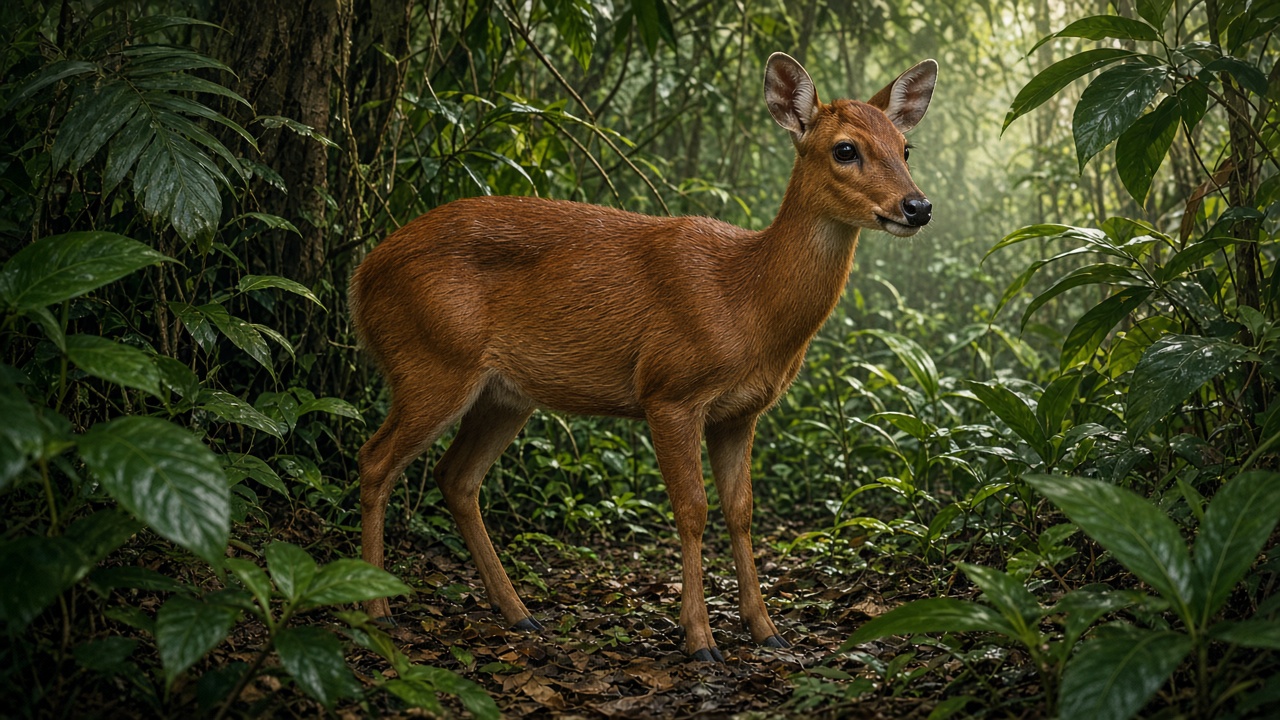
Mexican Red Brocket (Mazama temama): biology, habitats and field signs across its documented range, hunting-context reading.
Seen in: Mexico
Overview
Mexican Red Brocket (Mazama temama) is presented here in a hunting-context reading across its documented range: biology, habitats and field signs useful to observers — without publishing season, quota or authorisation.
Classification: order Artiodactyla, family Cervidae, genus Mazama. Common names: Mexican Red Brocket in English, Mazame de Hernandez in French, Temazate rojo in Spanish.
Identification
The Central American red brocket is a small deer: 80 to 110 cm long, with a 10 to 14 cm tail, 60 to 70 cm at the shoulder and 12 to 32 kg according to the Handbook of the Mammals of the World. The back is reddish, the head and throat brown or reddish, the underparts white. The forelegs are shorter than the hindlegs, giving it a low-fronted profile. It differs from the Yucatan brown brocket, with which it locally shares habitat, by its overall reddish colour and slightly smaller size.
Mainly frugivorous, it eats fallen fruit and seeds, but also grasses, shoots, vines and, where available, crops such as beans. Mating occurs throughout the year; after about 225 days of gestation the female gives birth to a single fawn of 0.5 to 1.4 kg, occasionally twins, which stays with her through its first year. Fairly sedentary, it uses a small home range; adult males are territorial, and males and females meet only briefly to mate.
Habitats and range
MDD places it from south-eastern Mexico southwards, with confirmed presence in Mexico, Belize, Guatemala, Honduras and El Salvador. It is commoner in well-preserved, especially humid forests and seems to prefer primary tropical rainforest, while also using secondary vegetation, up to 2,800 m. In the Calakmul Biosphere Reserve (Campeche) it shares the forest with white-tailed deer and Yucatan brown brocket.
The countries where the species’ presence is established are shown in the tags on this sheet.
Field signs
Extremely shy and wary, it is seldom seen; when it senses danger it often freezes. An excellent swimmer, it crosses large rivers easily, but it lacks endurance when running. Camera traps at Calakmul ponds monitored from 2014 to 2022 recorded it rarely and active both by day and by night. It lives alone, or as a female travelling with her young.
Conservation
For conservation status of Mazama temama, consult the current IUCN assessment and cross with national monitoring programmes in countries of documented presence. Never turn a global IUCN category into a local hunting rule. GBIF occurrences help situate distribution but remain effort-biased.
MDD lists the species as Not Evaluated; the Handbook (2011) gave it as Data Deficient because of unclear taxonomy and scant abundance data, with hunting and habitat loss as the main threats. Long treated as part of Mazama americana, the species has been redefined: MDD has removed M. reperticia and the populations now attributed to M. zetta, and a neotype was designated in 2022.
Limits
This sheet on the Mexican Red Brocket publishes no season, quota, hunting method or fee: those rules differ between countries and territories and must be checked in official texts. Being described here does not mean a species may be hunted.
Local densities and management plans are not covered here: they are a matter for the managers of each area.
Sources
Sources consulted for this sheet:
- IUCN Red List — species search (consulted 2026-11-02)
- ASM Mammal Diversity Database — Mazama temama (consulted 2026-11-02)
- GBIF — species search (consulted 2026-11-02)
- Plazi TreatmentBank — Mazama temama, Handbook of the Mammals of the World vol. 2 (Wilson & Mittermeier 2011) (consulted 2026-11-04)
- THERYA — Occupancy, relative abundance and activity patterns of three sympatric deer in ponds of Calakmul Biosphere Reserve (consulted 2026-11-04)
Conclusion
In short: use the scientific name Mazama temama to cross-check sources, confirm taxonomy and conservation status on the institutional portals listed above, and relate every field sign to the habitat where it was actually found.
Identification
Mazama temama
Mexican Red Brocket · preferred
Central American Red Brocket
Classification
Class : Mammalia
Order : Artiodactyla
Family : Cervidae
Genus : Mazama
Conservation
IUCN : DD
CITES : —
iucn · DD (global)
Frequently asked questions
How do I recognise Mexican Red Brocket?
Use Mazama temama as the scientific anchor. The Central American red brocket is a small deer: 80 to 110 cm long, with a 10 to 14 cm tail, 60 to 70 cm at the shoulder and 12 to 32 kg according to the Handbook of the Mammals of the World. The back is reddish, the head and throat brown or reddish, the underparts white. The fo...
Where does Mexican Red Brocket typically live?
MDD places it from south-eastern Mexico southwards, with confirmed presence in Mexico, Belize, Guatemala, Honduras and El Salvador. It is commoner in well-preserved, especially humid forests and seems to prefer primary tropical rainforest, while also using secondary vegetation, up to 2,800 m. In the Calakmul Biosphere Reserve (Campeche) it shares the forest...
What field signs help confirm Mexican Red Brocket?
Extremely shy and wary, it is seldom seen; when it senses danger it often freezes. An excellent swimmer, it crosses large rivers easily, but it lacks endurance when running. Camera traps at Calakmul ponds monitored from 2014 to 2022 recorded it rarely and active both by day and by night. It lives alone, or as a female travelling with her young.