Moose
Alces alcesMoose (Alces alces): biology, habitats and field signs across its documented range, hunting-context reading.
Seen in: Canada · Croatia · Czechia · Estonia · Finland
Overview
Moose (Alces alces) is presented here in a hunting-context reading across its documented range: biology, habitats and field signs useful to observers — without publishing season, quota or authorisation.
Classification: order Artiodactyla, family Cervidae, genus Alces. Common names: Moose in English, Élan in French, Alce in Spanish.
Identification
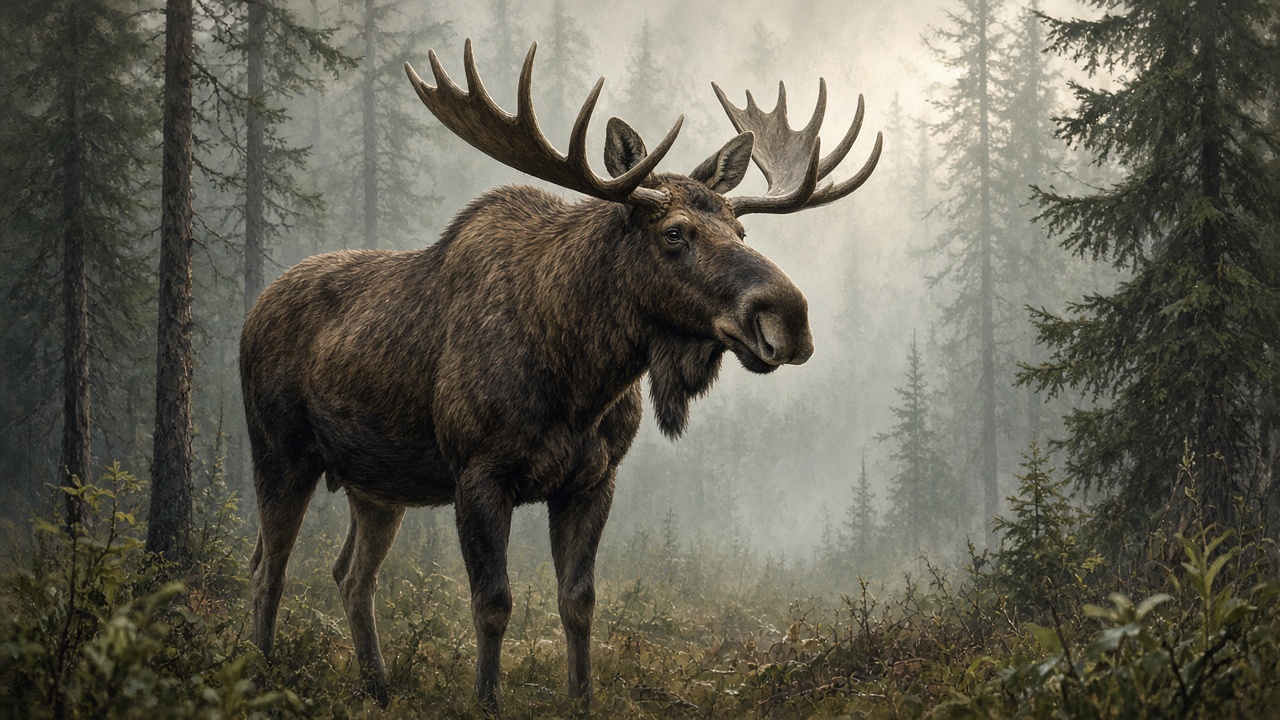
The moose is the largest member of the deer family, standing up to 2.3 m at the shoulder; males are 2.4 to 3.1 m long and weigh 360 to 600 kg, females 2.3 to 3 m and 270 to 400 kg, and the Alaskan subspecies (A. a. gigas) reaches 771 kg. A massive body sits on long, slender legs, with a short, thick neck and humped shoulders. The long, drooping muzzle has an upper lip overhanging the lower one, and a flap of furred skin, the bell, hangs under the throat. The coat is dark, black to brown or greyish-brown, paler on the lower legs. Only males carry antlers, the largest of any mammal: palmate in North America, more often without palms in Europe.
Mating takes place in September and October; after about 231 days a single calf, sometimes twins, is born, reddish-brown and unspotted, weighing about 16 kg. It follows its mother at three weeks, is weaned at five months and stays with her until the next calf is born. The least social of deer, moose live alone outside the rut, are mostly active at dawn and dusk and swim strongly. They browse woody stems and twigs in winter, willows above all, and leaves, shoots and aquatic plants in summer, about 20 kg a day. Wolves and bears are the main predators; half or more of calves die within six weeks.
Habitats and range
A circumpolar species of boreal forests. In Eurasia it ranges from Scandinavia, Poland and the southern Czech Republic east to Siberia, south to Ukraine, northern Kazakhstan, northern China and northern Mongolia; in North America it occupies Alaska, Canada and the northern United States, extending down the Rocky Mountains to Utah and Colorado. It uses taiga, mixed temperate forest and the subalpine zone, especially early regrowth after fire, logging or flooding, close to ponds, lakes, rivers and swamps. It cannot tolerate temperatures above 27 °C for long.
The countries where the species’ presence is established are shown in the tags on this sheet.
Field signs
Most active at dawn and dusk, moose are often seen near water, where they eat aquatic plants in summer. They strip bark from trees and shrubs and rub their forehead and preorbital glands on the bare patch to leave their scent. During the rut, cows give a long, quavering moan that carries up to 3.2 km and bulls grunt. Heavy browsing holds back the growth of young trees.
Conservation
For conservation status of Alces alces, consult the current IUCN assessment and cross with national monitoring programmes in countries of documented presence. Never turn a global IUCN category into a local hunting rule. GBIF occurrences help situate distribution but remain effort-biased.
The IUCN lists it as Least Concern: most populations are expanding, with about 1.5 million animals in Eurasia and one million in the United States and Canada in 2002. Exceptions are the scarce moose of Manchuria and Mongolia (A. a. cameloides) and a Nova Scotia population that Canada considers endangered. Road collisions are common, around 4,500 a year in Sweden. MDD includes americanus in this species; introduced to New Zealand, it has since died out there.
Limits
This sheet on the Moose publishes no season, quota, hunting method or fee: those rules differ between countries and territories and must be checked in official texts. Being described here does not mean a species may be hunted.
Local densities and management plans are not covered here: they are a matter for the managers of each area.
Sources
Sources consulted for this sheet:
- IUCN Red List — species search (consulted 2026-11-02)
- ASM Mammal Diversity Database — Alces alces (consulted 2026-11-02)
- GBIF — species search (consulted 2026-11-02)
- Animal Diversity Web — Alces alces (moose, Eurasian elk) (consulted 2026-11-04)
Conclusion
In short: use the scientific name Alces alces to cross-check sources, confirm taxonomy and conservation status on the institutional portals listed above, and relate every field sign to the habitat where it was actually found.
Identification
Alces alces
Moose · preferred
Élan · preferred
Alce · preferred
Elk
Eurasian Elk
Caucasian Moose
Classification
Class : Mammalia
Order : Artiodactyla
Family : Cervidae
Genus : Alces
Conservation
IUCN : LC
CITES : —
iucn · LC (global)
Habitat
Practices
Frequently asked questions
How do I recognise Moose?
Use Alces alces as the scientific anchor. The moose is the largest member of the deer family, standing up to 2.3 m at the shoulder; males are 2.4 to 3.1 m long and weigh 360 to 600 kg, females 2.3 to 3 m and 270 to 400 kg, and the Alaskan subspecies (A. a. gigas) reaches 771 kg. A massive body sits on long, slender legs,...
Where does Moose typically live?
A circumpolar species of boreal forests. In Eurasia it ranges from Scandinavia, Poland and the southern Czech Republic east to Siberia, south to Ukraine, northern Kazakhstan, northern China and northern Mongolia; in North America it occupies Alaska, Canada and the northern United States, extending down the Rocky Mountains to Utah and Colorado. It uses taiga,...
What field signs help confirm Moose?
Most active at dawn and dusk, moose are often seen near water, where they eat aquatic plants in summer. They strip bark from trees and shrubs and rub their forehead and preorbital glands on the bare patch to leave their scent. During the rut, cows give a long, quavering moan that carries up to 3.2 km and bulls grunt. Heavy browsing holds back the growth of y...