Northern Huemul
Hippocamelus antisensisNorthern Huemul (Hippocamelus antisensis): biology, habitats and field signs across its documented range, hunting-context reading.
Seen in: Argentina · Chile
Overview
Northern Huemul (Hippocamelus antisensis) is presented here in a hunting-context reading across its documented range: biology, habitats and field signs useful to observers — without publishing season, quota or authorisation.
Classification: order Artiodactyla, family Cervidae, genus Hippocamelus. Common names: Northern Huemul in English, Huémul du Nord in French, Taruca in Spanish.
Identification
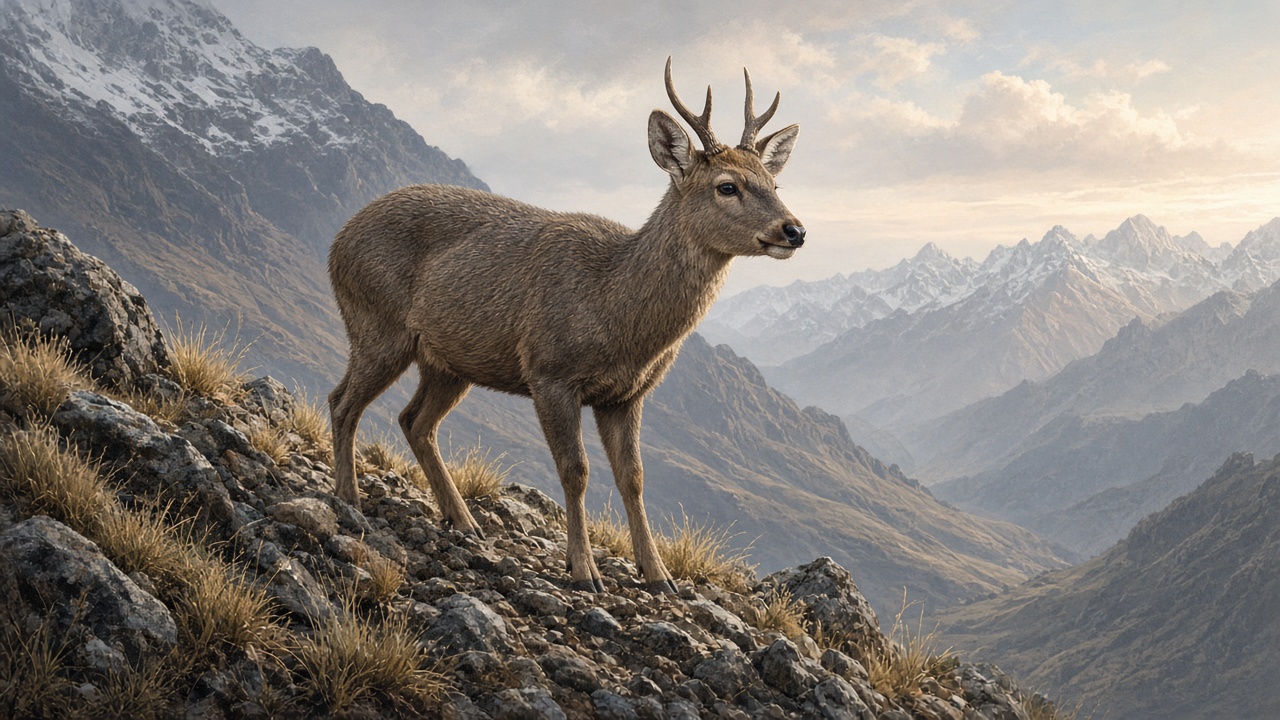
The northern huemul, or taruca, is a stocky deer with a thick body and short legs, averaging 68.6 kg (45 kg at least). Sexual dimorphism is marked: males stand 74 to 77 cm at the shoulder, females 69 to 71 cm. Both sexes have a speckled yellowish grey-brown coat, a pale throat, a dark band above the eyes and a light band around the muzzle; the short tail is dark brown above and white below. The male’s antlers are small (22 to 27 cm in large males) and fork only once, the front prong usually being the shorter. It has canine teeth.
A herbivore, it eats mainly sedges and grasses growing among the rocks of high peaks, and moves higher during the rainy season, from December to May. It lives in close-knit mixed groups of four to nine, largest during the rut, which peaks in June and July in the driest season; males guard females and fight with their antlers. Gestation, about 240 days, is long for a small deer; females leave the group for some 30 days to give birth. Antlers are cast in October–November and are hard again by May. The puma is its main predator; the mountain fox may also take newborn fawns.
Habitats and range
MDD gives it in the Andes of north-western Argentina, Bolivia, Ecuador and Peru, and also lists Chile; ADW places it between 12 and 28° south. It lives at high elevations, from 4,100 to 5,000 m, on rock outcrops, rarely below 3,960 m, in places with large daily temperature swings. Its home range exceeds 2 km in length. The other huemul, Hippocamelus bisulcus, lives further south in Chile and western Argentina, separated from it by a wide gap.
The countries where the species’ presence is established are shown in the tags on this sheet.
Field signs
It is seen in small groups on high rocky slopes. Faced with a predator it prefers to hide or slip away unnoticed; surprised at close range, it flees quickly, putting an obstacle between itself and its pursuer. The male’s simple forked antlers, the dark band above the eyes and the pale muzzle identify it.
Conservation
For conservation status of Hippocamelus antisensis, consult the current IUCN assessment and cross with national monitoring programmes in countries of documented presence. Never turn a global IUCN category into a local hunting rule. GBIF occurrences help situate distribution but remain effort-biased.
The IUCN lists it as Vulnerable and it is on CITES Appendix I. ADW links its decline to poaching, habitat loss to agriculture at lower elevations, competition with livestock at higher elevations and logging. Described as Cervus antisensis (d’Orbigny, 1834) from specimens from the Bolivian Andes, it is also known as taruga, guemal and Peruvian huemul.
Limits
This sheet on the Northern Huemul publishes no season, quota, hunting method or fee: those rules differ between countries and territories and must be checked in official texts. Being described here does not mean a species may be hunted.
Local densities and management plans are not covered here: they are a matter for the managers of each area.
Sources
Sources consulted for this sheet:
- IUCN Red List — species search (consulted 2026-11-02)
- ASM Mammal Diversity Database — Hippocamelus antisensis (consulted 2026-11-02)
- GBIF — species search (consulted 2026-11-02)
- Animal Diversity Web — Hippocamelus antisensis (taruca) (consulted 2026-11-04)
Conclusion
In short: use the scientific name Hippocamelus antisensis to cross-check sources, confirm taxonomy and conservation status on the institutional portals listed above, and relate every field sign to the habitat where it was actually found.
Identification
Hippocamelus antisensis
Huémul du Nord · preferred
Taruca · preferred
Northern Huemul · preferred
Peruvian Heumul
Taruca
Heumul
Geumul
North Andean Huemul
Classification
Class : Mammalia
Order : Artiodactyla
Family : Cervidae
Genus : Hippocamelus
Conservation
IUCN : VU
CITES : —
iucn · VU (global)
Habitat
Frequently asked questions
How do I recognise Northern Huemul?
Use Hippocamelus antisensis as the scientific anchor. The northern huemul, or taruca, is a stocky deer with a thick body and short legs, averaging 68.6 kg (45 kg at least). Sexual dimorphism is marked: males stand 74 to 77 cm at the shoulder, females 69 to 71 cm. Both sexes have a speckled yellowish grey-brown coat, a pale throat, a...
Where does Northern Huemul typically live?
MDD gives it in the Andes of north-western Argentina, Bolivia, Ecuador and Peru, and also lists Chile; ADW places it between 12 and 28° south. It lives at high elevations, from 4,100 to 5,000 m, on rock outcrops, rarely below 3,960 m, in places with large daily temperature swings. Its home range exceeds 2 km in length. The other huemul, Hippocamelus bisulcus...
What field signs help confirm Northern Huemul?
It is seen in small groups on high rocky slopes. Faced with a predator it prefers to hide or slip away unnoticed; surprised at close range, it flees quickly, putting an obstacle between itself and its pursuer. The male’s simple forked antlers, the dark band above the eyes and the pale muzzle identify it.