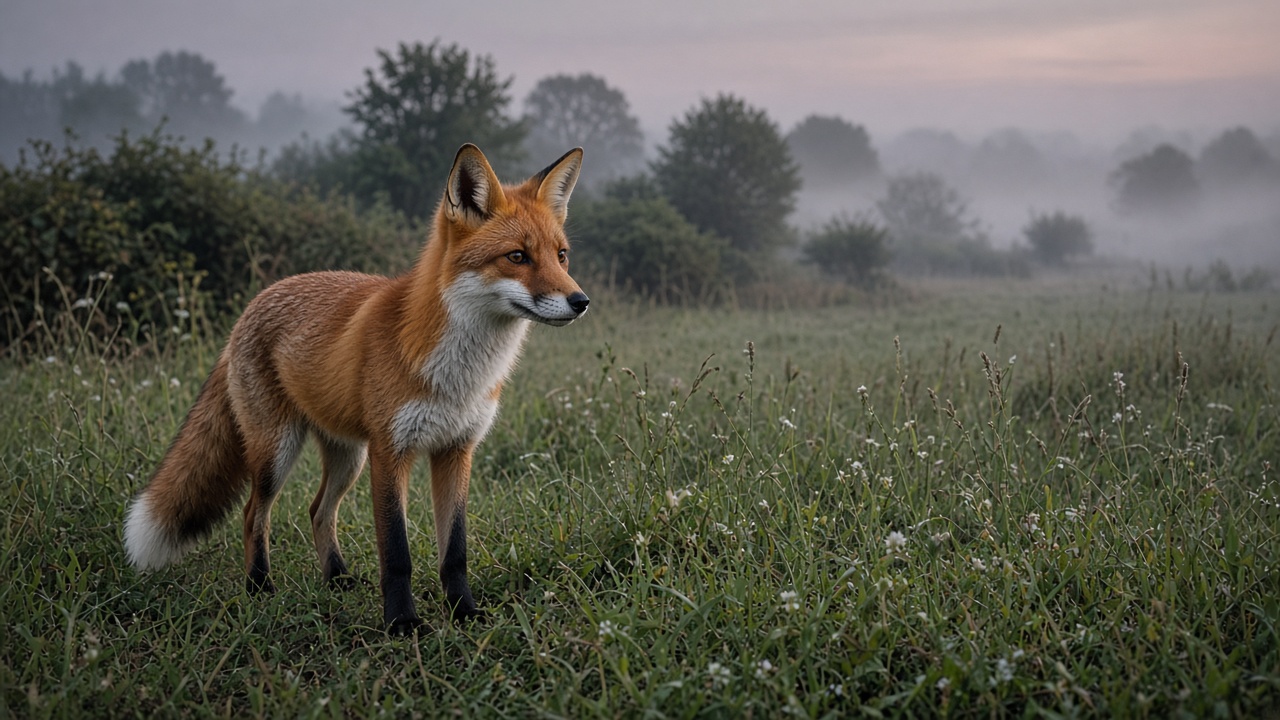
Red Fox
Vulpes vulpesRed Fox (Vulpes vulpes): biology, habitats and field signs across its documented range, hunting-context reading.
Seen in: Australia · Austria · Belgium · Bulgaria · Croatia
Overview
Red Fox (Vulpes vulpes) is presented here in a hunting-context reading across its documented range: biology, habitats and field signs useful to observers — without publishing season, quota or authorisation.
Classification: order Carnivora, family Canidae, genus Vulpes. Common names: Red Fox in English, Renard roux in French, Zorro rojo in Spanish.
Identification
The largest of the Vulpes foxes, the red fox measures 45.5 to 90 cm head and body, with a 30 to 55.5 cm tail, and weighs 3 to 14 kg; males are slightly larger. The upperparts range from pale yellowish-red to deep reddish-brown and the underside from white to slate grey; the lower legs are usually black and the tail is tipped with white or black. There are “cross” variants, with a black stripe along the back and across the shoulders, and “silver” variants that are nearly black. Adults have yellow eyes and a black or dark brown nose.
Essentially omnivorous, it eats mainly rodents, rabbits, insects and fruit, as well as carrion – 0.5 to 1 kg of food a day – and caches surplus food, which it relocates very well. Mating runs from December–January in the south to February–April in the north. After 49 to 56 days of gestation, 5 cubs on average are born; they leave the den at 4 to 5 weeks and are weaned at 8 to 10 weeks. The male feeds the female, and older offspring sometimes help raise the cubs. The family stays together until autumn.
Habitats and range
It has the widest range of any canid. MDD lists it across almost all of Europe, North Africa, the Middle East and the Arabian Peninsula, Central and South Asia east to Japan, and North America (Alaska, Canada, most of the United States) and Greenland; it has been introduced to Australia. It uses forest, tundra, prairie, desert, mountains, farmland and towns, preferring edges and mosaics of scrub and woodland, from sea level to 4,500 m.
The countries where the species’ presence is established are shown in the tags on this sheet.
Field signs
It has a main den and emergency burrows, often takes over those of rabbits or marmots, and the same den may serve several generations; paths link it with resting sites, hunting grounds and caches. It marks its territory with urine and scat. Nocturnal or crepuscular, it hunts mice with a high pounce, pinning them to the ground with its forefeet. Some 28 different calls have been described.
Conservation
For conservation status of Vulpes vulpes, consult the current IUCN assessment, then cross with French monitoring programmes when they exist (OFB portal and related publications). Never turn a global IUCN category into a departmental hunting rule. GBIF occurrences help situate documented distribution but remain effort-biased.
The IUCN lists it as Least Concern: populations are stable and it has expanded its range by exploiting human changes to the landscape. Three subspecies are listed in CITES Appendix III. It can transmit rabies. MDD notes that some authors split off a North American fox, V. fulva, but keeps it within V. vulpes, because the split would leave the Palearctic red fox paraphyletic.
Limits
This sheet on the Red Fox publishes no season, quota, hunting method or fee: those rules differ between countries and territories and must be checked in official texts. Being described here does not mean a species may be hunted.
Local densities and management plans are not covered here: they are a matter for the managers of each area.
Sources
Sources consulted for this sheet:
- IUCN Red List — species search (consulted 2026-11-01)
- ASM Mammal Diversity Database — Vulpes vulpes (consulted 2026-11-01)
- GBIF — species search (consulted 2026-11-01)
- Animal Diversity Web — Vulpes vulpes (red fox) (consulted 2026-11-04)
Conclusion
In short: use the scientific name Vulpes vulpes to cross-check sources, confirm taxonomy and conservation status on the institutional portals listed above, and relate every field sign to the habitat where it was actually found.
Identification
Vulpes vulpes
Renard roux · preferred
Zorro rojo · preferred
Red Fox · preferred
Silver Fox
Cross Fox
Classification
Class : Mammalia
Order : Carnivora
Family : Canidae
Genus : Vulpes
Conservation
IUCN : LC
CITES : —
iucn · LC (global)
Habitat
Practices
Frequently asked questions
How do I recognise Red Fox?
Use Vulpes vulpes as the scientific anchor. The largest of the Vulpes foxes, the red fox measures 45.5 to 90 cm head and body, with a 30 to 55.5 cm tail, and weighs 3 to 14 kg; males are slightly larger. The upperparts range from pale yellowish-red to deep reddish-brown and the underside from white to slate grey; the lower...
Where does Red Fox typically live?
It has the widest range of any canid. MDD lists it across almost all of Europe, North Africa, the Middle East and the Arabian Peninsula, Central and South Asia east to Japan, and North America (Alaska, Canada, most of the United States) and Greenland; it has been introduced to Australia. It uses forest, tundra, prairie, desert, mountains, farmland and towns,...
What field signs help confirm Red Fox?
It has a main den and emergency burrows, often takes over those of rabbits or marmots, and the same den may serve several generations; paths link it with resting sites, hunting grounds and caches. It marks its territory with urine and scat. Nocturnal or crepuscular, it hunts mice with a high pounce, pinning them to the ground with its forefeet. Some 28 diffe...