Reeves's Muntjac
Muntiacus reevesiReeves's Muntjac (Muntiacus reevesi): biology, habitats and field signs across its documented range, hunting-context reading.
Seen in: United Kingdom
Overview
Reeves's Muntjac (Muntiacus reevesi) is presented here in a hunting-context reading across its documented range: biology, habitats and field signs useful to observers — without publishing season, quota or authorisation.
Classification: order Artiodactyla, family Cervidae, genus Muntiacus. Common names: Reeves's Muntjac in English, Muntjac de Chine in French, Muntíaco de Reeves in Spanish.
Identification
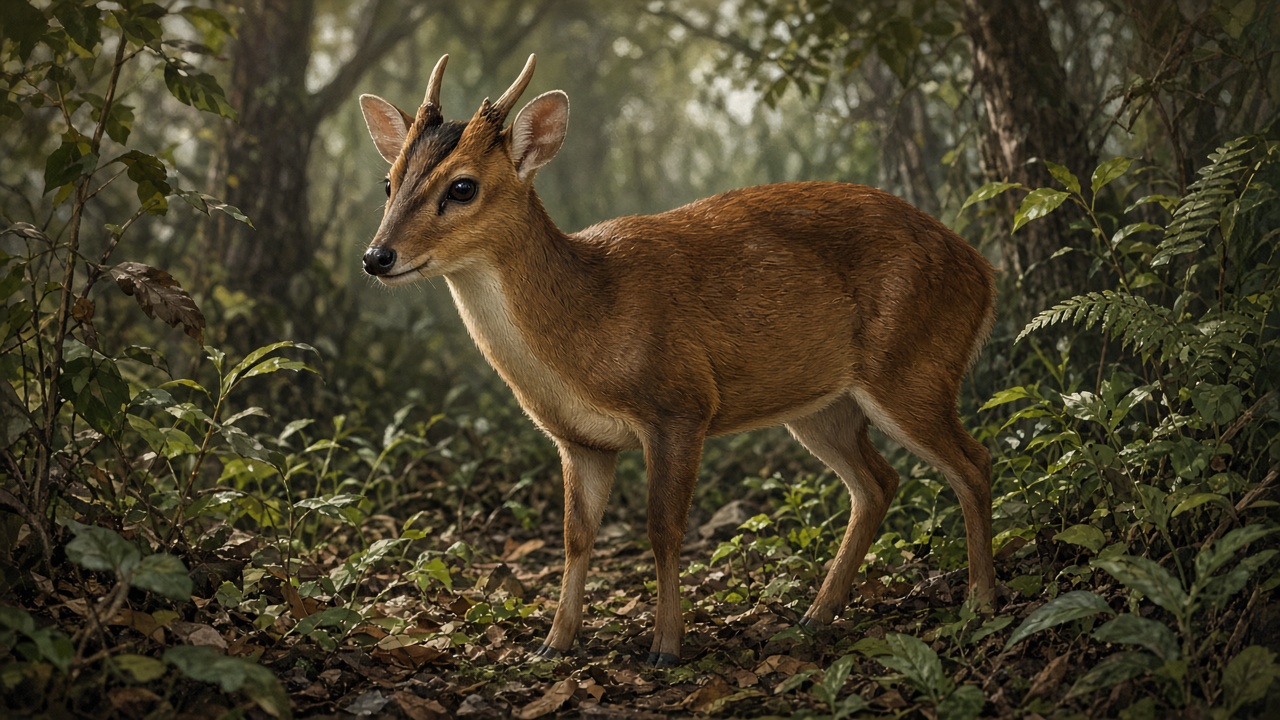
A small deer, 70 to 113 cm long (80 cm on average), 43 to 45 cm at the shoulder and 11 to 28 kg (18 kg on average). The coat is chestnut; the tail, about 10 cm long, is black above and white below. Both sexes have bony ridges on the face lined with black hair, running into hair-covered pedicles that carry the male’s short antlers (125 to 150 mm) or a black tuft in the female. The heavier male also has tusk-like canines 2.5 to 5 cm long. One of the two hooves is smaller than the other and fringed with hair.
An unfussy eater, it takes bamboo, seeds, bark, fruit and foliage, as well as eggs, carrion and fungi, and can catch small mammals and ground-nesting birds. It is most active at dawn and dusk, in foraging bouts of 30 to 40 minutes. Solitary and territorial, the male defends its territory with its canines. Breeding occurs year-round in China and from late October to early March in England; after about seven months a single fawn is born, weaned at about two months and adult at six months. In China, leopards, tigers, dholes, jackals, crocodiles and pythons prey on it.
Habitats and range
Its native range covers the subtropical forests of south-eastern China and Taiwan (MDD, ADW). There it lives in rainforest at moderate elevations, often near water, and makes trails through the vegetation. Introduced around 1900 at Woburn, Bedfordshire, it has become established in England, where it uses broadleaf and conifer woodland, farmland and even suburban and urban areas; it has become the most widely distributed deer there.
The countries where the species’ presence is established are shown in the tags on this sheet.
Field signs
Regular trails with worn vegetation, and small trampled patches used for lying up or urinating, give it away; in its tracks, one hoof is smaller than the other and the hair fringe shows. It is heard more often than seen: it barks, sometimes for up to an hour, at a predator or a dominant rival, especially at dawn and dusk. It forages with its head held low, making soft growling sounds.
Conservation
For conservation status of Muntiacus reevesi, consult the current IUCN assessment and cross with national monitoring programmes in countries of documented presence. Never turn a global IUCN category into a local hunting rule. GBIF occurrences help situate distribution but remain effort-biased.
The IUCN lists it as Least Concern; it is common in south-eastern China. In England, where the fox is its only potential predator, it browses vegetation heavily, especially coppice; at high densities it reduces plant diversity and small-mammal populations. With 2n = 46 chromosomes, it differs sharply from other muntjacs, some of which have greatly reduced karyotypes.
Limits
This sheet on the Reeves's Muntjac publishes no season, quota, hunting method or fee: those rules differ between countries and territories and must be checked in official texts. Being described here does not mean a species may be hunted.
Local densities and management plans are not covered here: they are a matter for the managers of each area.
Sources
Sources consulted for this sheet:
- IUCN Red List — species search (consulted 2026-11-02)
- ASM Mammal Diversity Database — Muntiacus reevesi (consulted 2026-11-02)
- GBIF — species search (consulted 2026-11-02)
- Animal Diversity Web — Muntiacus reevesi (Reeves’s muntjac) (consulted 2026-11-04)
Conclusion
In short: use the scientific name Muntiacus reevesi to cross-check sources, confirm taxonomy and conservation status on the institutional portals listed above, and relate every field sign to the habitat where it was actually found.
Identification
Muntiacus reevesi
Muntjac de Chine · preferred
Muntíaco de Reeves · preferred
Reeves's Muntjac · preferred
Classification
Class : Mammalia
Order : Artiodactyla
Family : Cervidae
Genus : Muntiacus
Conservation
IUCN : LC
CITES : —
iucn · LC (global)
Frequently asked questions
How do I recognise Reeves's Muntjac?
Use Muntiacus reevesi as the scientific anchor. A small deer, 70 to 113 cm long (80 cm on average), 43 to 45 cm at the shoulder and 11 to 28 kg (18 kg on average). The coat is chestnut; the tail, about 10 cm long, is black above and white below. Both sexes have bony ridges on the face lined with black hair, running into hair-c...
Where does Reeves's Muntjac typically live?
Its native range covers the subtropical forests of south-eastern China and Taiwan (MDD, ADW). There it lives in rainforest at moderate elevations, often near water, and makes trails through the vegetation. Introduced around 1900 at Woburn, Bedfordshire, it has become established in England, where it uses broadleaf and conifer woodland, farmland and even subu...
What field signs help confirm Reeves's Muntjac?
Regular trails with worn vegetation, and small trampled patches used for lying up or urinating, give it away; in its tracks, one hoof is smaller than the other and the hair fringe shows. It is heard more often than seen: it barks, sometimes for up to an hour, at a predator or a dominant rival, especially at dawn and dusk. It forages with its head held low, m...