Roan Antelope
Hippotragus equinusRoan Antelope (Hippotragus equinus): coexistence sheet across its documented range — presence, biology and prudence, without an invented hunting status.
Seen in: Namibia · South Africa
Overview
Roan Antelope (Hippotragus equinus) is a coexistence sheet across its documented range: presence, biology and prudence — not a hunting status claim.
Classification: order Artiodactyla, family Bovidae, genus Hippotragus. Common names: Roan Antelope in English, Hippotrague rouan in French, Antílope ruano in Spanish.
Identification
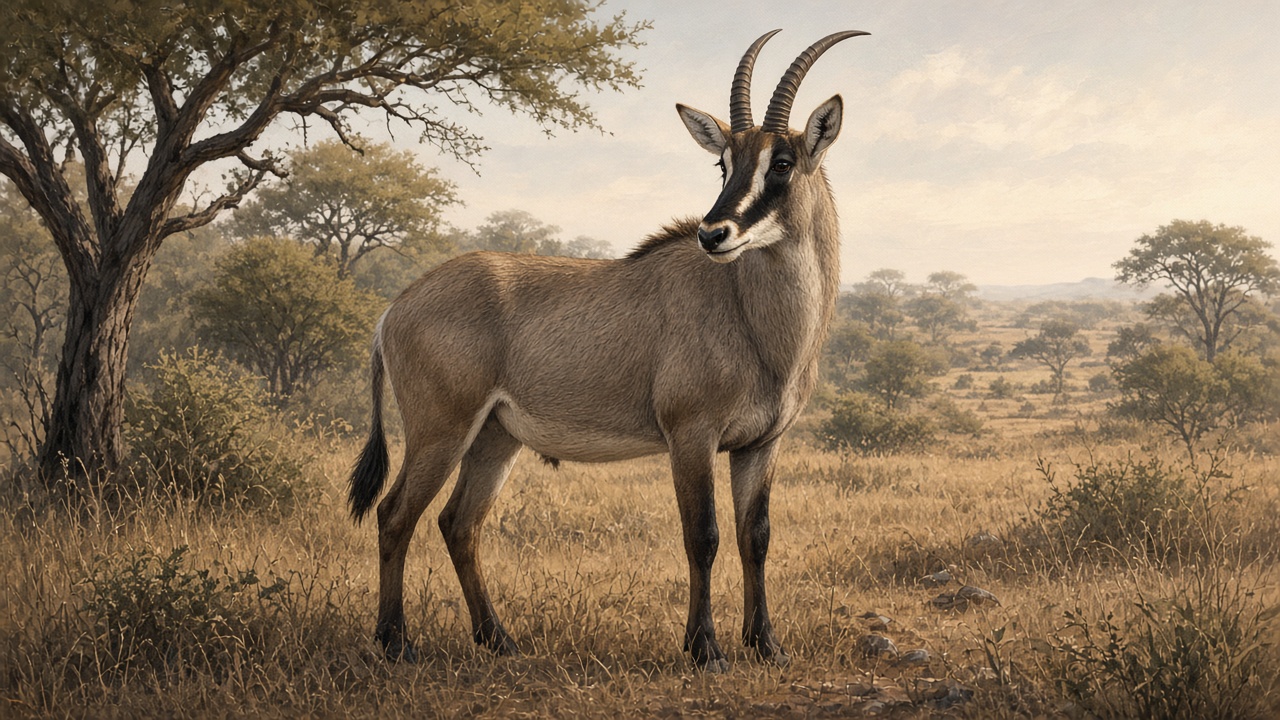
The roan antelope is the second-largest antelope: 225 to 300 kg and 140 to 160 cm at the shoulder. Its greyish-brown coat with a reddish tinge contrasts with darker legs and a dark brown to black head, marked with white around the mouth and nose, large white patches in front of the eyes and pale patches behind them. The ears are long and narrow with dark brown tips; a short, stiff mane and a black-tipped tail complete the look. Both sexes carry ridged, scimitar-shaped horns, longer and thicker in males.
A grazer that prefers leaves to stems, it switches to browse when grass is poor; it eats in the morning and evening and retreats to more wooded areas at midday. It lives in herds of 6 to 15, sometimes up to 35, led by a single dominant bull; young males driven out at about 3 years form bachelor groups. With no distinct breeding season, the female gives birth to a single calf after 260 to 281 days; the calf stays hidden for four to five weeks.
Habitats and range
It occurs in the savanna woodlands of Africa south of the Sahara: from Senegal, Guinea and Ghana to Chad, Sudan and western Ethiopia, then south to Angola, Namibia, Botswana, Zimbabwe and eastern South Africa (MDD). MDD lists it as extinct in Burundi and Gambia and reintroduced in Eswatini. It seeks lightly wooded savanna with medium to tall grass and must have access to water.
The countries where the species’ presence is established are shown in the tags on this sheet.
Field signs
Mostly active in the cooler morning and evening hours, it is not very wary where it has not been persecuted: when disturbed, it runs a short way and then turns to look back, and can reach 57 km/h. A bull defends an area of 300 to 500 m around his herd. Fights between bulls, horn against horn, are fierce but rarely fatal.
Conservation
For conservation status of Hippotragus equinus, consult the current IUCN assessment and cross with national monitoring programmes in countries of documented presence. Never turn a global IUCN category into a local hunting rule. GBIF occurrences help situate distribution but remain effort-biased.
The IUCN lists it as Least Concern; ADW mentions an earlier Lower Risk, conservation dependent category and its listing in CITES Appendix III for Ghana. It has declined sharply through habitat deterioration, poaching, agricultural encroachment and deliberate killing during tsetse fly control campaigns.
Limits
This sheet on the Roan Antelope covers presence and biology. A species being present in a country does not mean it may be hunted, and no season or quota is published here.
Local densities and management plans are not covered here: they are a matter for the managers of each area.
Sources
Sources consulted for this sheet:
- IUCN Red List — species search (consulted 2026-11-02)
- ASM Mammal Diversity Database — Hippotragus equinus (consulted 2026-11-02)
- GBIF — species search (consulted 2026-11-02)
- Animal Diversity Web — Hippotragus equinus (roan antelope) (consulted 2026-11-04)
Conclusion
In short: use the scientific name Hippotragus equinus to cross-check sources, confirm taxonomy and conservation status on the institutional portals listed above, and relate every field sign to the habitat where it was actually found.
Identification
Hippotragus equinus
Roan Antelope · preferred
Hippotrague rouan · preferred
Antílope ruano · preferred
Bastergemsbok
Gwanki
Korongo
Kwalataseta
Classification
Class : Mammalia
Order : Artiodactyla
Family : Bovidae
Genus : Hippotragus
Conservation
IUCN : LC
CITES : —
iucn · LC (global)
Habitat
Frequently asked questions
How do I recognise Roan Antelope?
Use Hippotragus equinus as the scientific anchor. The roan antelope is the second-largest antelope: 225 to 300 kg and 140 to 160 cm at the shoulder. Its greyish-brown coat with a reddish tinge contrasts with darker legs and a dark brown to black head, marked with white around the mouth and nose, large white patches in front of t...
Where does Roan Antelope typically live?
It occurs in the savanna woodlands of Africa south of the Sahara: from Senegal, Guinea and Ghana to Chad, Sudan and western Ethiopia, then south to Angola, Namibia, Botswana, Zimbabwe and eastern South Africa (MDD). MDD lists it as extinct in Burundi and Gambia and reintroduced in Eswatini. It seeks lightly wooded savanna with medium to tall grass and must h...
What field signs help confirm Roan Antelope?
Mostly active in the cooler morning and evening hours, it is not very wary where it has not been persecuted: when disturbed, it runs a short way and then turns to look back, and can reach 57 km/h. A bull defends an area of 300 to 500 m around his herd. Fights between bulls, horn against horn, are fierce but rarely fatal.