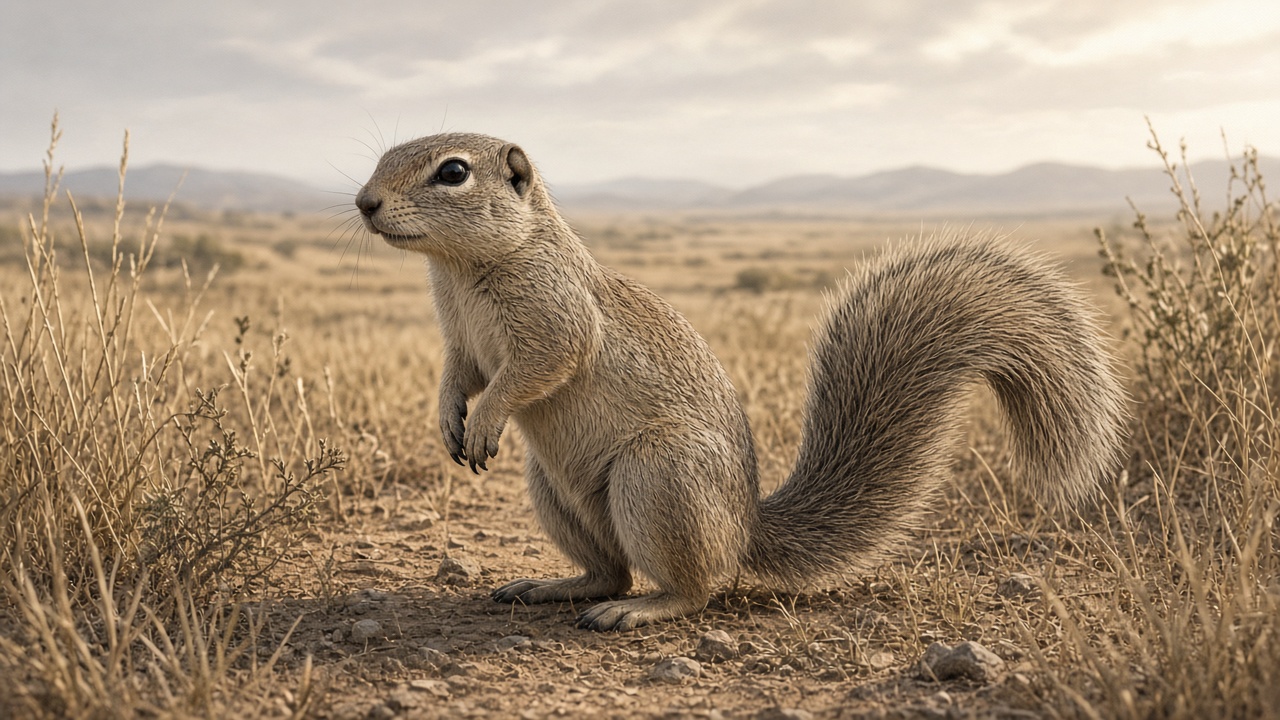
South African Ground Squirrel
Geosciurus inaurisSouth African Ground Squirrel (Geosciurus inauris): ecology sheet across its documented range — natural history and habitats, without hunting framing.
Seen in: Namibia · South Africa
Overview
South African Ground Squirrel (Geosciurus inauris) is an ecology sheet across its documented range: natural history and habitats, without any hunting framing.
Classification: order Rodentia, family Sciuridae, genus Geosciurus. Common names: South African Ground Squirrel in English, Écureuil fouisseur du Cap in French, Ardilla terrestre del Cabo in Spanish.
Identification
The Cape ground squirrel measures 43.5 to 47.6 cm including the tail and weighs 423 to 649 g (528 g on average). Males (45.2 to 47.6 cm) are slightly longer than females (43.5 to 44.6 cm). The hair is short and coarse over black skin. The back ranges from light to dark reddish-brown, while the underparts, limbs, neck and face are white. The ears are small. The best feature is the long, bushy white tail, almost as large as the body.
Diurnal, it leaves its burrow a couple of hours after sunrise, grooms and lies belly-down in the sun before foraging; afternoons are spent grooming and socialising. It eats bulbs, grasses, herbs, seeds, shrubs and insects. Females live in groups of 1 to 4 with their young; males form separate bands of up to 19 animals with an age-based hierarchy. Breeding takes place all year with a winter peak: after 42 to 49 days, 1 to 3 young are born, emerging from the burrow at about 45 days. Black-backed jackals, puff adders and savannah monitor lizards are its predators.
Habitats and range
MDD gives its range from southern Angola through Namibia, Botswana and western Zimbabwe to South Africa. It favours dry habitats, savannah and grassland, and also lives in the Kalahari Desert at 600 to 1,200 m. It rarely strays far from its burrows, which shelter it from extreme temperatures and predators, and it does not hibernate. Burrows form separate clusters, some linked underground: one study counted 60 entrances in 700 m², 200 m from the next cluster.
The countries where the species’ presence is established are shown in the tags on this sheet.
Field signs
Look for clusters of burrow entrances and animals stretched out in the morning sun. In the heat of the day it raises its large white tail as a parasol and shuttles constantly between the surface and the burrow. Alarm calls are high-pitched for serious threats and medium-pitched otherwise. It sometimes mobs a snake or jackal by putting its tail between itself and the predator; meerkats and yellow mongooses share its burrows.
Conservation
For conservation status of Geosciurus inauris, consult the current IUCN assessment and cross with national monitoring programmes in countries of documented presence. Never turn a global IUCN category into a local hunting rule. GBIF occurrences help situate distribution but remain effort-biased.
The IUCN lists it as Least Concern; ADW, citing the IUCN, reports a stable population with no specific threats. It can carry rabies and occasionally damages crops. Described as Sciurus (inauris), it was long placed in Xerus (the name ADW still uses); MDD places it in Geosciurus following the revision by Kryštufek et al. (2016).
Limits
This sheet on the South African Ground Squirrel covers biology and ecology only; it publishes no hunting season, quota or authorisation.
Local densities and management plans are not covered here: they are a matter for the managers of each area.
Sources
Sources consulted for this sheet:
- IUCN Red List — species search (consulted 2026-11-02)
- ASM Mammal Diversity Database — Geosciurus inauris (consulted 2026-11-02)
- GBIF — species search (consulted 2026-11-02)
- Animal Diversity Web — Xerus inauris (South African ground squirrel) (consulted 2026-11-04)
Conclusion
In short: use the scientific name Geosciurus inauris to cross-check sources, confirm taxonomy and conservation status on the institutional portals listed above, and relate every field sign to the habitat where it was actually found.
Identification
Geosciurus inauris
Écureuil fouisseur du Cap · preferred
Ardilla terrestre del Cabo · preferred
South African Ground Squirrel · preferred
Xerus inauris
Classification
Class : Mammalia
Order : Rodentia
Family : Sciuridae
Genus : Geosciurus
Conservation
IUCN : LC
CITES : —
iucn · LC (global)
Habitat
Frequently asked questions
How do I recognise South African Ground Squirrel?
Use Geosciurus inauris as the scientific anchor. The Cape ground squirrel measures 43.5 to 47.6 cm including the tail and weighs 423 to 649 g (528 g on average). Males (45.2 to 47.6 cm) are slightly longer than females (43.5 to 44.6 cm). The hair is short and coarse over black skin. The back ranges from light to dark reddish-br...
Where does South African Ground Squirrel typically live?
MDD gives its range from southern Angola through Namibia, Botswana and western Zimbabwe to South Africa. It favours dry habitats, savannah and grassland, and also lives in the Kalahari Desert at 600 to 1,200 m. It rarely strays far from its burrows, which shelter it from extreme temperatures and predators, and it does not hibernate. Burrows form separate clu...
What field signs help confirm South African Ground Squirrel?
Look for clusters of burrow entrances and animals stretched out in the morning sun. In the heat of the day it raises its large white tail as a parasol and shuttles constantly between the surface and the burrow. Alarm calls are high-pitched for serious threats and medium-pitched otherwise. It sometimes mobs a snake or jackal by putting its tail between itself...