Striped Hyena
Hyaena hyaenaNo solid country presence documented yet.
Striped Hyena (Hyaena hyaena): coexistence sheet across its documented range — presence, biology and prudence, without an invented hunting status.
Overview
Striped Hyena (Hyaena hyaena) is a coexistence sheet across its documented range: presence, biology and prudence — not a hunting status claim.
Classification: order Carnivora, family Hyaenidae, genus Hyaena. Common names: Striped Hyena in English, Hyène rayée in French, Hiena rayada in Spanish.
Identification
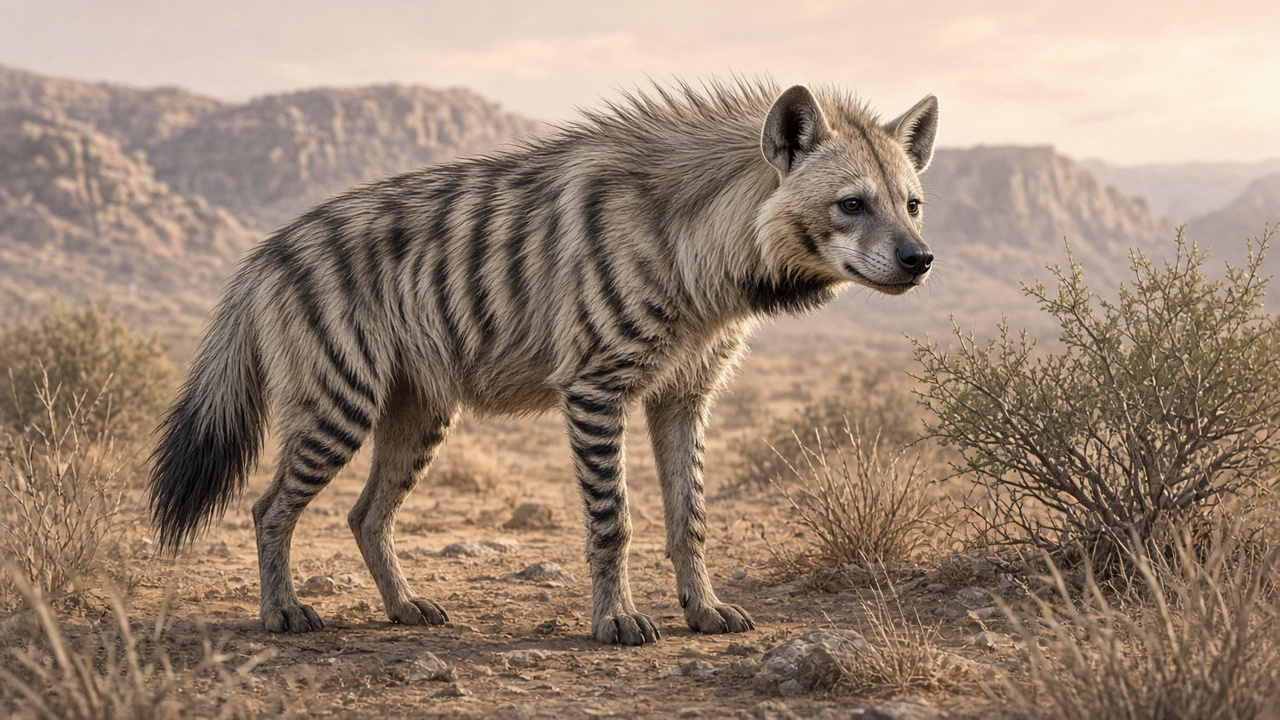
The striped hyena stands 65 to 80 cm at the shoulder, averages about 1 m in length and weighs 25 to 45 kg. Males and females are the same size, though males tend to be slightly heavier. Its long coat is grey to straw-coloured, with a black muzzle and black stripes on the head, body and legs; the ears are large and pointed. A long mane runs along the back: when threatened, the animal raises it and appears 38% larger.
Mainly a scavenger, it lives on carcasses of large and medium-sized mammals (zebras, wildebeest, gazelles, impalas), even eating the bones, and on human refuse; it adds fruit, insects and small animals (hares, rodents, reptiles, birds). It forages alone at night at 2 to 4 km/h and drinks every night if water is available, but can go without for long periods. Solitary when foraging, it lives in small family groups at the den, where older young bring food back for younger siblings. Breeding is not seasonal: after 88 to 92 days, 1 to 6 cubs are born and nursed for about a year.
Habitats and range
ADW describes it from northern and eastern Africa, the Middle East, India and Asia north to the Caucasus; MDD lists, among others, Afghanistan, Morocco, Egypt, Ethiopia, India, Iran, Israel, Kenya, Nepal, Pakistan, Saudi Arabia, Tanzania, Turkmenistan and Yemen. It lives in arid, mountainous scrub country and dens in rocky hills, ravines and crevices; it also uses savannah with dense grass, but in Africa the spotted hyena pushes it out of open areas.
The countries where the species’ presence is established are shown in the tags on this sheet.
Field signs
Near the places where it eats and along well-used paths there are latrines and anal-gland scent marks. Rarely seen in groups, it moves about at night and visits rubbish dumps around villages, fruit trees and the remains of large kills. It is not very vocal, giving mostly soft growls; when threatened it raises its mane.
Conservation
For conservation status of Hyaena hyaena, consult the current IUCN assessment and cross with national monitoring programmes in countries of documented presence. Never turn a global IUCN category into a local hunting rule. GBIF occurrences help situate distribution but remain effort-biased.
The IUCN lists it as Near Threatened. ADW considers it fairly compatible with human populations: it rarely attacks livestock or people and, being unaggressive, often lets dogs attack it without fighting back. In some African villages, rubbish is left out at night for it. It keeps about 50 m away from lions and tigers and yields its food to the spotted hyena.
Limits
This sheet on the Striped Hyena covers presence and biology. A species being present in a country does not mean it may be hunted, and no season or quota is published here.
Local densities and management plans are not covered here: they are a matter for the managers of each area.
Sources
Sources consulted for this sheet:
- IUCN Red List — species search (consulted 2026-11-02)
- ASM Mammal Diversity Database — Hyaena hyaena (consulted 2026-11-02)
- GBIF — species search (consulted 2026-11-02)
- Animal Diversity Web — Hyaena hyaena (striped hyena) (consulted 2026-11-04)
Conclusion
In short: use the scientific name Hyaena hyaena to cross-check sources, confirm taxonomy and conservation status on the institutional portals listed above, and relate every field sign to the habitat where it was actually found.
Identification
Hyaena hyaena
Striped Hyena · preferred
Hyène rayée · preferred
Hiena rayada · preferred
Classification
Class : Mammalia
Order : Carnivora
Family : Hyaenidae
Genus : Hyaena
Conservation
IUCN : NT
CITES : —
iucn · NT (global)
Habitat
Frequently asked questions
How do I recognise Striped Hyena?
Use Hyaena hyaena as the scientific anchor. The striped hyena stands 65 to 80 cm at the shoulder, averages about 1 m in length and weighs 25 to 45 kg. Males and females are the same size, though males tend to be slightly heavier. Its long coat is grey to straw-coloured, with a black muzzle and black stripes on the head, bo...
Where does Striped Hyena typically live?
ADW describes it from northern and eastern Africa, the Middle East, India and Asia north to the Caucasus; MDD lists, among others, Afghanistan, Morocco, Egypt, Ethiopia, India, Iran, Israel, Kenya, Nepal, Pakistan, Saudi Arabia, Tanzania, Turkmenistan and Yemen. It lives in arid, mountainous scrub country and dens in rocky hills, ravines and crevices; it als...
What field signs help confirm Striped Hyena?
Near the places where it eats and along well-used paths there are latrines and anal-gland scent marks. Rarely seen in groups, it moves about at night and visits rubbish dumps around villages, fruit trees and the remains of large kills. It is not very vocal, giving mostly soft growls; when threatened it raises its mane.