Aunerys
Hunting Fishing · soon
FR EN ES
Biodiversity · 3 min read

Wild boar and biodiversity in Germany: reading the stakes

Wild boar have expanded strongly in Germany. Federal and state legal framework, the role of maize and mast years, African swine fever since 2020, effects on biodiversity, with Brandenburg and Hesse as examples.

Byline: Lena Hoffmann Published Updated
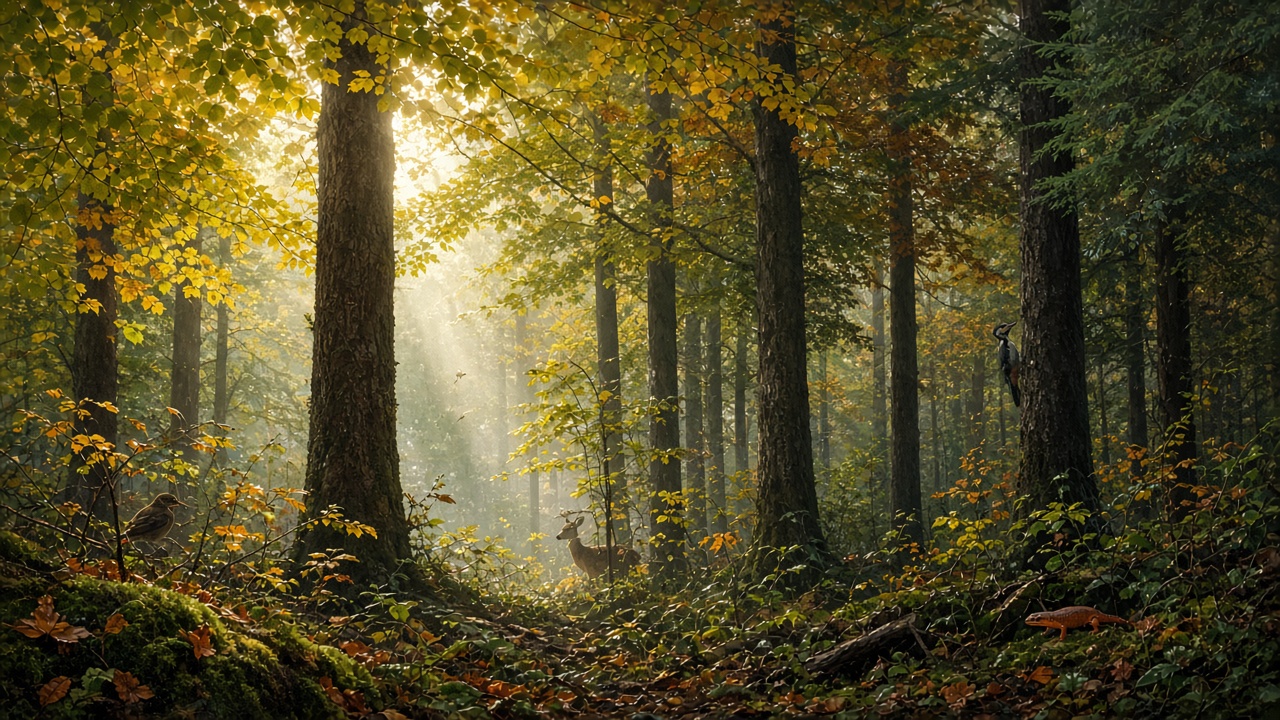
German beech forest in autumn, soft light — AI-generated illustration AI-generated illustration for Aunerys
Short answer

In Germany, hunting rests on a federal law, the Bundesjagdgesetz, supplemented by sixteen state laws. Wild boar numbers have risen sharply, and since 2020 their management has been shaped by African swine fever. Facts compiled on 4 November 2026.

Written by Lena Hoffmann Facts compiled on 4 November 2026 Updated

Introduction

With record bags at the end of the 2010s, Germany is one of the European countries where wild boar have expanded most. Their management combines hunting, farming, animal health and nature conservation.

One federal act and sixteen state laws

The Federal Hunting Act (Bundesjagdgesetz) sets out the principles; each state (Land) adopts its own hunting law (Landesjagdgesetz) and seasons. Hunting rights are tied to land: an owner of at least 75 contiguous hectares forms a private ground (Eigenjagdbezirk); the remaining land in a municipality forms a shared ground run by a landowners’ association (Jagdgenossenschaft), which leases it out. Hunters obtain their licence (Jagdschein) after a demanding exam, often called the “green A-levels”.

Why wild boar have increased

Two factors recur in analyses: the spread of maize, including for biogas, which provides food and cover in summer, and more frequent heavy beech and oak mast years, which improve survival and reproduction. Mild winters also play a part. According to the Deutscher Jagdverband, the 2019/20 season exceeded 800,000 wild boar taken, a record.

African swine fever

The first ASF case in a wild boar in Germany was confirmed on 10 September 2020 in Brandenburg, near the Polish border. The disease then reached Saxony and, in 2024, Hesse. Infected zones impose fences, carcass searches, hunting restrictions and sometimes harvest restrictions, coordinated by the Friedrich-Loeffler-Institut and the states.

Two states, two contexts

Brandenburg, flat and sandy, combines pine forests and large fields: it is the state of the first ASF outbreak and of fences hundreds of kilometres long. Hesse, hillier and more wooded, with beech forests, has had to organise disease control from 2024 in a densely populated region around Frankfurt.

Effects on biodiversity

Rooting turns over forest soils and meadows, which can favour some pioneer plants but damage species-rich grassland. Predation on ground-nesting birds’ nests and on amphibians is documented locally. The Federal Agency for Nature Conservation (BfN) monitors these effects, notably in Natura 2000 sites. The return of the wolf, present since 2000 in Lusatia (Saxony), adds a predator, with no demonstrated large-scale effect on boar numbers.
Destination Germany — hunting and nature →

Conclusion

In Germany, wild boar are read state by state: regional law, densities, disease status. BfN sheds light on biodiversity effects; the states’ hunting authorities and the DJV publish rules and bag figures.
Sources : Gesetze im Internet — Bundesjagdgesetz (BJagdG); Deutscher Jagdverband — Jagdstatistik; Friedrich-Loeffler-Institut — Afrikanische Schweinepest; Bundesamt für Naturschutz (BfN)
The author Lena Hoffmann Articles on the link between hunting and biodiversity in Germany, drawn from the cited sources. Editorial byline of the Aunerys desk. It does not attest to a verified local expertise. View profile →

Read next

Natural landscape in Czechia — AI-generated illustration AI-generated illustration for Aunerys
Ethics · 5 min

Hunting and biodiversity in Czechia: conservation issues

Natural landscape in Iceland — AI-generated illustration AI-generated illustration for Aunerys
Ethics · 4 min

Hunting and biodiversity in Iceland: conservation issues

Natural landscape in Portugal — AI-generated illustration AI-generated illustration for Aunerys
Ethics · 3 min

Hunting and biodiversity in Portugal: conservation issues