Common Genet
Genetta genettaCommon Genet (Genetta genetta): coexistence sheet across its documented range — presence, biology and prudence, without an invented hunting status.
Seen in: France · Namibia · Portugal · South Africa · Spain
Overview
Common Genet (Genetta genetta) is a coexistence sheet across its documented range: presence, biology and prudence — not a hunting status claim.
Classification: order Carnivora, family Viverridae, genus Genetta. Common names: Common Genet in English, Genette commune in French, Gineta in Spanish.
Identification
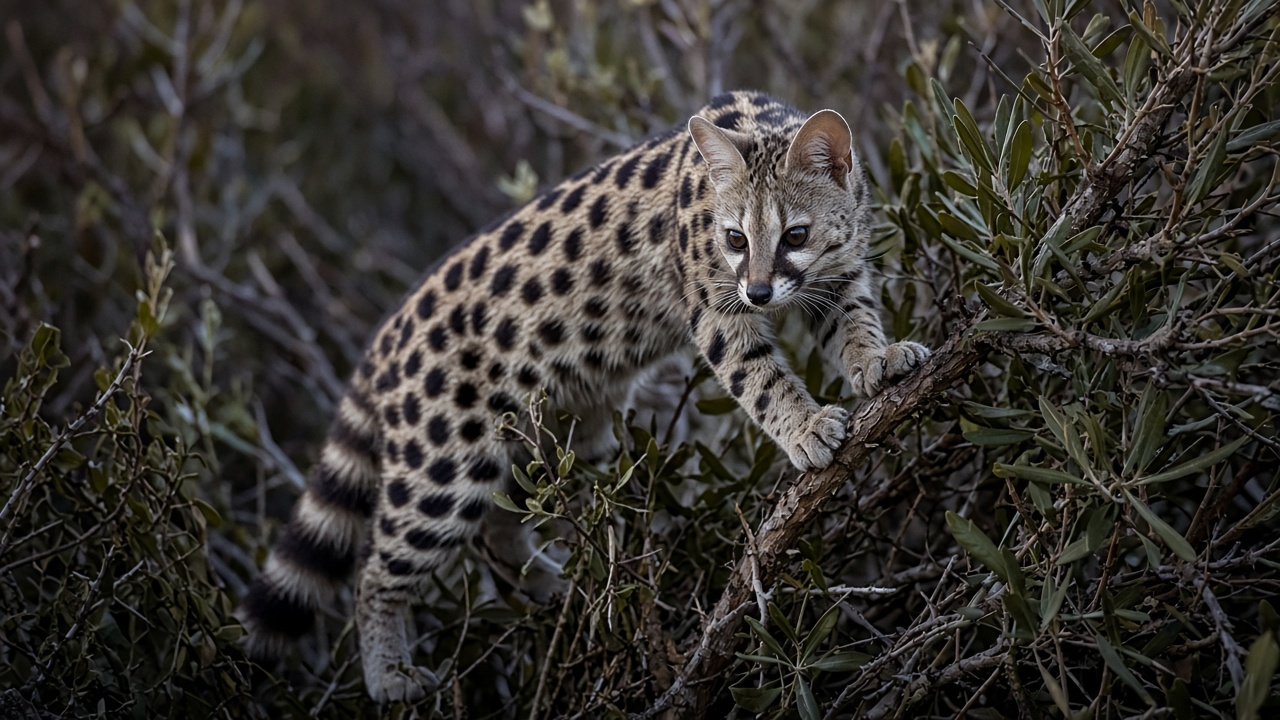
The common genet is a long, lean carnivore of 1 to 3 kg, with a tail usually at least as long as its body. It looks catlike, except for its longer face. The fur, exceptionally soft, is cream to buff with a pattern of dark spots or marbling. Its claws are semi-retractile, and its extremely flexible body lets it slip into very small spaces. It is also known as the common small-spotted genet.
A carnivore, it eats most small animals it can catch: rats, mice, insects, small reptiles and birds. A stealth hunter much like a cat, it kills with a quick bite to the neck and pins prey with its sharp claws. Solitary, it holds a territory exclusive of same-sex individuals, while male and female ranges overlap. Females come into heat during the wet season or seasons; after 10 to 11 weeks of gestation, 1 to 3 blind, helpless young are born, weaned at about eight weeks and sexually mature at two years.
Habitats and range
Native to northern Africa according to ADW, the genet has also spread to Europe. MDD lists it across much of Africa, from the Maghreb to southern Africa, in the Arabian Peninsula and, in Europe, in Portugal, Spain, France and Italy; its type locality is El Pardo, near Madrid. It prefers drier areas than other genets and favours forests, where it climbs with great agility, but also occurs in savanna and scrub forest.
The countries where the species’ presence is established are shown in the tags on this sheet.
Field signs
Nocturnal, it is seldom seen by day, though it is sometimes reported foraging at twilight. The long tail and dark-spotted cream coat are the best features when one is glimpsed climbing a tree or slipping through a narrow gap. It often lives on the edges of human communities. During mating, preceded by foreplay lasting up to an hour, both male and female utter “meows”.
Conservation
For conservation status of Genetta genetta, consult the current IUCN assessment, then cross with French monitoring programmes when they exist (OFB portal and related publications). Never turn a global IUCN category into a departmental hunting rule. GBIF occurrences help situate documented distribution but remain effort-biased.
The IUCN lists it as Least Concern; according to ADW it remains plentiful throughout its range and seems to have little to fear. It helps keep rodents down near crops and only occasionally takes poultry, without notable damage. According to MDD, the species previously included Genetta felina. Viverrids are commonly regarded as the closest living mammals to the common ancestor of the carnivores.
Limits
This sheet on the Common Genet covers presence and biology. A species being present in a country does not mean it may be hunted, and no season or quota is published here.
Local densities and management plans are not covered here: they are a matter for the managers of each area.
Sources
Sources consulted for this sheet:
- IUCN Red List — species search (consulted 2026-11-01)
- ASM Mammal Diversity Database — Genetta genetta (consulted 2026-11-01)
- GBIF — species search (consulted 2026-11-01)
- Animal Diversity Web — Genetta genetta (common genet) (consulted 2026-11-04)
Conclusion
In short: use the scientific name Genetta genetta to cross-check sources, confirm taxonomy and conservation status on the institutional portals listed above, and relate every field sign to the habitat where it was actually found.
Identification
Genetta genetta
Common Genet · preferred
Genette commune · preferred
Gineta · preferred
Common Small-spotted Genet
Classification
Class : Mammalia
Order : Carnivora
Family : Viverridae
Genus : Genetta
Conservation
IUCN : LC
CITES : —
iucn · LC (global)
Habitat
Frequently asked questions
How do I recognise Common Genet?
Use Genetta genetta as the scientific anchor. The common genet is a long, lean carnivore of 1 to 3 kg, with a tail usually at least as long as its body. It looks catlike, except for its longer face. The fur, exceptionally soft, is cream to buff with a pattern of dark spots or marbling. Its claws are semi-retractile, and its...
Where does Common Genet typically live?
Native to northern Africa according to ADW, the genet has also spread to Europe. MDD lists it across much of Africa, from the Maghreb to southern Africa, in the Arabian Peninsula and, in Europe, in Portugal, Spain, France and Italy; its type locality is El Pardo, near Madrid. It prefers drier areas than other genets and favours forests, where it climbs with...
What field signs help confirm Common Genet?
Nocturnal, it is seldom seen by day, though it is sometimes reported foraging at twilight. The long tail and dark-spotted cream coat are the best features when one is glimpsed climbing a tree or slipping through a narrow gap. It often lives on the edges of human communities. During mating, preceded by foreplay lasting up to an hour, both male and female utte...