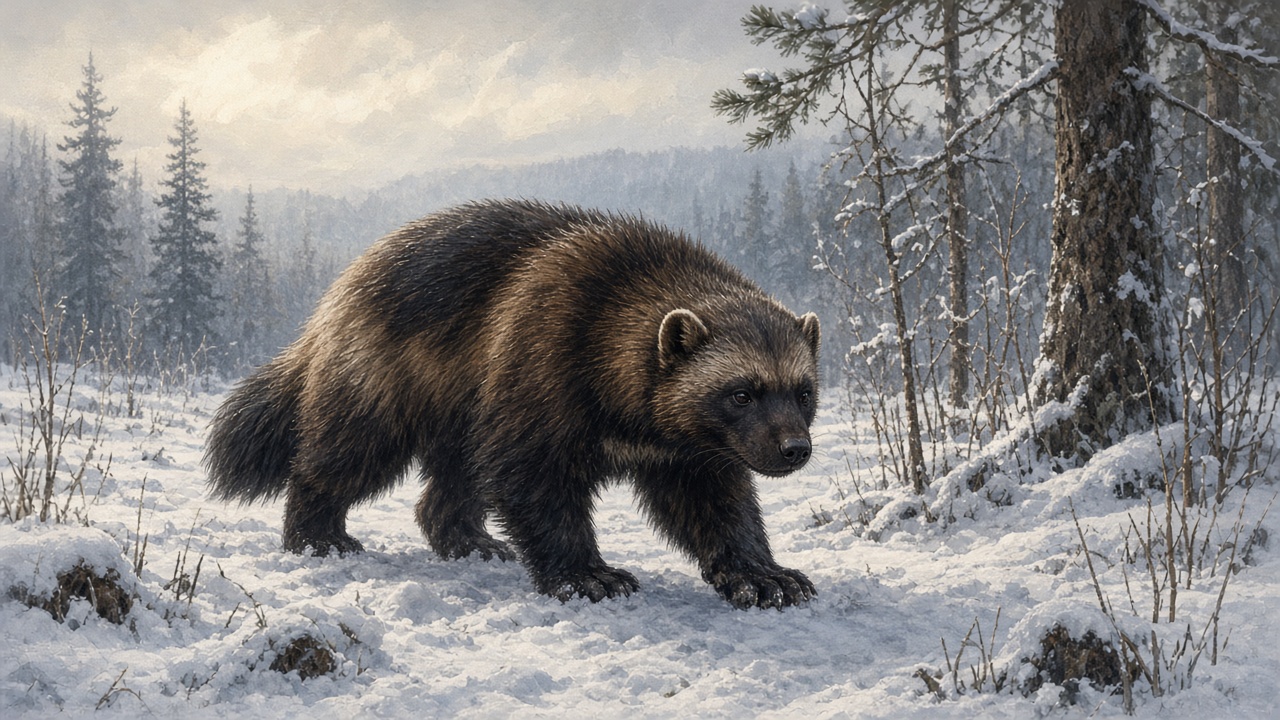
Wolverine
Gulo guloWolverine (Gulo gulo): biology, habitats and field signs across its documented range, hunting-context reading.
Seen in: Estonia · Finland · Norway · Sweden
Overview
Wolverine (Gulo gulo) is presented here in a hunting-context reading across its documented range: biology, habitats and field signs useful to observers — without publishing season, quota or authorisation.
Classification: order Carnivora, family Mustelidae, genus Gulo. Common names: Wolverine in English, Glouton in French, Glotón in Spanish.
Identification
The wolverine is one of the largest mustelids: 65 to 105 cm in body length, a 13 to 26 cm tail, 36 to 45 cm at the shoulder and 9 to 30 kg; females are about 10% smaller and 30% lighter than males. Stocky, it has a large head, small rounded ears, short powerful legs with five toes on each paw and semi-retractable claws. The brown to brownish-black coat has a yellow or golden stripe running from the crown along each side to meet at the base of the tail.
An opportunist and specialised scavenger, it eats anything from eggs to ungulates (reindeer, roe deer, moose), which it catches mainly when they flounder in deep snow, and takes over carcasses left by wolves and bears. It caches food and sprays it with scent. Solitary and territorial, it mates from May to August; thanks to delayed implantation, females, which breed only every other year, give birth between January and April to about 3 kits in a snow den.
Habitats and range
It lives in the boreal zone of North America and northern Eurasia: Norway, Sweden, Finland, Russia, Mongolia, northern China, Alaska, Canada and a few western US states (MDD). It uses alpine forest, tundra, open grassland and boreal shrub zones at or above the treeline, away from human development. It depends on snow cover that lasts into spring and on huge home ranges: 600 to 1,000 km² for a male.
The countries where the species’ presence is established are shown in the tags on this sheet.
Field signs
Rarely seen because of its low densities, it is active all year, even in severe cold, mostly at night. It travels with a loping gallop, sometimes 10 to 15 km without rest and up to 45 km a day. Food caches and territory boundaries are marked with strong-smelling urine and anal gland secretions. It is usually silent apart from occasional grunts and growls.
Conservation
For conservation status of Gulo gulo, consult the current IUCN assessment and cross with national monitoring programmes in countries of documented presence. Never turn a global IUCN category into a local hunting rule. GBIF occurrences help situate distribution but remain effort-biased.
The IUCN lists it as Least Concern, but European populations, now confined to Scandinavia and northern Russia, are at higher risk. It has vanished from much of its former southern range in Europe and North America through fur trapping, persecution over its attacks on domestic reindeer, and forest clearance.
Limits
This sheet on the Wolverine publishes no season, quota, hunting method or fee: those rules differ between countries and territories and must be checked in official texts. Being described here does not mean a species may be hunted.
Local densities and management plans are not covered here: they are a matter for the managers of each area.
Sources
Sources consulted for this sheet:
- IUCN Red List — species search (consulted 2026-11-02)
- ASM Mammal Diversity Database — Gulo gulo (consulted 2026-11-02)
- GBIF — species search (consulted 2026-11-02)
- Animal Diversity Web — Gulo gulo (wolverine) (consulted 2026-11-04)
Conclusion
In short: use the scientific name Gulo gulo to cross-check sources, confirm taxonomy and conservation status on the institutional portals listed above, and relate every field sign to the habitat where it was actually found.
Identification
Gulo gulo
Wolverine · preferred
Glouton · preferred
Glotón · preferred
Glutton
Skunk Bear
Classification
Class : Mammalia
Order : Carnivora
Family : Mustelidae
Genus : Gulo
Conservation
IUCN : LC
CITES : —
iucn · LC (global)
Habitat
Frequently asked questions
How do I recognise Wolverine?
Use Gulo gulo as the scientific anchor. The wolverine is one of the largest mustelids: 65 to 105 cm in body length, a 13 to 26 cm tail, 36 to 45 cm at the shoulder and 9 to 30 kg; females are about 10% smaller and 30% lighter than males. Stocky, it has a large head, small rounded ears, short powerful legs with five toe...
Where does Wolverine typically live?
It lives in the boreal zone of North America and northern Eurasia: Norway, Sweden, Finland, Russia, Mongolia, northern China, Alaska, Canada and a few western US states (MDD). It uses alpine forest, tundra, open grassland and boreal shrub zones at or above the treeline, away from human development. It depends on snow cover that lasts into spring and on huge...
What field signs help confirm Wolverine?
Rarely seen because of its low densities, it is active all year, even in severe cold, mostly at night. It travels with a loping gallop, sometimes 10 to 15 km without rest and up to 45 km a day. Food caches and territory boundaries are marked with strong-smelling urine and anal gland secretions. It is usually silent apart from occasional grunts and growls.