Waterbuck
Kobus ellipsiprymnusWaterbuck (Kobus ellipsiprymnus): coexistence sheet across its documented range — presence, biology and prudence, without an invented hunting status.
Seen in: Namibia · South Africa
Overview
Waterbuck (Kobus ellipsiprymnus) is a coexistence sheet across its documented range: presence, biology and prudence — not a hunting status claim.
Classification: order Artiodactyla, family Bovidae, genus Kobus. Common names: Waterbuck in English, Cobe à croissant in French, Antílope acuático in Spanish.
Identification
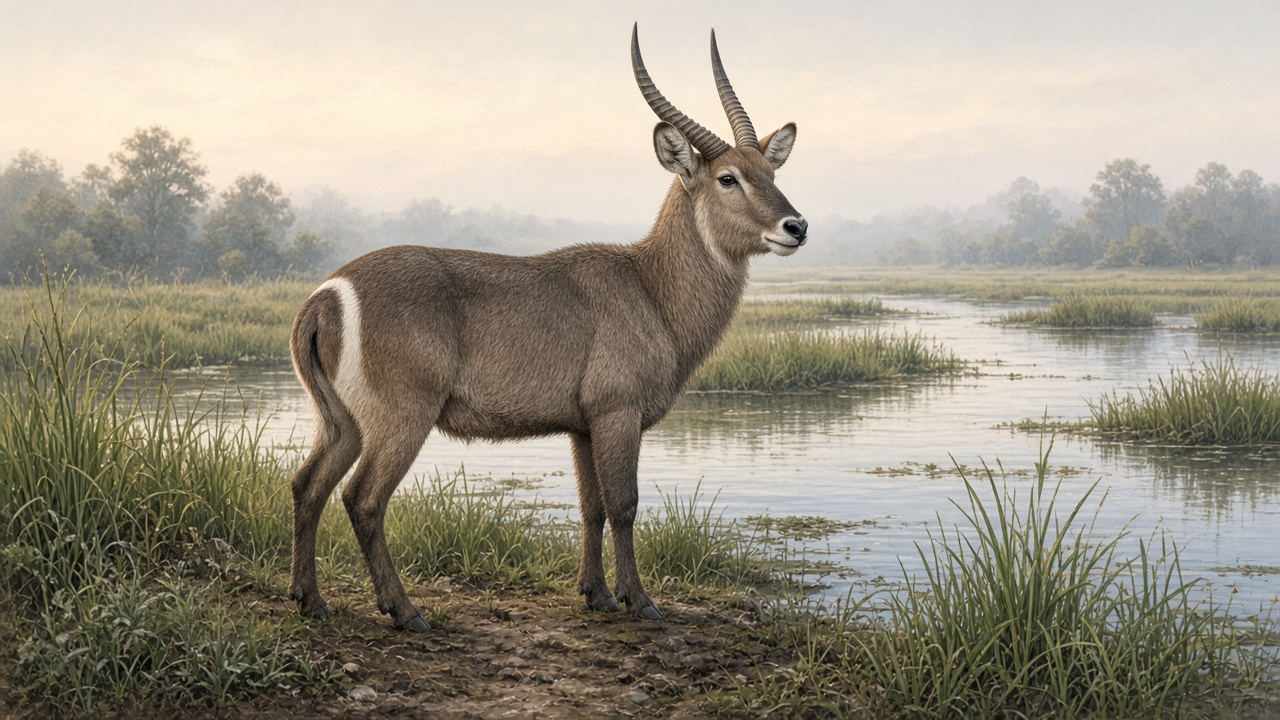
The waterbuck is a large antelope with a long body and neck on short legs: 177 to 235 cm long, 120 to 136 cm at the shoulder and 160 to 300 kg. The hair is coarse and forms a mane on the neck. The coat ranges from grey to reddish-brown and darkens with age; the lower legs are black with white rings just above the hooves. Only males carry horns, which curve forward and measure 55 to 99 cm depending on age. Two groups are recognised: ellipsiprymnus in south-eastern Africa and defassa in the north-east, centre and west.
Strongly dependent on water, it grazes medium and short grasses rich in protein and turns to other herbs when grass is scarce. Mostly diurnal, it rests more in dry conditions. Females live alone, in pairs or in loose groups of 5 to 10 with no rank order; from 8 to 9 months, young males form bachelor herds ranked by seniority and later become territorial. After a gestation of eight to eight and a half months, usually a single calf is born and stays hidden for two to four weeks. Lions, hyenas and leopards mainly take newborn calves.
Habitats and range
MDD places it in mesic non-forested habitats across much of sub-Saharan Africa, from Senegal and Guinea to Eritrea and Ethiopia, and south to Angola, the Caprivi Strip (Namibia), northern Botswana, Zimbabwe, Mozambique, Eswatini and eastern South Africa; it is extinct in Gambia. It uses grassland close to water, preferably along drainage lines and in valleys: it keeps to dry ground but stays near water, both for food and to escape predators.
The countries where the species’ presence is established are shown in the tags on this sheet.
Field signs
Active mainly by day, it is found in grassland along water, where it takes refuge from predators. Expect lone females or pairs, small female groups and bachelor herds of 5 to 10 young males. A solitary female may have a calf hidden in a nearby thicket. The white rings above the black hooves and the long, forward-curving horns of males identify it at a distance.
Conservation
For conservation status of Kobus ellipsiprymnus, consult the current IUCN assessment and cross with national monitoring programmes in countries of documented presence. Never turn a global IUCN category into a local hunting rule. GBIF occurrences help situate distribution but remain effort-biased.
The IUCN lists it as Least Concern. According to ADW, predator pressure strongly affects its numbers. MDD includes the defassa waterbuck in this species, which Groves and Grubb (2011) treated as a separate species; MDD chose not to follow that ungulate revision. The species is recorded as extinct in Gambia.
Limits
This sheet on the Waterbuck covers presence and biology. A species being present in a country does not mean it may be hunted, and no season or quota is published here.
Local densities and management plans are not covered here: they are a matter for the managers of each area.
Sources
Sources consulted for this sheet:
- IUCN Red List — species search (consulted 2026-11-02)
- ASM Mammal Diversity Database — Kobus ellipsiprymnus (consulted 2026-11-02)
- GBIF — species search (consulted 2026-11-02)
- Animal Diversity Web — Kobus ellipsiprymnus (waterbuck) (consulted 2026-11-04)
Conclusion
In short: use the scientific name Kobus ellipsiprymnus to cross-check sources, confirm taxonomy and conservation status on the institutional portals listed above, and relate every field sign to the habitat where it was actually found.
Identification
Kobus ellipsiprymnus
Cobe à croissant · preferred
Antílope acuático · preferred
Waterbuck · preferred
Common Waterbuck
Ellipsen Waterbuck
Defassa Waterbuck
Classification
Class : Mammalia
Order : Artiodactyla
Family : Bovidae
Genus : Kobus
Conservation
IUCN : LC
CITES : —
iucn · LC (global)
Habitat
Frequently asked questions
How do I recognise Waterbuck?
Use Kobus ellipsiprymnus as the scientific anchor. The waterbuck is a large antelope with a long body and neck on short legs: 177 to 235 cm long, 120 to 136 cm at the shoulder and 160 to 300 kg. The hair is coarse and forms a mane on the neck. The coat ranges from grey to reddish-brown and darkens with age; the lower legs are bla...
Where does Waterbuck typically live?
MDD places it in mesic non-forested habitats across much of sub-Saharan Africa, from Senegal and Guinea to Eritrea and Ethiopia, and south to Angola, the Caprivi Strip (Namibia), northern Botswana, Zimbabwe, Mozambique, Eswatini and eastern South Africa; it is extinct in Gambia. It uses grassland close to water, preferably along drainage lines and in valleys...
What field signs help confirm Waterbuck?
Active mainly by day, it is found in grassland along water, where it takes refuge from predators. Expect lone females or pairs, small female groups and bachelor herds of 5 to 10 young males. A solitary female may have a calf hidden in a nearby thicket. The white rings above the black hooves and the long, forward-curving horns of males identify it at a distan...