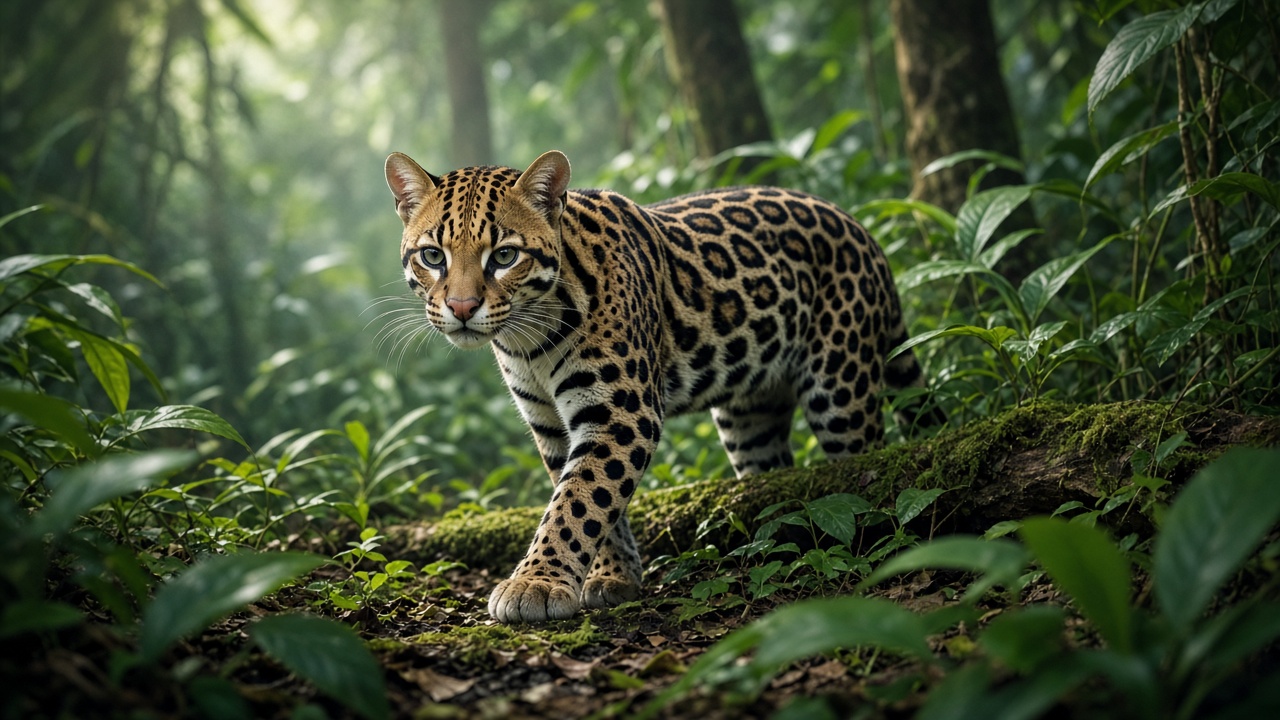
Ocelot (Leopardus pardalis): coexistence sheet across its documented range — presence, biology and prudence, without an invented hunting status.
Seen in: Brazil · Mexico
Overview
Ocelot (Leopardus pardalis) is a coexistence sheet across its documented range: presence, biology and prudence — not a hunting status claim.
Classification: order Carnivora, family Felidae, genus Leopardus. Common names: Ocelot in English, Ocelot in French, Ocelote in Spanish.
Identification
The largest member of the genus Leopardus, the ocelot weighs 8.5 to 16 kg and measures 65 to 97 cm, males being considerably larger than females. The back ranges from off-white to tawny-yellow or reddish-grey (greyer in arid scrub), the belly is white. Black-edged streaks, blotches and rosettes with lighter centres run in parallel horizontal chains; two black stripes cross the cheeks and the black ears bear a central yellow spot. The long tail is ringed. The paws, especially the front ones, are large, hence its Spanish name “manigordo”. Its coat is shorter and less thick than the margay’s.
A hunter that follows odour trails, it preys mostly on small rodents (65 to 66% of the diet), then reptiles, medium-sized mammals, birds, crustaceans and fish; it occasionally takes lesser anteaters, red brockets, monkeys or tortoises. Solitary and polygynous, it breeds year-round in the tropics. After 79 to 85 days, the female gives birth to 1 to 3 kittens in a den in thick brush; they are weaned at about 6 weeks and independent at around 1 year. Harpy eagles, pumas, jaguars and anacondas are occasional predators.
Habitats and range
Its range extends from the southern United States (Texas, Arizona) to northern Argentina, across Mexico, Central America and most of South America, including Uruguay and Trinidad and Tobago according to MDD. It uses tropical forest, savanna grassland, mangroves and marshes, and thorn scrub, generally below 1,200 m, with sightings up to 3,800 m. Its key requirement is dense vegetation cover.
The countries where the species’ presence is established are shown in the tags on this sheet.
Field signs
Nocturnal and crepuscular, it sleeps by day in hollow trees, thick vegetation or on branches, and enters open areas only on cloudy days or moonless nights. It travels 1.8 to 6.7 km a day. After a kill it eats on the spot and covers the remains. It marks territory with scent; females in oestrus give loud yowls.
Conservation
For conservation status of Leopardus pardalis, consult the current IUCN assessment and cross with national monitoring programmes in countries of documented presence. Never turn a global IUCN category into a local hunting rule. GBIF occurrences help situate distribution but remain effort-biased.
The IUCN lists it as Least Concern. Nearly wiped out by the mid-1980s by the spotted-fur trade, it has made a strong recovery. Current threats are habitat loss and fragmentation, illegal trade in pets and pelts, and retaliatory killing by poultry farmers. The subspecies albescens, now confined to southernmost Texas, is listed as endangered in the United States.
Limits
This sheet on the Ocelot covers presence and biology. A species being present in a country does not mean it may be hunted, and no season or quota is published here.
Local densities and management plans are not covered here: they are a matter for the managers of each area.
Sources
Sources consulted for this sheet:
- IUCN Red List — species search (consulted 2026-11-02)
- ASM Mammal Diversity Database — Leopardus pardalis (consulted 2026-11-02)
- GBIF — species search (consulted 2026-11-02)
- Animal Diversity Web — Leopardus pardalis (ocelot) (consulted 2026-11-04)
Conclusion
In short: use the scientific name Leopardus pardalis to cross-check sources, confirm taxonomy and conservation status on the institutional portals listed above, and relate every field sign to the habitat where it was actually found.
Identification
Leopardus pardalis
Ocelot · preferred
Ocelote · preferred
Ocelot · preferred
Classification
Class : Mammalia
Order : Carnivora
Family : Felidae
Genus : Leopardus
Conservation
IUCN : LC
CITES : —
iucn · LC (global)
Frequently asked questions
How do I recognise Ocelot?
Use Leopardus pardalis as the scientific anchor. The largest member of the genus Leopardus, the ocelot weighs 8.5 to 16 kg and measures 65 to 97 cm, males being considerably larger than females. The back ranges from off-white to tawny-yellow or reddish-grey (greyer in arid scrub), the belly is white. Black-edged streaks, blotch...
Where does Ocelot typically live?
Its range extends from the southern United States (Texas, Arizona) to northern Argentina, across Mexico, Central America and most of South America, including Uruguay and Trinidad and Tobago according to MDD. It uses tropical forest, savanna grassland, mangroves and marshes, and thorn scrub, generally below 1,200 m, with sightings up to 3,800 m. Its key requi...
What field signs help confirm Ocelot?
Nocturnal and crepuscular, it sleeps by day in hollow trees, thick vegetation or on branches, and enters open areas only on cloudy days or moonless nights. It travels 1.8 to 6.7 km a day. After a kill it eats on the spot and covers the remains. It marks territory with scent; females in oestrus give loud yowls.