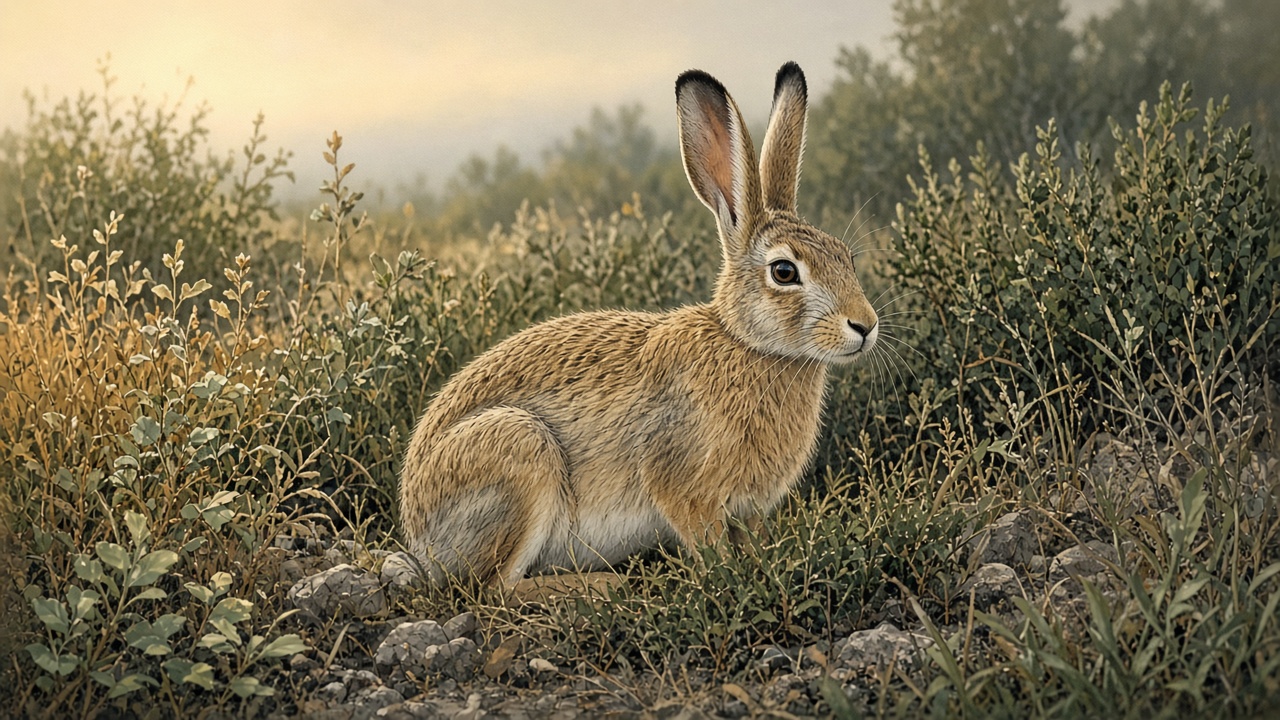
Corsican Hare (Lepus corsicanus): biology, habitats and field signs across its documented range, hunting-context reading.
Seen in: Italy
Overview
Corsican Hare (Lepus corsicanus) is presented here in a hunting-context reading across its documented range: biology, habitats and field signs useful to observers — without publishing season, quota or authorisation.
Classification: order Lagomorpha, family Leporidae, genus Lepus. Common names: Corsican Hare in English, Lièvre corse in French, Liebre de Córcega in Spanish.
Identification
A medium-sized, slender hare with a small, elongated head: 55 to 61 cm head and body and about 2.22 kg, some 800 g lighter than the European hare. The fur is reddish-grey on the neck, shoulders and hips and grey-black on the back, with a dark nape. The ears, about 11 cm long, are black-tipped and the eyes large and brown. It differs from the European hare in its redder coat, proportionally longer hind legs and ears, a tawny patch below the eye and a sharp boundary between the coloured back and the white belly. There is no obvious sexual dimorphism.
Solitary, sedentary and nocturnal, it forages at night and stays under cover by day. Strictly herbivorous, it eats mainly grasses, plus mints in spring and summer; sedges, rushes, peas and asters complete its diet. Like all lagomorphs, it reingests part of its droppings. It breeds from January to September, with a break of about 67 days between October and December: usually 3 to 4 litters a year, after 41 to 42 days of gestation, of 1 to 5 leverets. Males compete for females by striking each other with their forelegs.
Habitats and range
MDD lists it for Italy; ADW describes it in the south of the peninsula, from Umbria and southern Tuscany to Calabria, and as widespread in Sicily and Corsica, where it is thought to have been introduced in the 16th century. It prefers a mix of clearings, scrub and broadleaved woods, but also uses dunes, farmland, Mediterranean scrub and urban edges, from sea level to 1,900 m in the Apennines and up to 2,400 m on Mount Etna.
The countries where the species’ presence is established are shown in the tags on this sheet.
Field signs
Being nocturnal, it is mostly seen at night in clearings and along broadleaved woodland edges; by day it stays hidden. Its droppings, of two kinds as in all lagomorphs, build up across its home range. At close range, the reddish coat, tawny patch below the eye, long black-tipped ears and sharply defined white belly point to this species rather than the European hare.
Conservation
For conservation status of Lepus corsicanus, consult the current IUCN assessment and cross with national monitoring programmes in countries of documented presence. Never turn a global IUCN category into a local hunting rule. GBIF occurrences help situate distribution but remain effort-biased.
The IUCN lists it as Vulnerable because of its fragmented range. ADW cites habitat fragmentation and degradation, low densities, introduced European hares and illegal killing through confusion with that species, although it is protected in Italy. Long treated as a subspecies of the European hare and believed extinct in the mid-20th century, it is now recognised as a species; hybridisation with European and Iberian hares probably occurs in Corsica.
Limits
This sheet on the Corsican Hare publishes no season, quota, hunting method or fee: those rules differ between countries and territories and must be checked in official texts. Being described here does not mean a species may be hunted.
Local densities and management plans are not covered here: they are a matter for the managers of each area.
Sources
Sources consulted for this sheet:
- IUCN Red List — species search (consulted 2026-11-02)
- ASM Mammal Diversity Database — Lepus corsicanus (consulted 2026-11-02)
- GBIF — species search (consulted 2026-11-02)
- Animal Diversity Web — Lepus corsicanus (Corsican hare) (consulted 2026-11-04)
Conclusion
In short: use the scientific name Lepus corsicanus to cross-check sources, confirm taxonomy and conservation status on the institutional portals listed above, and relate every field sign to the habitat where it was actually found.
Identification
Lepus corsicanus
Corsican Hare · preferred
Lièvre corse · preferred
Liebre de Córcega · preferred
Apennine Hare
Italian Hare
Classification
Class : Mammalia
Order : Lagomorpha
Family : Leporidae
Genus : Lepus
Conservation
IUCN : VU
CITES : —
iucn · VU (global)
Habitat
Frequently asked questions
How do I recognise Corsican Hare?
Use Lepus corsicanus as the scientific anchor. A medium-sized, slender hare with a small, elongated head: 55 to 61 cm head and body and about 2.22 kg, some 800 g lighter than the European hare. The fur is reddish-grey on the neck, shoulders and hips and grey-black on the back, with a dark nape. The ears, about 11 cm long, are...
Where does Corsican Hare typically live?
MDD lists it for Italy; ADW describes it in the south of the peninsula, from Umbria and southern Tuscany to Calabria, and as widespread in Sicily and Corsica, where it is thought to have been introduced in the 16th century. It prefers a mix of clearings, scrub and broadleaved woods, but also uses dunes, farmland, Mediterranean scrub and urban edges, from sea...
What field signs help confirm Corsican Hare?
Being nocturnal, it is mostly seen at night in clearings and along broadleaved woodland edges; by day it stays hidden. Its droppings, of two kinds as in all lagomorphs, build up across its home range. At close range, the reddish coat, tawny patch below the eye, long black-tipped ears and sharply defined white belly point to this species rather than the Europ...