African Savanna Elephant
Loxodonta africanaAfrican Savanna Elephant (Loxodonta africana): coexistence sheet across its documented range — presence, biology and prudence, without an invented hunting status.
Seen in: Namibia · South Africa
Overview
African Savanna Elephant (Loxodonta africana) is a coexistence sheet across its documented range: presence, biology and prudence — not a hunting status claim.
Classification: order Proboscidea, family Elephantidae, genus Loxodonta. Common names: African Savanna Elephant in English, Éléphant de savane d'Afrique in French, Elefante africano de sabana in Spanish.
Identification
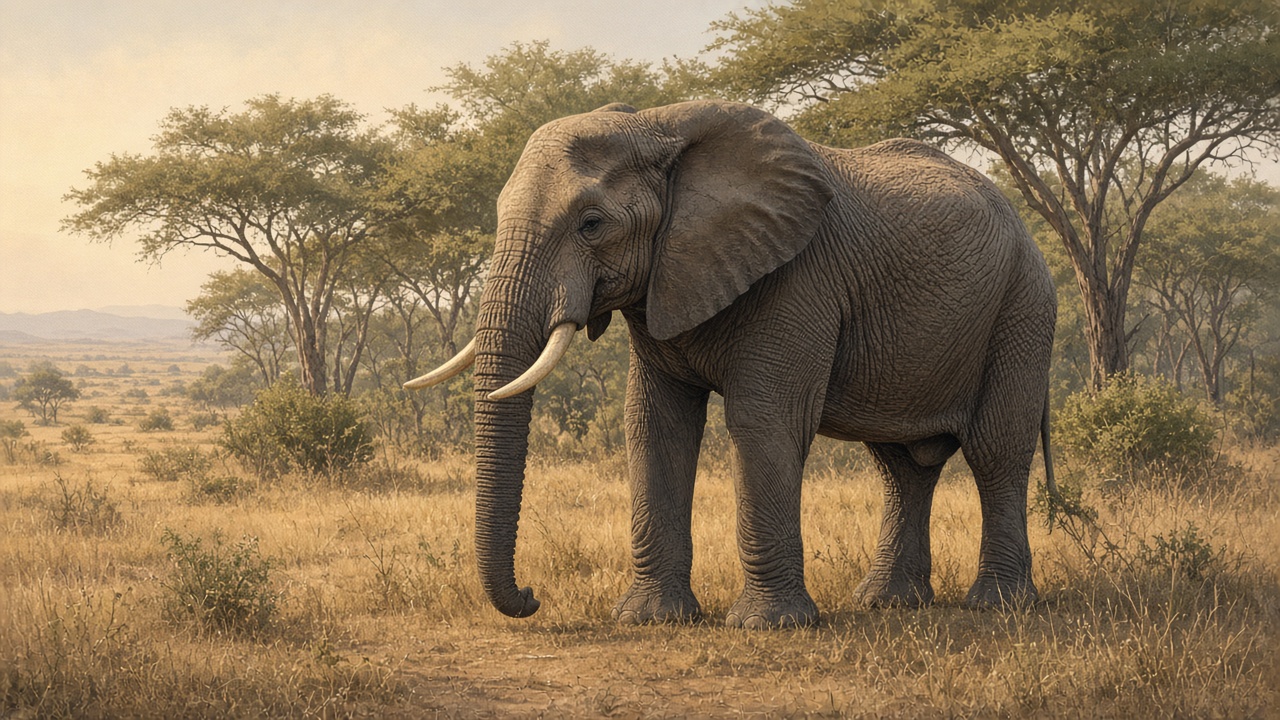
The largest living land animal, the African savanna elephant shows clear sexual dimorphism: females weigh 2,000 to 3,500 kg and stand 2.2 to 2.6 m at the shoulder, males 4,500 to 6,100 kg and 3.2 to 4 m, with a broader, bulkier build. Both sexes carry curved ivory tusks up to 350 cm long. The large triangular ears help it keep cool. The grey, creased skin is up to 30 mm thick; flattened dark hairs up to 0.8 m grow along the back and tail. Calves have softer, reddish or brown hair.
Both a browser and a grazer, it eats foliage, fruit, herbs, grasses, roots, twigs and bark, sometimes pushing a tree over to reach them, and drinks about 190 litres a day. Females live in matriarchal herds of 6 to 70; adult males are solitary or in small groups. It breeds year-round: a single calf (rarely twins) of 90 to 120 kg is born after about 22 months of gestation, every 3 to 9 years, and becomes independent at about 8 years. Lions, African wild dogs, hyenas and Nile crocodiles mainly take young animals.
Habitats and range
MDD places it in sub-Saharan Africa, except the central and west coast, in about 30 countries from Senegal to Somalia. ADW describes a patchy range across central and southern Africa, with remnant populations as far as Guinea-Bissau and Ethiopia and south into northern South Africa; it has been extirpated from Burundi, Gambia and Mauritania and reintroduced to Eswatini. It uses savanna, forest, woodland, scrub and occasionally desert and beaches, from sea level to 4,000 m, now mostly within protected areas.
The countries where the species’ presence is established are shown in the tags on this sheet.
Field signs
Pushed-over trees and stripped bark mark its passage, as do the mud and water baths it sprays over itself with its trunk. Males mark trees and bushes with their tusks or with a secretion. Its very low rumbles, around 20 Hz, carry more than 2 km; it also trumpets and grunts. Cattle egrets often accompany it. It walks at about 6 km/h and covers some 10 km a day on average.
Conservation
For conservation status of Loxodonta africana, consult the current IUCN assessment and cross with national monitoring programmes in countries of documented presence. Never turn a global IUCN category into a local hunting rule. GBIF occurrences help situate distribution but remain effort-biased.
MDD gives its IUCN status as Endangered. ADW describes poaching for ivory, hide and meat: despite the international ban on the ivory trade since 1989, illegal trade doubled between 2007 and 2014. Habitat loss adds to this, with about 70% of the range unprotected. MDD notes that the species formerly included the forest elephant (L. cyclotis), which some authorities still lump with it.
Limits
This sheet on the African Savanna Elephant covers presence and biology. A species being present in a country does not mean it may be hunted, and no season or quota is published here.
Local densities and management plans are not covered here: they are a matter for the managers of each area.
Sources
Sources consulted for this sheet:
- IUCN Red List — species search (consulted 2026-11-02)
- ASM Mammal Diversity Database — Loxodonta africana (consulted 2026-11-02)
- GBIF — species search (consulted 2026-11-02)
- Animal Diversity Web — Loxodonta africana (African bush elephant) (consulted 2026-11-04)
Conclusion
In short: use the scientific name Loxodonta africana to cross-check sources, confirm taxonomy and conservation status on the institutional portals listed above, and relate every field sign to the habitat where it was actually found.
Identification
Loxodonta africana
Éléphant de savane d'Afrique · preferred
Elefante africano de sabana · preferred
African Savanna Elephant · preferred
African Bush Elephant
Classification
Class : Mammalia
Order : Proboscidea
Family : Elephantidae
Genus : Loxodonta
Conservation
IUCN : EN
CITES : —
iucn · EN (global)
Habitat
Frequently asked questions
How do I recognise African Savanna Elephant?
Use Loxodonta africana as the scientific anchor. The largest living land animal, the African savanna elephant shows clear sexual dimorphism: females weigh 2,000 to 3,500 kg and stand 2.2 to 2.6 m at the shoulder, males 4,500 to 6,100 kg and 3.2 to 4 m, with a broader, bulkier build. Both sexes carry curved ivory tusks up to 350...
Where does African Savanna Elephant typically live?
MDD places it in sub-Saharan Africa, except the central and west coast, in about 30 countries from Senegal to Somalia. ADW describes a patchy range across central and southern Africa, with remnant populations as far as Guinea-Bissau and Ethiopia and south into northern South Africa; it has been extirpated from Burundi, Gambia and Mauritania and reintroduced...
What field signs help confirm African Savanna Elephant?
Pushed-over trees and stripped bark mark its passage, as do the mud and water baths it sprays over itself with its trunk. Males mark trees and bushes with their tusks or with a secretion. Its very low rumbles, around 20 Hz, carry more than 2 km; it also trumpets and grunts. Cattle egrets often accompany it. It walks at about 6 km/h and covers some 10 km a da...