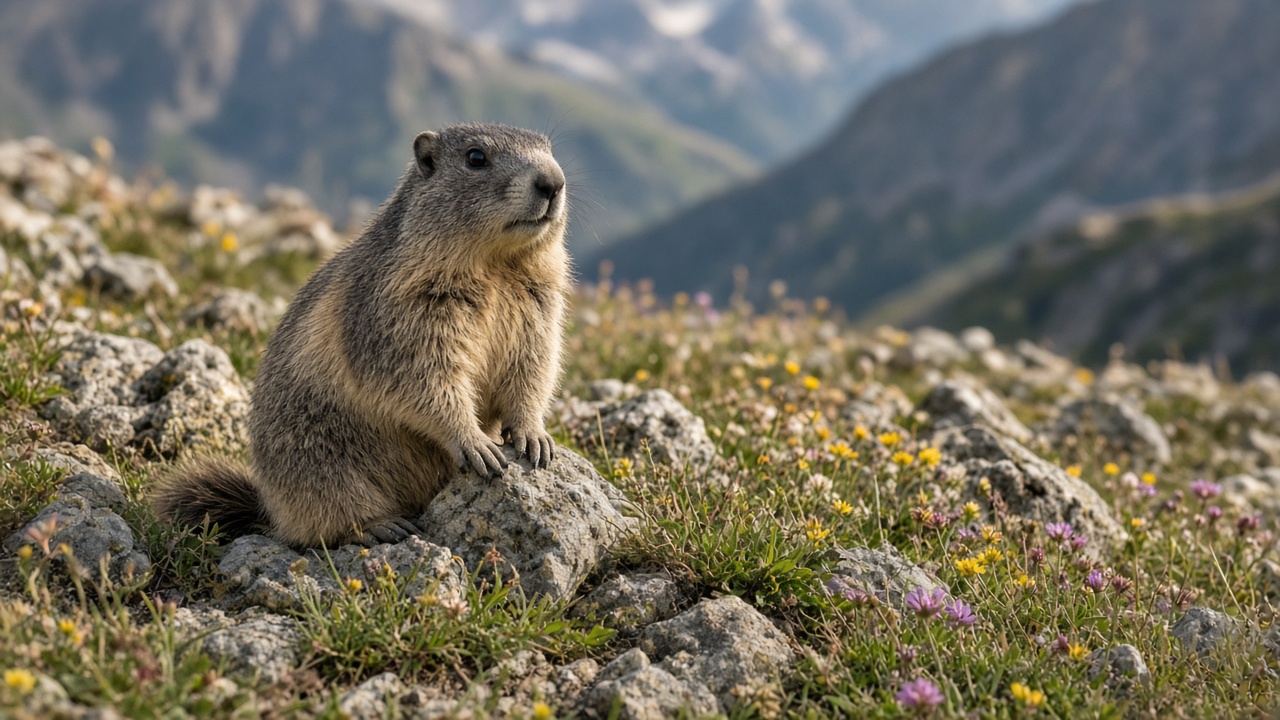
Alpine Marmot
Marmota marmotaAlpine Marmot (Marmota marmota): ecology sheet across its documented range — natural history and habitats, without hunting framing.
Seen in: Austria · France · Germany · Italy · Poland
Overview
Alpine Marmot (Marmota marmota) is an ecology sheet across its documented range: natural history and habitats, without any hunting framing.
Classification: order Rodentia, family Sciuridae, genus Marmota. Common names: Alpine Marmot in English, Marmotte des Alpes in French, Marmota alpina in Spanish.
Identification
The Alpine marmot measures 40 to 50 cm, with a short tail of 10 to 15 cm; stocky, it has small ears and powerful forelegs built for digging – the thumb bears a nail, the other digits claws. Its fur mixes blond, reddish and dark grey; juveniles are smaller, greyer and darker. Weight changes greatly with the seasons: according to ADW, about 4.5 kg on average before hibernation and 3 kg in spring. Males and females are the same size and colour, so they cannot be told apart at a distance.
A herbivore, it eats mostly leaves and flowers; in the Swiss National Park it concentrates on certain plants such as Alpine clover, rich in the unsaturated fats it needs for its winter reserves. It lives in families – an adult pair and several young – that drive off outsiders. Only the dominant female breeds, and not every year. Mating follows emergence from hibernation within days; after 33 to 34 days, 1 to 7 young of about 30 g are born and stay underground for some 40 days. From late September or October it hibernates: body temperature falls to 3–6 °C but rises to about 38 °C roughly every two weeks.
Habitats and range
MDD lists it in the Swiss, Italian and French Alps, western Austria, southern Germany, the Romanian Carpathians and the Tatras; it has been introduced to the French Pyrenees, eastern Austria and northern Serbia. It lives in alpine meadows and subalpine grassland, often in a 200 m belt above the treeline, between 800 and 3,000 m according to the ETH report. It seeks loose soil for digging; a territory covers about 2.5 ha, up to 6 ha when food is short.
The countries where the species’ presence is established are shown in the tags on this sheet.
Field signs
At any sign of danger a sentinel gives a high-pitched whistle and the whole colony vanishes into a burrow or a 1 to 2 m escape tunnel. Burrows can be 20 m long and 3 m deep, with separate summer and winter quarters. It spends almost 90% of its life underground and comes out on warm, sunny days in the morning and late afternoon, never at night and rarely in rain or fog. It rubs its cheek glands on rocks to mark its territory.
Conservation
For conservation status of Marmota marmota, consult the current IUCN assessment, then cross with French monitoring programmes when they exist (OFB portal and related publications). Never turn a global IUCN category into a departmental hunting rule. GBIF occurrences help situate documented distribution but remain effort-biased.
MDD gives its IUCN status as Least Concern and records introductions outside its native range. Very sensitive to heat, which it regulates poorly, it suffers from heat stress, which limits it at lower elevations. Human lowering of the treeline has created open pastures that suit it. The golden eagle is its main predator; young are also taken by eagle owls, goshawks and foxes. Its fat has long been used as a traditional remedy for rheumatism.
Limits
This sheet on the Alpine Marmot covers biology and ecology only; it publishes no hunting season, quota or authorisation.
Local densities and management plans are not covered here: they are a matter for the managers of each area.
Sources
Sources consulted for this sheet:
- IUCN Red List — species search (consulted 2026-11-01)
- ASM Mammal Diversity Database — Marmota marmota (consulted 2026-11-01)
- GBIF — species search (consulted 2026-11-01)
- Animal Diversity Web — Marmota marmota (alpine marmot) (consulted 2026-11-05)
- Swiss National Park — Marmot (Marmota marmota) (consulted 2026-11-05)
- Schäfer (2009), ETH Zurich report — Population size and life-history traits of the Alpine marmot in the Swiss National Park (consulted 2026-11-05)
Conclusion
In short: use the scientific name Marmota marmota to cross-check sources, confirm taxonomy and conservation status on the institutional portals listed above, and relate every field sign to the habitat where it was actually found.
Identification
Marmota marmota
Marmotte des Alpes · preferred
Marmota alpina · preferred
Alpine Marmot · preferred
Common Marmot
Classification
Class : Mammalia
Order : Rodentia
Family : Sciuridae
Genus : Marmota
Conservation
IUCN : LC
CITES : —
iucn · LC (global)
Habitat
Frequently asked questions
How do I recognise Alpine Marmot?
Use Marmota marmota as the scientific anchor. The Alpine marmot measures 40 to 50 cm, with a short tail of 10 to 15 cm; stocky, it has small ears and powerful forelegs built for digging – the thumb bears a nail, the other digits claws. Its fur mixes blond, reddish and dark grey; juveniles are smaller, greyer and darker. Weig...
Where does Alpine Marmot typically live?
MDD lists it in the Swiss, Italian and French Alps, western Austria, southern Germany, the Romanian Carpathians and the Tatras; it has been introduced to the French Pyrenees, eastern Austria and northern Serbia. It lives in alpine meadows and subalpine grassland, often in a 200 m belt above the treeline, between 800 and 3,000 m according to the ETH report. I...
What field signs help confirm Alpine Marmot?
At any sign of danger a sentinel gives a high-pitched whistle and the whole colony vanishes into a burrow or a 1 to 2 m escape tunnel. Burrows can be 20 m long and 3 m deep, with separate summer and winter quarters. It spends almost 90% of its life underground and comes out on warm, sunny days in the morning and late afternoon, never at night and rarely in r...