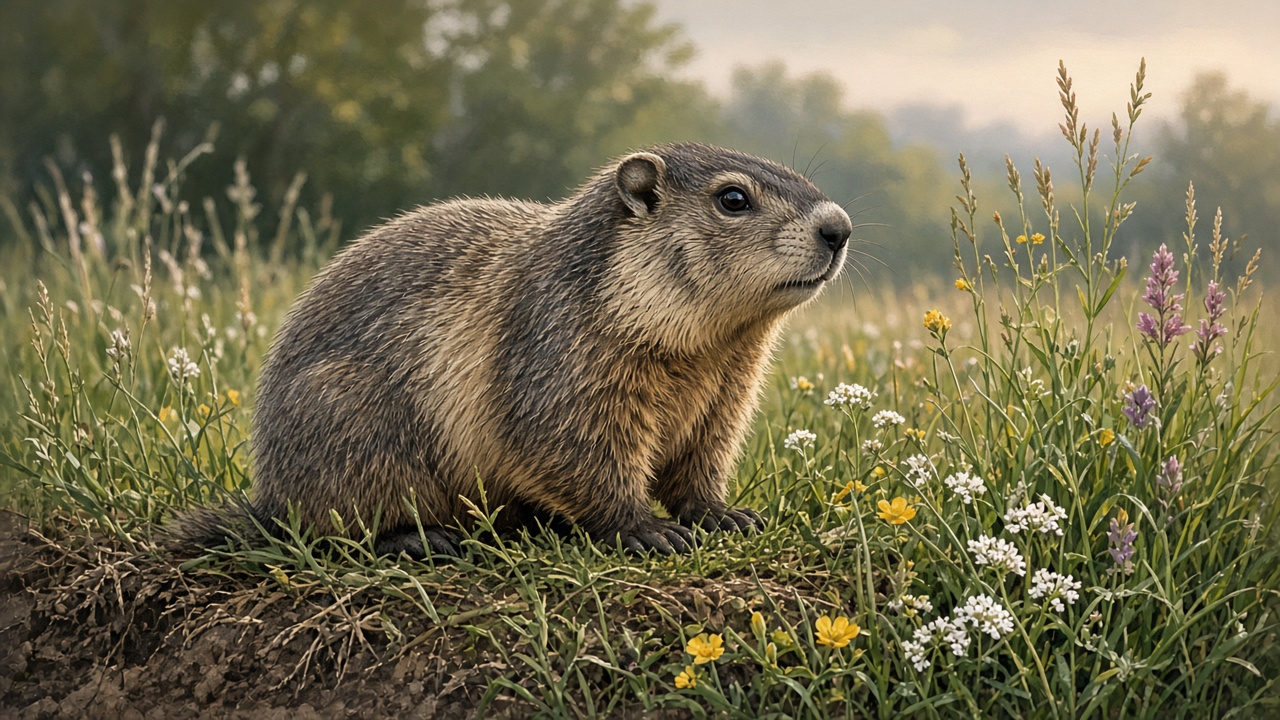
Woodchuck (Marmota monax): ecology sheet across its documented range — natural history and habitats, without hunting framing.
Seen in: United States
Overview
Woodchuck (Marmota monax) is an ecology sheet across its documented range: natural history and habitats, without any hunting framing.
Classification: order Rodentia, family Sciuridae, genus Marmota. Common names: Woodchuck in English, Marmotte commune in French, Marmota canadiense in Spanish.
Identification
A stocky rodent, 415 to 675 mm in total length and 2 to 6 kg, the woodchuck often stands up on its hind legs, which makes it look tall. The coat ranges from grey to cinnamon and dark brown; white-tipped guard hairs give it a grizzled look. The short, bushy tail is black to dark brown and measures 100 to 160 mm, 20 to 25% of total length. The paws are black to dark brown. The rounded ears can close over the ear canal while it digs, and the incisors are white, unusual for a rodent. Males are larger than females.
Diurnal and solitary, it eats mostly in the morning and afternoon, in bouts of under two hours: alfalfa, clover and dandelion, plus bark, leaves, insects and bird eggs. It lays down fat and then hibernates, though in the south of its range some stay active all year. Males emerge first to set up territories. Mating takes place from February to May depending on latitude; after 31 to 32 days, 1 to 9 young are born, most often 3 to 5, weaned at about 44 days and independent at about two months. Wolves, coyotes, foxes, lynx, black bears, hawks and snakes are among its predators.
Habitats and range
It is the most widespread marmot in North America: from Alaska across southern Canada to Labrador, and through the north-eastern and south-central United States to eastern Oklahoma, northern Louisiana, Alabama, Georgia and North Carolina; in the west it follows the Rocky Mountains, possibly to northern Idaho (MDD, ADW). It lives in low-elevation forests, small woodlots, fields, pastures and hedgerows, and has benefited from forest clearing, roads and farming. In well-drained soil it digs a summer den near food and a winter den near protective cover.
The countries where the species’ presence is established are shown in the tags on this sheet.
Field signs
Burrows have several entrances, including an escape hole, and many tunnels and chambers. In summer it can be seen sunning itself at midday or sitting up to watch its surroundings. When threatened it gives a shrill whistle that also warns others, especially young, and it may climb trees to escape. It whistles, hisses, growls, shrieks, chatters its teeth and barks; secretions from facial and anal glands mark its territory.
Conservation
For conservation status of Marmota monax, consult the current IUCN assessment and cross with national monitoring programmes in countries of documented presence. Never turn a global IUCN category into a local hunting rule. GBIF occurrences help situate distribution but remain effort-biased.
The IUCN lists it as Least Concern because it is abundant and widespread. Its abandoned burrows shelter many other species, from rabbits and skunks to foxes, weasels and snakes. It is used as a model in biomedical research (hepatitis B, obesity, metabolism). It sometimes damages gardens and crops, and its burrows can injure livestock and damage farm machinery and building foundations. The name woodchuck is thought to come from a Native American word, “wuchak”, roughly “the digger”.
Limits
This sheet on the Woodchuck covers biology and ecology only; it publishes no hunting season, quota or authorisation.
Local densities and management plans are not covered here: they are a matter for the managers of each area.
Sources
Sources consulted for this sheet:
- IUCN Red List — species search (consulted 2026-11-02)
- ASM Mammal Diversity Database — Marmota monax (consulted 2026-11-02)
- GBIF — species search (consulted 2026-11-02)
- Animal Diversity Web — Marmota monax (woodchuck) (consulted 2026-11-04)
Conclusion
In short: use the scientific name Marmota monax to cross-check sources, confirm taxonomy and conservation status on the institutional portals listed above, and relate every field sign to the habitat where it was actually found.
Identification
Marmota monax
Marmotte commune · preferred
Marmota canadiense · preferred
Woodchuck · preferred
Groundhog
Classification
Class : Mammalia
Order : Rodentia
Family : Sciuridae
Genus : Marmota
Conservation
IUCN : LC
CITES : —
iucn · LC (global)
Frequently asked questions
How do I recognise Woodchuck?
Use Marmota monax as the scientific anchor. A stocky rodent, 415 to 675 mm in total length and 2 to 6 kg, the woodchuck often stands up on its hind legs, which makes it look tall. The coat ranges from grey to cinnamon and dark brown; white-tipped guard hairs give it a grizzled look. The short, bushy tail is black to dark b...
Where does Woodchuck typically live?
It is the most widespread marmot in North America: from Alaska across southern Canada to Labrador, and through the north-eastern and south-central United States to eastern Oklahoma, northern Louisiana, Alabama, Georgia and North Carolina; in the west it follows the Rocky Mountains, possibly to northern Idaho (MDD, ADW). It lives in low-elevation forests, sma...
What field signs help confirm Woodchuck?
Burrows have several entrances, including an escape hole, and many tunnels and chambers. In summer it can be seen sunning itself at midday or sitting up to watch its surroundings. When threatened it gives a shrill whistle that also warns others, especially young, and it may climb trees to escape. It whistles, hisses, growls, shrieks, chatters its teeth and b...