European Badger
Meles melesEuropean Badger (Meles meles): biology, habitats and field signs across its documented range, hunting-context reading.
Seen in: Austria · Belgium · Bulgaria · Croatia · Czechia
Overview
European Badger (Meles meles) is presented here in a hunting-context reading across its documented range: biology, habitats and field signs useful to observers — without publishing season, quota or authorisation.
Classification: order Carnivora, family Mustelidae, genus Meles. Common names: European Badger in English, Blaireau européen in French, Tejón europeo in Spanish.
Identification
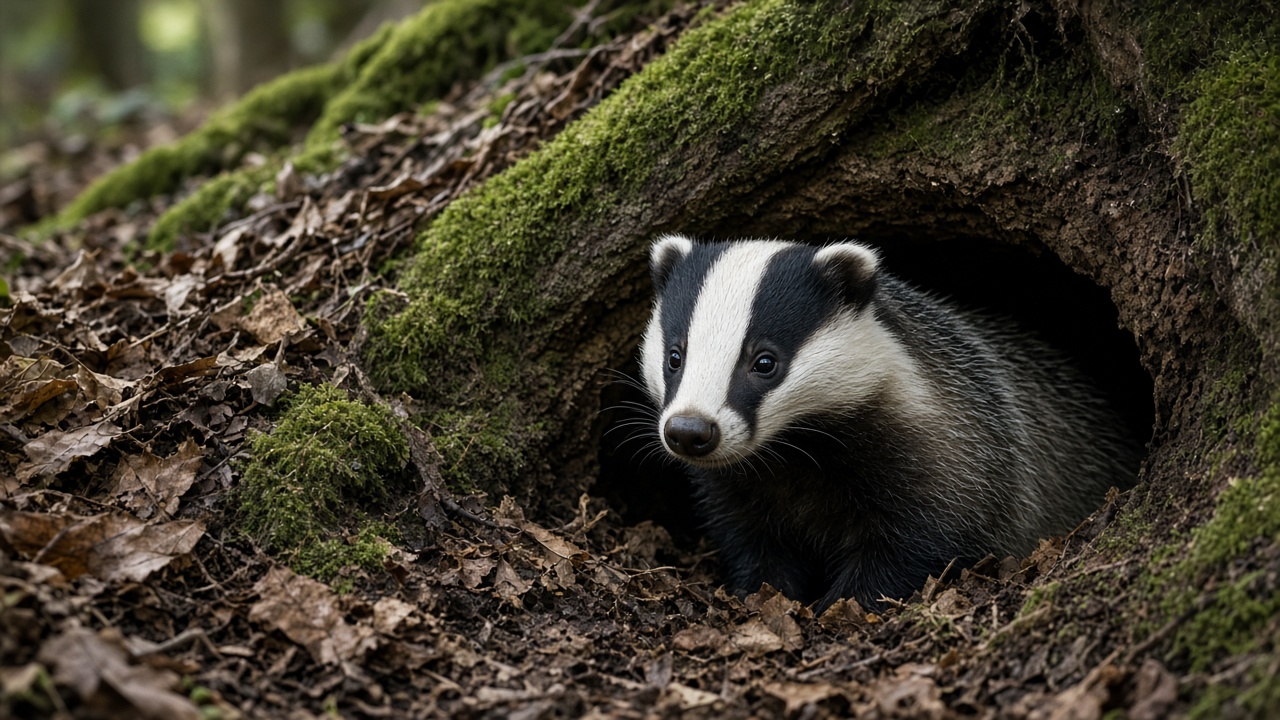
The European badger has a stocky body, short, sturdy legs and a short tail of 11.5 to 20.2 cm. Males and females share the same head-and-body length, 56 to 90 cm, but males are heavier: 9.1 to 16.7 kg against 6.6 to 13.9 kg for females. Two dark stripes run from the nose through the eyes to the ears, separated by a white central stripe. The back is grizzled grey, each hair white at the base and dark at the tip; the underside is dark grey or black. The massive skull has a prominent sagittal crest.
Earthworms are one of its main foods: it hunts them alone, over an area of roughly one hectare. It also takes rabbits, voles, shrews, moles, hedgehogs, large insects and wasp nests, carrion, more than thirty kinds of fruit, cereals, tubers and occasionally fungi. Nocturnal, it is most active at dusk and dawn. Groups hold 2 to 23 animals, and usually only the dominant pair breeds. Mating peaks from February to May and from August to October; implantation is delayed and litters contain 1 to 6 cubs, 3 on average.
Habitats and range
MDD lists it across Europe, from Ireland, Great Britain and Iberia to Scandinavia, the Balkans, Ukraine, Russia and Turkey, France included. It prefers broadleaf, conifer or mixed woodland next to open fields, but also uses hedgerows, scrub, riverbanks, farmland, grassland, steppe and semi-desert. For its burrows it seeks well-drained, easily dug soil sheltered by trees, shrubs or rocks and little disturbed by people. The average elevation used is about 1,000 m.
The countries where the species’ presence is established are shown in the tags on this sheet.
Field signs
The clearest sign is the communal burrow, or sett: a large tunnel system, often lined with dry grass, with a main sett at the centre of the territory and smaller outlying setts. Territory boundaries are marked by shared latrines. Badgers may be heard growling, and cubs give a chattering call when playing. It emerges mostly at dusk and dawn.
Conservation
For conservation status of Meles meles, consult the current IUCN assessment, then cross with French monitoring programmes when they exist (OFB portal and related publications). Never turn a global IUCN category into a departmental hunting rule. GBIF occurrences help situate documented distribution but remain effort-biased.
The IUCN lists it as Least Concern: it is widespread and abundant, and ADW reports that densities rose in Europe over the last decade. Warmer springs may, however, rouse badgers from winter torpor too early, when little food is available. It can pass tuberculosis to cattle. MDD notes that the species formerly included Meles canescens, the Southwest Asian badger, now treated as separate.
Limits
This sheet on the European Badger publishes no season, quota, hunting method or fee: those rules differ between countries and territories and must be checked in official texts. Being described here does not mean a species may be hunted.
Local densities and management plans are not covered here: they are a matter for the managers of each area.
Sources
Sources consulted for this sheet:
- IUCN Red List — species search (consulted 2026-11-01)
- ASM Mammal Diversity Database — Meles meles (consulted 2026-11-01)
- GBIF — species search (consulted 2026-11-01)
- Animal Diversity Web — Meles meles (Eurasian badger) (consulted 2026-11-04)
Conclusion
In short: use the scientific name Meles meles to cross-check sources, confirm taxonomy and conservation status on the institutional portals listed above, and relate every field sign to the habitat where it was actually found.
Identification
Meles meles
Blaireau européen · preferred
Tejón europeo · preferred
European Badger · preferred
Eurasian Badger
Classification
Class : Mammalia
Order : Carnivora
Family : Mustelidae
Genus : Meles
Conservation
IUCN : LC
CITES : —
iucn · LC (global)
Habitat
Practices
Frequently asked questions
How do I recognise European Badger?
Use Meles meles as the scientific anchor. The European badger has a stocky body, short, sturdy legs and a short tail of 11.5 to 20.2 cm. Males and females share the same head-and-body length, 56 to 90 cm, but males are heavier: 9.1 to 16.7 kg against 6.6 to 13.9 kg for females. Two dark stripes run from the nose through...
Where does European Badger typically live?
MDD lists it across Europe, from Ireland, Great Britain and Iberia to Scandinavia, the Balkans, Ukraine, Russia and Turkey, France included. It prefers broadleaf, conifer or mixed woodland next to open fields, but also uses hedgerows, scrub, riverbanks, farmland, grassland, steppe and semi-desert. For its burrows it seeks well-drained, easily dug soil shelte...
What field signs help confirm European Badger?
The clearest sign is the communal burrow, or sett: a large tunnel system, often lined with dry grass, with a main sett at the centre of the territory and smaller outlying setts. Territory boundaries are marked by shared latrines. Badgers may be heard growling, and cubs give a chattering call when playing. It emerges mostly at dusk and dawn.