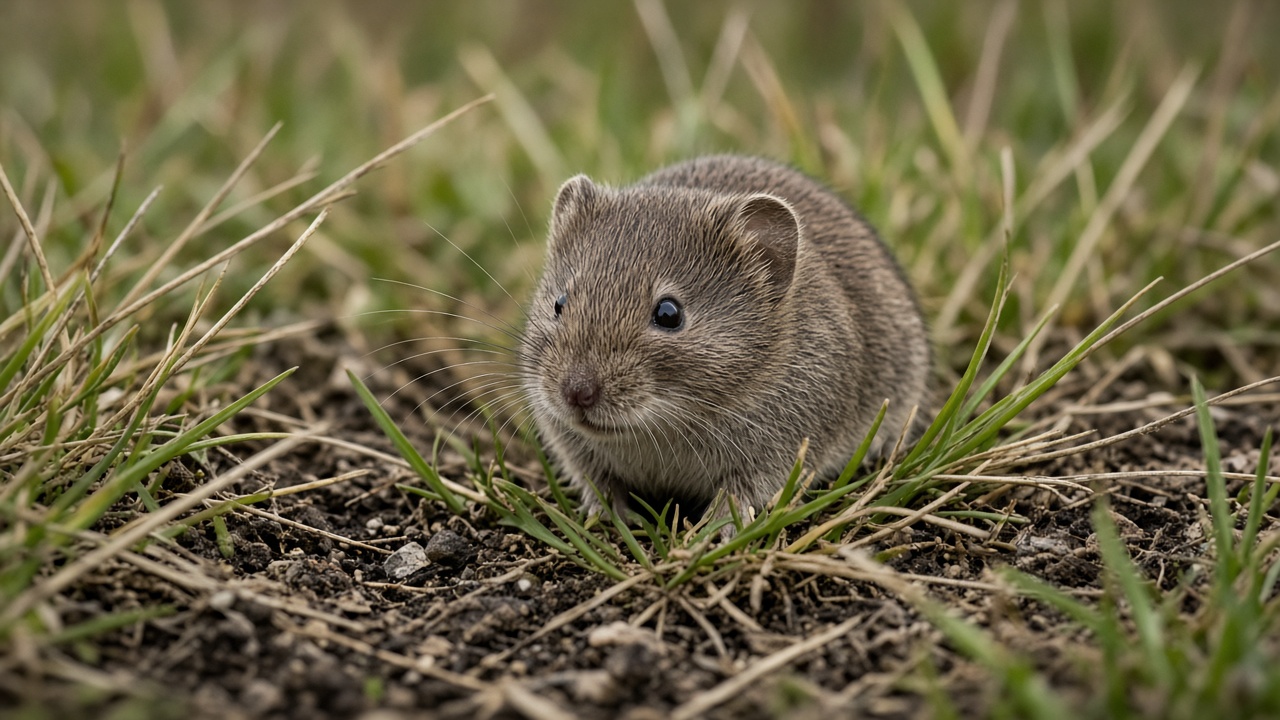
Common Vole
Microtus arvalisCommon Vole (Microtus arvalis): ecology sheet across its documented range — natural history and habitats, without hunting framing.
Seen in: Austria · Belgium · Bulgaria · Croatia · Czechia
Overview
Common Vole (Microtus arvalis) is an ecology sheet across its documented range: natural history and habitats, without any hunting framing.
Classification: order Rodentia, family Cricetidae, genus Microtus. Common names: Common Vole in English, Campagnol des champs in French, Topillo campesino in Spanish.
Identification
A small, stocky rodent, the common vole averages 27.5 g in weight and 113.7 mm in length. The fur is brownish grey above and paler below. Its round ears seem absent at first glance because they are hidden in the fur, and the tail is relatively short. The feet, hairy from the nails to the heels, each bear six tubercles, and the hind claws are longer than the front ones. Females always have four pairs of nipples, two pectoral and two inguinal.
A herbivore, it eats herbaceous plants and grasses and often crops, foraging underground or under grass cover; it revisits a known food source until it runs out. It lives in groups in burrows and does not hibernate. Breeding runs roughly from April to October: 21 days of gestation, an average of 5.1 young per litter, about 5.5 litters a year, weaning at around 20 days; females mature at 38 days and males at 56. Barn owls, common buzzards, common kestrels, weasels and domestic cats are its predators.
Habitats and range
MDD lists it in most of continental Europe, from Spain, Portugal and France to the Baltic states, Finland, Belarus, Ukraine and Russia, as well as Italy and the Balkans. It uses forests, pastures, meadows and farmland from sea level to 3,000 m. One form, the Orkney vole, was introduced to the Orkney Islands off Scotland about 4,500 years ago; genetics link it to populations from France or Spain.
The countries where the species’ presence is established are shown in the tags on this sheet.
Field signs
Diurnal, it stays close to its burrow: group members surface together to feed and, on sighting a predator, either freeze or run for the burrow. When upset it gives a high-pitched squeal. Home ranges are small, about 198 m² for males and 141 m² for females, a little larger in summer. Population peaks occur from July to September. In their breeding season, common kestrels take many to feed their young.
Conservation
For conservation status of Microtus arvalis, consult the current IUCN assessment, then cross with French monitoring programmes when they exist (OFB portal and related publications). Never turn a global IUCN category into a departmental hunting rule. GBIF occurrences help situate documented distribution but remain effort-biased.
The IUCN lists it as Least Concern. It is regarded as a crop pest, eating the leafy parts of plants. It hosts several parasites, including the tapeworm Echinococcus multilocularis, whose final host is the red fox. According to MDD, the species previously included M. obscurus, and the name mystacinus now applies to the species formerly known as M. levis.
Limits
This sheet on the Common Vole covers biology and ecology only; it publishes no hunting season, quota or authorisation.
Local densities and management plans are not covered here: they are a matter for the managers of each area. Hunting-related sources on this small rodent are limited, so the sheet sticks to biology and ecology.
Sources
Sources consulted for this sheet:
- IUCN Red List — species search (consulted 2026-11-01)
- ASM Mammal Diversity Database — Microtus arvalis (consulted 2026-11-01)
- GBIF — species search (consulted 2026-11-01)
- Animal Diversity Web — Microtus arvalis (common vole) (consulted 2026-11-04)
Conclusion
In short: use the scientific name Microtus arvalis to cross-check sources, confirm taxonomy and conservation status on the institutional portals listed above, and relate every field sign to the habitat where it was actually found.
Identification
Microtus arvalis
Campagnol des champs · preferred
Topillo campesino · preferred
Common Vole · preferred
Guernsey Vole
Orkney Vole
Classification
Class : Mammalia
Order : Rodentia
Family : Cricetidae
Genus : Microtus
Conservation
IUCN : LC
CITES : —
iucn · LC (global)
Habitat
Frequently asked questions
How do I recognise Common Vole?
Use Microtus arvalis as the scientific anchor. A small, stocky rodent, the common vole averages 27.5 g in weight and 113.7 mm in length. The fur is brownish grey above and paler below. Its round ears seem absent at first glance because they are hidden in the fur, and the tail is relatively short. The feet, hairy from the nail...
Where does Common Vole typically live?
MDD lists it in most of continental Europe, from Spain, Portugal and France to the Baltic states, Finland, Belarus, Ukraine and Russia, as well as Italy and the Balkans. It uses forests, pastures, meadows and farmland from sea level to 3,000 m. One form, the Orkney vole, was introduced to the Orkney Islands off Scotland about 4,500 years ago; genetics link i...
What field signs help confirm Common Vole?
Diurnal, it stays close to its burrow: group members surface together to feed and, on sighting a predator, either freeze or run for the burrow. When upset it gives a high-pitched squeal. Home ranges are small, about 198 m² for males and 141 m² for females, a little larger in summer. Population peaks occur from July to September. In their breeding season, com...