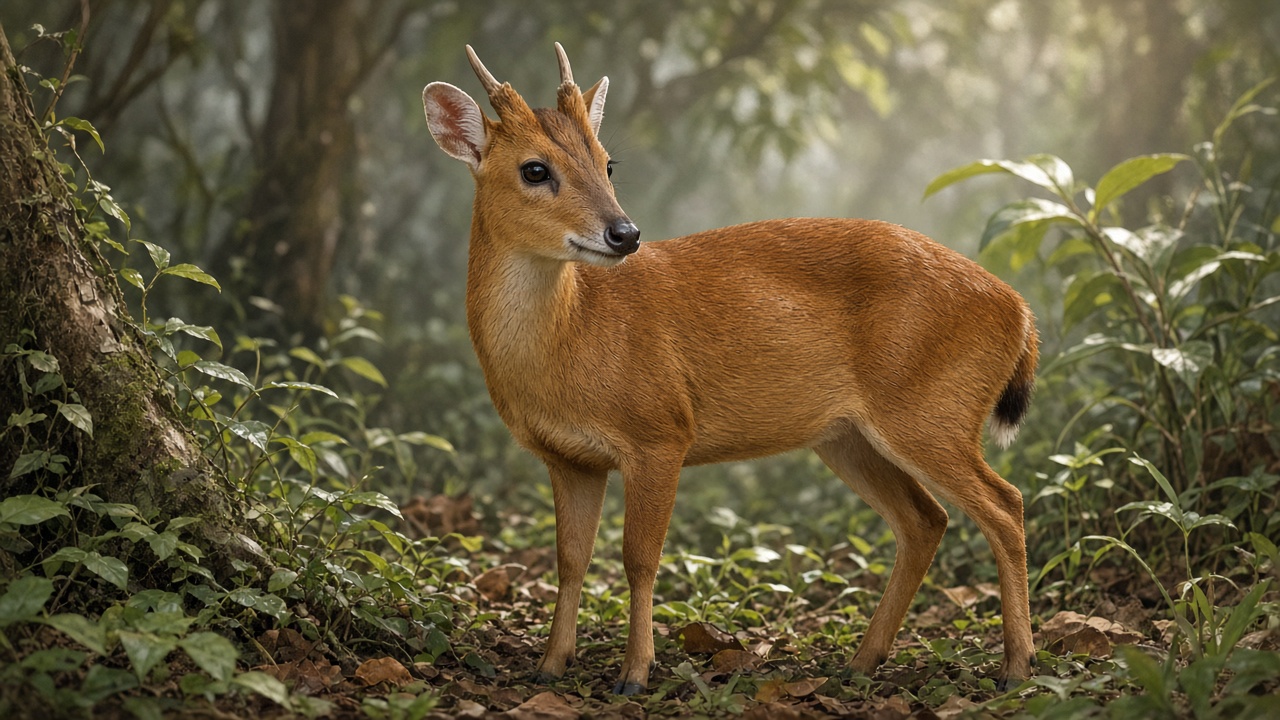
Northern Red Muntjac
Muntiacus vaginalisNo solid country presence documented yet.
Northern Red Muntjac (Muntiacus vaginalis): biology, habitats and field signs across its documented range, hunting-context reading.
Overview
Northern Red Muntjac (Muntiacus vaginalis) is presented here in a hunting-context reading across its documented range: biology, habitats and field signs useful to observers — without publishing season, quota or authorisation.
Classification: order Artiodactyla, family Cervidae, genus Muntiacus. Common names: Northern Red Muntjac in English, Muntjac indien in French, Muntíaco de la India norteño in Spanish.
Identification
Muntiacus vaginalis, the northern red muntjac, measures 90 to 120 cm as an adult. The body is orange; the lower jaw, inner limbs, belly and undertail are milky white, and the triangular tail is edged white. The face is long and narrow, marked by broad frontal glands that form a blackish V on the snout. Males carry short, single-forked antlers on long pedicles; females have only a tuft of black hair in the same place. The legs, orange in young animals, darken with age.
ADW, which describes red muntjacs under M. muntjak before M. vaginalis was split off, presents them as solitary, active by day and night and omnivorous: herbs, fruit, shoots, seeds and grasses, but also eggs and small animals. Breeding is not restricted to one season; females mature in their first year and usually give birth to a single young after about 180 days. Pythons, jackals, tigers, leopards and crocodiles are among its predators.
Habitats and range
MDD lists it from Pakistan, India, Nepal, Bhutan, Bangladesh and Sri Lanka to Myanmar, Thailand, Laos, Cambodia, Vietnam and southern China (southern Tibet, Yunnan, Guangdong). In the Yarlung Zangbo Grand Canyon reserve (Tibet) it occupies both banks of the river between about 843 and 2,123 m. In India it mostly uses dense forest edges, riparian and sal forests and plantations, and rarely enters open grassland.
The countries where the species’ presence is established are shown in the tags on this sheet.
Field signs
Shy and solitary, it keeps close to dense forest edges. Its name of barking deer comes from its alarm call, like a dog’s bark, which it may repeat for over an hour when it detects a predator. On camera-trap images, the orange coat, orange tail and dark V on the snout separate it from the darker Gongshan muntjac and from Fea’s muntjac, which has a black tail.
Conservation
For conservation status of Muntiacus vaginalis, consult the current IUCN assessment and cross with national monitoring programmes in countries of documented presence. Never turn a global IUCN category into a local hunting rule. GBIF occurrences help situate distribution but remain effort-biased.
The IUCN lists it as Least Concern. MDD split it from M. muntjak, now restricted to the Sunda Islands, and tentatively includes aureus and malabaricus, which may represent still unnamed species, as well as nigripes; its internal taxonomy remains debated. In Tibet, camera-trap density was estimated at about 0.85 animals per km².
Limits
This sheet on the Northern Red Muntjac publishes no season, quota, hunting method or fee: those rules differ between countries and territories and must be checked in official texts. Being described here does not mean a species may be hunted.
Local densities and management plans are not covered here: they are a matter for the managers of each area.
Sources
Sources consulted for this sheet:
- IUCN Red List — species search (consulted 2026-11-02)
- ASM Mammal Diversity Database — Muntiacus vaginalis (consulted 2026-11-02)
- GBIF — species search (consulted 2026-11-02)
- Animals (MDPI) — Morphological, phaneroptic, habitat and population description of three muntjac species in a Tibetan nature reserve (consulted 2026-11-04)
- Records of the Zoological Survey of India — The Northern red muntjak in southern West Bengal (consulted 2026-11-04)
- Animal Diversity Web — Muntiacus muntjak (red muntjac, before the split of M. vaginalis) (consulted 2026-11-04)
Conclusion
In short: use the scientific name Muntiacus vaginalis to cross-check sources, confirm taxonomy and conservation status on the institutional portals listed above, and relate every field sign to the habitat where it was actually found.
Identification
Muntiacus vaginalis
Northern Red Muntjac · preferred
Himalayan Red Muntjac
Himalayan Red Muntjak
Northern Red Muntjak
Malabar Red Muntjac
Classification
Class : Mammalia
Order : Artiodactyla
Family : Cervidae
Genus : Muntiacus
Conservation
IUCN : LC
CITES : —
iucn · LC (global)
Frequently asked questions
How do I recognise Northern Red Muntjac?
Use Muntiacus vaginalis as the scientific anchor. Muntiacus vaginalis, the northern red muntjac, measures 90 to 120 cm as an adult. The body is orange; the lower jaw, inner limbs, belly and undertail are milky white, and the triangular tail is edged white. The face is long and narrow, marked by broad frontal glands that form a b...
Where does Northern Red Muntjac typically live?
MDD lists it from Pakistan, India, Nepal, Bhutan, Bangladesh and Sri Lanka to Myanmar, Thailand, Laos, Cambodia, Vietnam and southern China (southern Tibet, Yunnan, Guangdong). In the Yarlung Zangbo Grand Canyon reserve (Tibet) it occupies both banks of the river between about 843 and 2,123 m. In India it mostly uses dense forest edges, riparian and sal fore...
What field signs help confirm Northern Red Muntjac?
Shy and solitary, it keeps close to dense forest edges. Its name of barking deer comes from its alarm call, like a dog’s bark, which it may repeat for over an hour when it detects a predator. On camera-trap images, the orange coat, orange tail and dark V on the snout separate it from the darker Gongshan muntjac and from Fea’s muntjac, which has a black tail.