Stoat
Mustela ermineaStoat (Mustela erminea): biology, habitats and field signs across its documented range, hunting-context reading.
Seen in: Austria · Belgium · Croatia · Czechia · Denmark
Overview
Stoat (Mustela erminea) is presented here in a hunting-context reading across its documented range: biology, habitats and field signs useful to observers — without publishing season, quota or authorisation.
Classification: order Carnivora, family Mustelidae, genus Mustela. Common names: Stoat in English, Hermine in French, Armiño in Spanish.
Identification
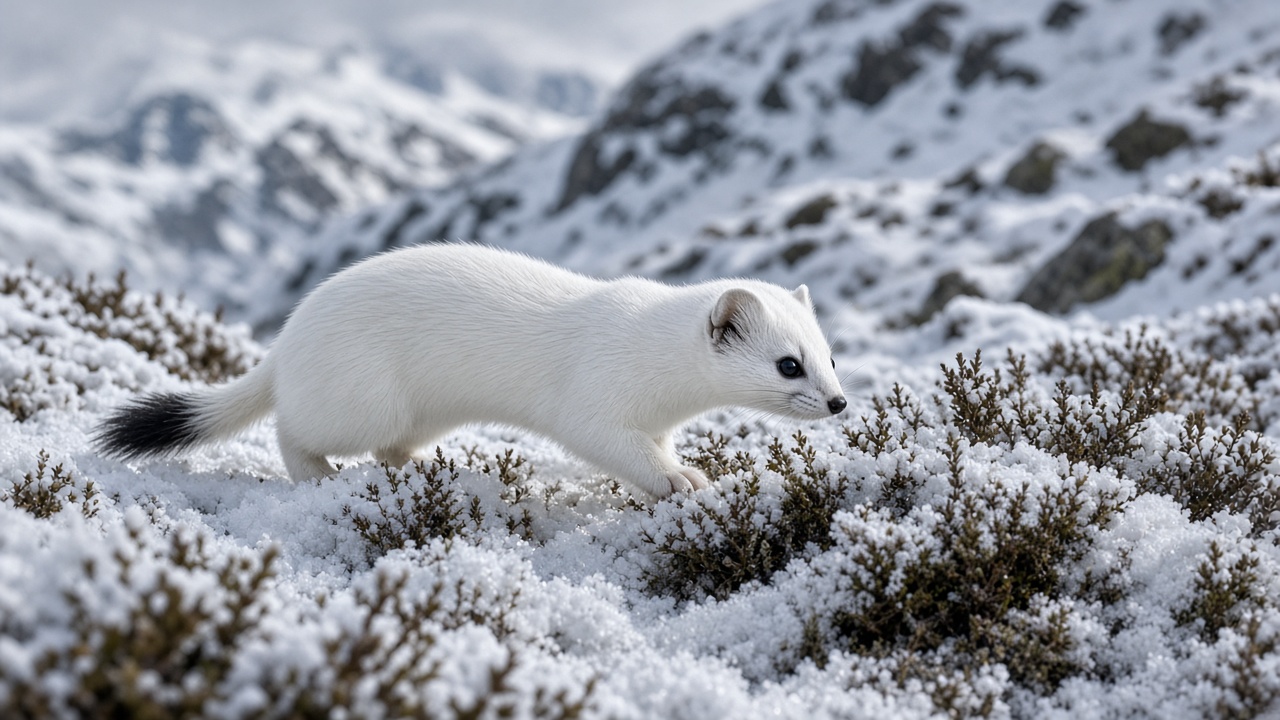
A small mustelid with a long, supple body, short legs and a triangular head. Males are clearly larger than females, often up to twice their weight. In summer the back is chocolate brown and the belly yellowish-white; in cold regions the coat turns white in winter. The tail tip stays black all year: that is the best feature to tell it from the least weasel, which is smaller and has a short tail with no black tip.
A specialist predator of small mammals, mostly voles and other rodents up to rabbit size, it turns to birds, eggs or amphibians when rodents are scarce. It hunts in a zigzag of bounds, checks every hole and often stands up on its hind legs to look around. Solitary and territorial, it has delayed implantation: mating takes place in spring or summer and the young are born the following spring.
Habitats and range
The species lives in the temperate, boreal and tundra regions of Eurasia, from western Europe (including France) to Japan, and in Alaska; it was introduced to New Zealand. It uses hedgerows, woodland edges, riparian strips, marshes, grassland and mountains rich in rodents, and dens in rodent burrows, stone walls, log piles or under roots.
The countries where the species’ presence is established are shown in the tags on this sheet.
Field signs
It moves in zigzag bounds of up to about 50 cm, and its tracks are easy to follow on snow. Side chambers of the den serve as food caches and latrines, and the nest is lined with fur and feathers from prey. A brief glimpse of a small brown animal with a black-tipped tail bounding across a path, or standing up on its hind legs, is typical.
Conservation
For conservation status of Mustela erminea, consult the current IUCN assessment, then cross with French monitoring programmes when they exist (OFB portal and related publications). Never turn a global IUCN category into a departmental hunting rule. GBIF occurrences help situate documented distribution but remain effort-biased.
The IUCN lists it as Least Concern. Numbers follow rodent abundance and vary sharply from year to year. MDD notes that after a 2021 revision (Colella et al.) the species no longer includes Mustela richardsonii or M. haidarum, hence the English name Beringian Ermine sometimes used.
Limits
This sheet on the Stoat publishes no season, quota, hunting method or fee: those rules differ between countries and territories and must be checked in official texts. Being described here does not mean a species may be hunted.
Local densities and management plans are not covered here: they are a matter for the managers of each area.
Sources
Sources consulted for this sheet:
- IUCN Red List — species search (consulted 2026-11-01)
- ASM Mammal Diversity Database — Mustela erminea (consulted 2026-11-01)
- GBIF — species search (consulted 2026-11-01)
- Animal Diversity Web — Mustela erminea (ermine) (consulted 2026-11-04)
Conclusion
In short: use the scientific name Mustela erminea to cross-check sources, confirm taxonomy and conservation status on the institutional portals listed above, and relate every field sign to the habitat where it was actually found.
Identification
Mustela erminea
Hermine · preferred
Armiño · preferred
Beringian Ermine · preferred
Stoat
Short-tailed Weasel
Classification
Class : Mammalia
Order : Carnivora
Family : Mustelidae
Genus : Mustela
Conservation
IUCN : LC
CITES : —
iucn · LC (global)
Habitat
Frequently asked questions
How do I recognise Stoat?
Use Mustela erminea as the scientific anchor. A small mustelid with a long, supple body, short legs and a triangular head. Males are clearly larger than females, often up to twice their weight. In summer the back is chocolate brown and the belly yellowish-white; in cold regions the coat turns white in winter. The tail tip st...
Where does Stoat typically live?
The species lives in the temperate, boreal and tundra regions of Eurasia, from western Europe (including France) to Japan, and in Alaska; it was introduced to New Zealand. It uses hedgerows, woodland edges, riparian strips, marshes, grassland and mountains rich in rodents, and dens in rodent burrows, stone walls, log piles or under roots.
What field signs help confirm Stoat?
It moves in zigzag bounds of up to about 50 cm, and its tracks are easy to follow on snow. Side chambers of the den serve as food caches and latrines, and the nest is lined with fur and feathers from prey. A brief glimpse of a small brown animal with a black-tipped tail bounding across a path, or standing up on its hind legs, is typical.