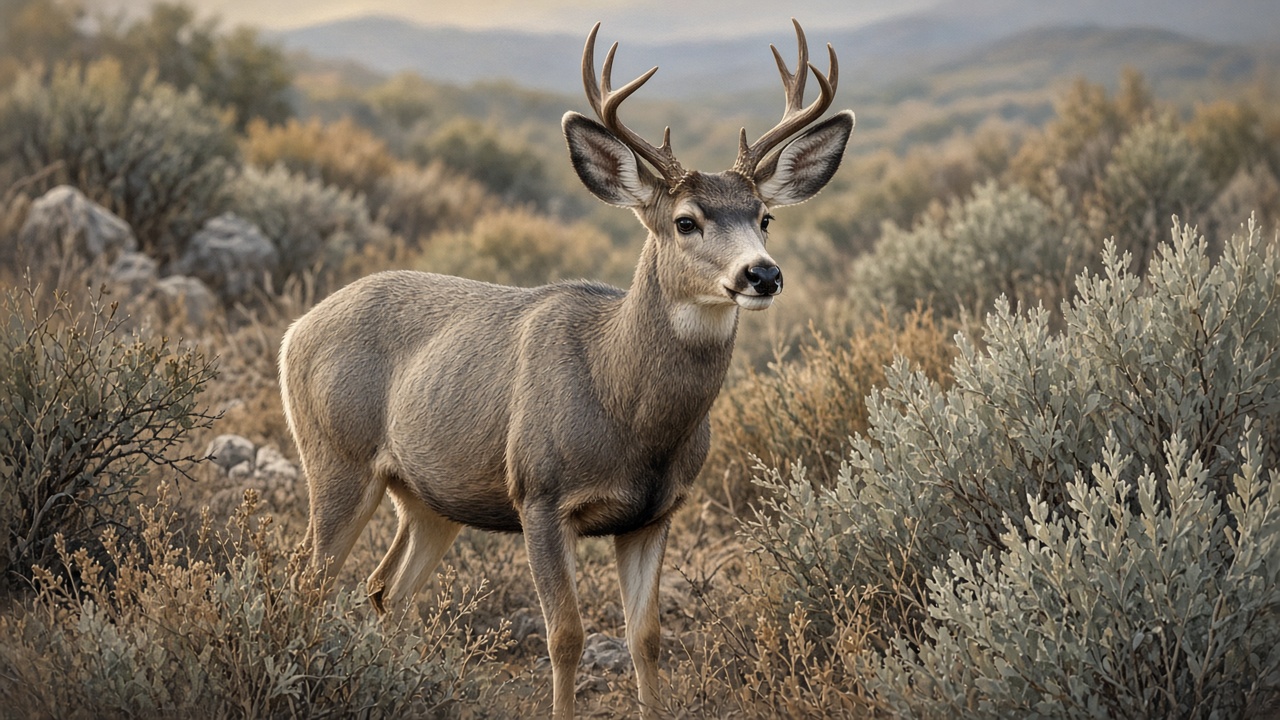
Mule Deer (Odocoileus hemionus): biology, habitats and field signs across its documented range, hunting-context reading.
Seen in: United States
Overview
Mule Deer (Odocoileus hemionus) is presented here in a hunting-context reading across its documented range: biology, habitats and field signs useful to observers — without publishing season, quota or authorisation.
Classification: order Artiodactyla, family Cervidae, genus Odocoileus. Common names: Mule Deer in English, Cerf mulet in French, Ciervo mulo in Spanish.
Identification
The mule deer’s coat ranges from dark brownish-grey through dark and light ash-grey to brown and even reddish; the rump patch is white or yellowish and the throat patch white. The white tail usually ends in a tuft of black hair, and a dark dorsal line sometimes runs down it. A dark V-shaped mark extends up from between the eyes, more conspicuous in males. Males weigh 45 to 150 kg (carcass weight), are 126 to 168 cm long and 84 to 106 cm at the shoulder; females weigh 43 to 75 kg and measure 125 to 156 cm and 80 to 100 cm. These markings vary between individuals but stay the same for life.
A dominant male tends a female in oestrus until mating; the largest males, with the largest antlers, perform most matings. The rut peaks from late November to mid-December; after about 204 days of gestation, most fawns are born in June, usually twins of 2 to 5 kg, though young mothers often have a single fawn. It eats woody and herbaceous plants in roughly equal amounts, plus acorns, legume seeds and fleshy fruits. Females live in clans related through the mother. Pumas, coyotes, bobcats, golden eagles, feral dogs and black bears are its predators.
Habitats and range
It occupies western North America, west of the 100th meridian between 23° and 60° N: western Canada, the Alaskan Panhandle, the western United States east to Minnesota and northern Mexico, from Baja California and Sonora to northern Tamaulipas. It occurs in every biome of western North America north of central Mexico except Arctic tundra: California chaparral, the Mojave and Sonoran deserts, the Great Plains, the Great Basin, sagebrush steppe, mountains and boreal forest. It spends summer at higher elevations and moves down in winter as snow builds up.
The countries where the species’ presence is established are shown in the tags on this sheet.
Field signs
It detects danger at long range with its large ears and keen eyesight: a male can track another animal visually up to 600 m away. When alarmed it may hide, bound rapidly uphill, or bound off and then trot away, stopping often to look back, while releasing an alarm scent from its metatarsal gland. It browses young Douglas fir and ponderosa pine heavily in clear-cuts.
Conservation
For conservation status of Odocoileus hemionus, consult the current IUCN assessment and cross with national monitoring programmes in countries of documented presence. Never turn a global IUCN category into a local hunting rule. GBIF occurrences help situate distribution but remain effort-biased.
The IUCN lists it as Least Concern. The threats described concern its ranges, especially winter ranges: farming development, rangeland conversion, mining, roads and housing; several states and provinces have bought critical wintering areas. It suffers from various parasites and diseases, including gastrointestinal nematodes, meningeal worm and foot-and-mouth disease passed on by livestock. It has been introduced to Kauai (Hawaii) and Argentina.
Limits
This sheet on the Mule Deer publishes no season, quota, hunting method or fee: those rules differ between countries and territories and must be checked in official texts. Being described here does not mean a species may be hunted.
Local densities and management plans are not covered here: they are a matter for the managers of each area.
Sources
Sources consulted for this sheet:
- IUCN Red List — species search (consulted 2026-11-02)
- ASM Mammal Diversity Database — Odocoileus hemionus (consulted 2026-11-02)
- GBIF — species search (consulted 2026-11-02)
- Animal Diversity Web — Odocoileus hemionus (mule deer) (consulted 2026-11-04)
Conclusion
In short: use the scientific name Odocoileus hemionus to cross-check sources, confirm taxonomy and conservation status on the institutional portals listed above, and relate every field sign to the habitat where it was actually found.
Identification
Odocoileus hemionus
Cerf mulet · preferred
Ciervo mulo · preferred
Mule Deer · preferred
Black-tailed Deer
Classification
Class : Mammalia
Order : Artiodactyla
Family : Cervidae
Genus : Odocoileus
Conservation
IUCN : LC
CITES : —
iucn · LC (global)
Habitat
Frequently asked questions
How do I recognise Mule Deer?
Use Odocoileus hemionus as the scientific anchor. The mule deer’s coat ranges from dark brownish-grey through dark and light ash-grey to brown and even reddish; the rump patch is white or yellowish and the throat patch white. The white tail usually ends in a tuft of black hair, and a dark dorsal line sometimes runs down it. A da...
Where does Mule Deer typically live?
It occupies western North America, west of the 100th meridian between 23° and 60° N: western Canada, the Alaskan Panhandle, the western United States east to Minnesota and northern Mexico, from Baja California and Sonora to northern Tamaulipas. It occurs in every biome of western North America north of central Mexico except Arctic tundra: California chaparra...
What field signs help confirm Mule Deer?
It detects danger at long range with its large ears and keen eyesight: a male can track another animal visually up to 600 m away. When alarmed it may hide, bound rapidly uphill, or bound off and then trot away, stopping often to look back, while releasing an alarm scent from its metatarsal gland. It browses young Douglas fir and ponderosa pine heavily in cle...