Red River Hog
Potamochoerus porcusNo solid country presence documented yet.
Red River Hog (Potamochoerus porcus): biology, habitats and field signs across its documented range, hunting-context reading.
Overview
Red River Hog (Potamochoerus porcus) is presented here in a hunting-context reading across its documented range: biology, habitats and field signs useful to observers — without publishing season, quota or authorisation.
Classification: order Artiodactyla, family Suidae, genus Potamochoerus. Common names: Red River Hog in English, Potamochère roux in French, Potamoquero rojo in Spanish.
Identification
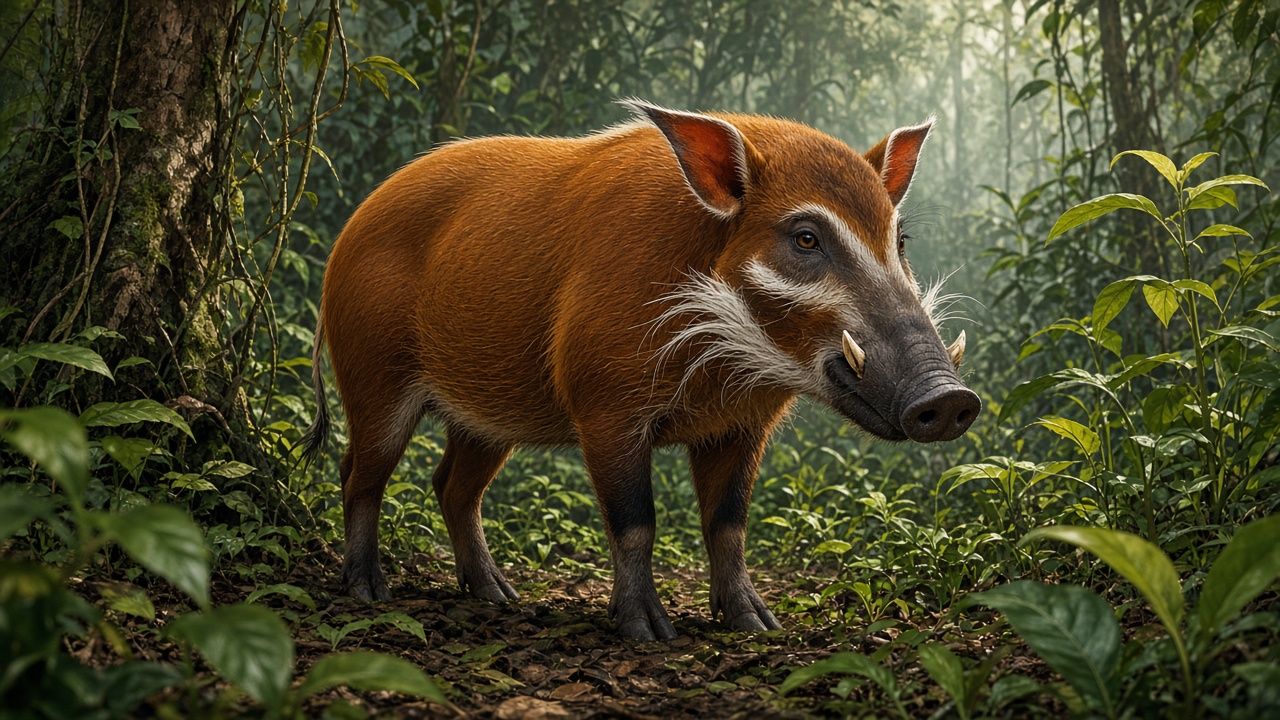
On average the smallest of the African pigs, the red river hog measures 102 to 127 cm in length and weighs 45 to 129 kg, males being slightly larger than females. In West Africa it is mostly bright red with a white stripe along the back, and many individuals have a white facial mask. Its long white whiskers and ear tufts earn it the nickname “tufted pig”. On the elongated snout, males have two well-developed warts that protect them from tusk blows. Piglets are reddish-brown and striped.
An unfussy omnivore, it roots with its snout for roots, tubers, bulbs and fungi, and also eats fruit, seeds, grasses, insects, eggs, snails, reptiles and carrion; it follows chimpanzees, baboons or elephants to pick up dropped fruit. Social, it lives in groups of up to about a dozen, sometimes 20, around a dominant male. Breeding takes place mostly from September to April, peaking from November to February; after 120 to 130 days the sow gives birth to 3 to 6 young in a grass nest, and both parents protect them. Leopards, lions, spotted hyenas and rock pythons prey on it.
Habitats and range
According to MDD, it occupies the rainforest zone of West and Central Africa: Senegal, Guinea-Bissau, Guinea, Sierra Leone, Liberia, Côte d’Ivoire, Ghana, Togo, Benin, Nigeria, Cameroon, Equatorial Guinea, Gabon, the Central African Republic and both Congos; MDD also lists Mali, Chad, South Sudan, Uganda and Angola. Its distribution is wide but patchy: rainforest and adjacent savanna, dry forest and farmland near forest, with plenty of brush to forage and hide in.
The countries where the species’ presence is established are shown in the tags on this sheet.
Field signs
Most active at dusk and at night, it spends the day in a burrow or dense vegetation. It marks its paths by scraping tree trunks with its tusks and with secretions from foot, neck and preorbital glands. It wallows in water or mud and swims well. When threatened, it raises its ear tassels, facial hair and mane to look bigger.
Conservation
For conservation status of Potamochoerus porcus, consult the current IUCN assessment and cross with national monitoring programmes in countries of documented presence. Never turn a global IUCN category into a local hunting rule. GBIF occurrences help situate distribution but remain effort-biased.
The IUCN lists it as Least Concern. Common and adaptable, it has benefited from the decline of its natural predators and from farming, sometimes raiding crops; the Smithsonian notes that humans, who hunt it heavily in Central Africa, remain its main threat, though it occurs in many protected areas. According to ADW, bush pigs can pass tick-borne African swine fever to domestic pigs without being harmed by it themselves.
Limits
This sheet on the Red River Hog publishes no season, quota, hunting method or fee: those rules differ between countries and territories and must be checked in official texts. Being described here does not mean a species may be hunted.
Local densities and management plans are not covered here: they are a matter for the managers of each area.
Sources
Sources consulted for this sheet:
- IUCN Red List — species search (consulted 2026-11-02)
- ASM Mammal Diversity Database — Potamochoerus porcus (consulted 2026-11-02)
- GBIF — species search (consulted 2026-11-02)
- Smithsonian’s National Zoo — Red river hog (Potamochoerus porcus) (consulted 2026-11-04)
- Los Angeles Zoo and Botanical Gardens — Red River Hog (Potamochoerus porcus) (consulted 2026-11-04)
- Animal Diversity Web — Potamochoerus porcus (red river hog, broad sense) (consulted 2026-11-04)
Conclusion
In short: use the scientific name Potamochoerus porcus to cross-check sources, confirm taxonomy and conservation status on the institutional portals listed above, and relate every field sign to the habitat where it was actually found.
Identification
Potamochoerus porcus
Red River Hog · preferred
Potamochère roux · preferred
Potamoquero rojo · preferred
Classification
Class : Mammalia
Order : Artiodactyla
Family : Suidae
Genus : Potamochoerus
Conservation
IUCN : LC
CITES : —
iucn · LC (global)
Frequently asked questions
How do I recognise Red River Hog?
Use Potamochoerus porcus as the scientific anchor. On average the smallest of the African pigs, the red river hog measures 102 to 127 cm in length and weighs 45 to 129 kg, males being slightly larger than females. In West Africa it is mostly bright red with a white stripe along the back, and many individuals have a white facial m...
Where does Red River Hog typically live?
According to MDD, it occupies the rainforest zone of West and Central Africa: Senegal, Guinea-Bissau, Guinea, Sierra Leone, Liberia, Côte d’Ivoire, Ghana, Togo, Benin, Nigeria, Cameroon, Equatorial Guinea, Gabon, the Central African Republic and both Congos; MDD also lists Mali, Chad, South Sudan, Uganda and Angola. Its distribution is wide but patchy: rainf...
What field signs help confirm Red River Hog?
Most active at dusk and at night, it spends the day in a burrow or dense vegetation. It marks its paths by scraping tree trunks with its tusks and with secretions from foot, neck and preorbital glands. It wallows in water or mud and swims well. When threatened, it raises its ear tassels, facial hair and mane to look bigger.