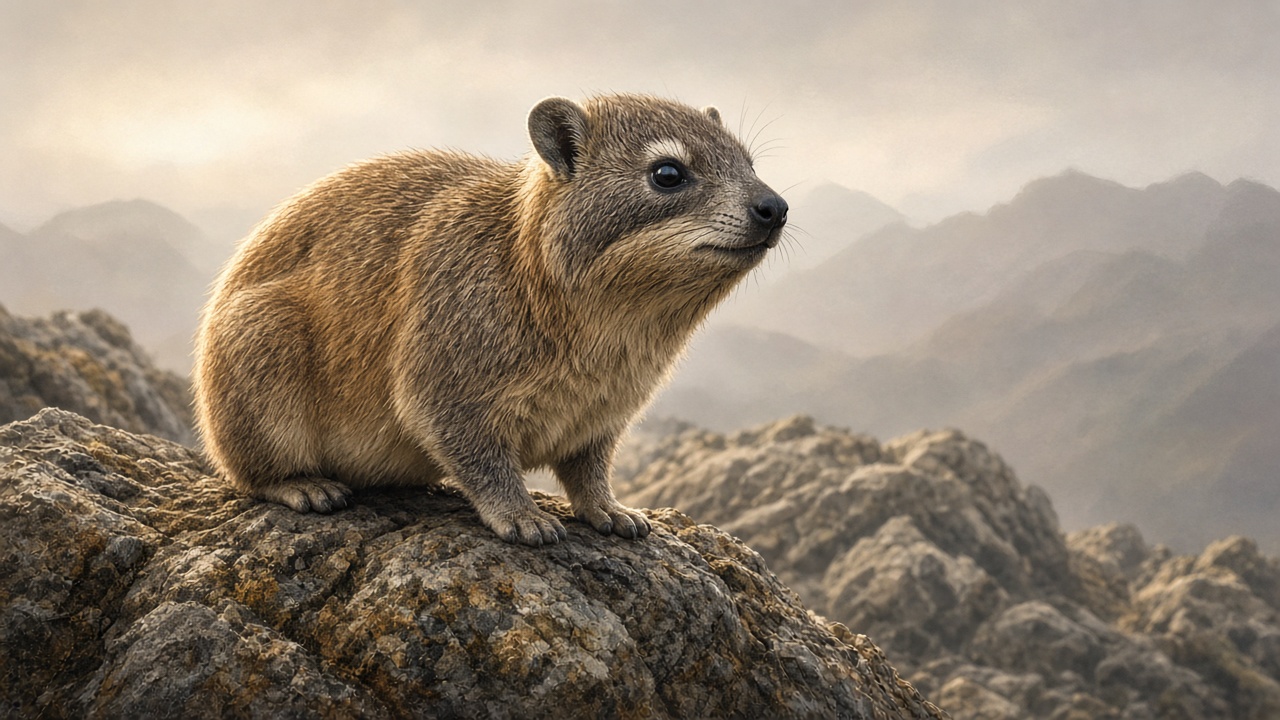
Rock Hyrax
Procavia capensisRock Hyrax (Procavia capensis): coexistence sheet across its documented range — presence, biology and prudence, without an invented hunting status.
Seen in: Namibia · South Africa
Overview
Rock Hyrax (Procavia capensis) is a coexistence sheet across its documented range: presence, biology and prudence — not a hunting status claim.
Classification: order Hyracoidea, family Procaviidae, genus Procavia. Common names: Rock Hyrax in English, Daman du Cap in French, Damán del Cabo in Spanish.
Identification
The rock hyrax looks like a stocky woodchuck: 30.5 to 55 cm long, with an 11 to 24 mm tail and up to 4.3 kg (males 4 kg, females 3.6 kg on average). A pair of incisors forms long tusks, larger and sharper in males, which also have thicker necks. The dense, rough coat ranges from grey to dark brown; a dorsal patch of contrasting black, yellow or orange hairs surrounds a gland. The black pads on its soles, kept moist by sweat glands, grip bare rock.
It lives in colonies of up to 80 animals, built around a territorial male and a harem of 3 to 7 related females. Its body temperature fluctuates widely: it basks in the morning sun, avoids the hottest hours and rain, and spends 95% of its time resting. Mainly a grazer (grasses make up 78% of the wet-season diet), it also eats shoots and fruit, and bark or lichens in drought. After a six- to eight-month gestation, 1 to 6 well-developed young are born. Leopards are its main predator.
Habitats and range
MDD gives it across sub-Saharan and north-eastern Africa, from a line through Senegal, southern Algeria, Libya and Egypt to the southern tip of the continent, plus parts of the Levant and the Arabian Peninsula; ADW adds that it is absent from the Congo Basin. It is the most arid-adapted hyrax, reaching dry mountains in the Namib, Sahara and Arabian deserts. It needs rocky areas full of crevices, in desert, savanna or scrub, or abandoned aardvark and meerkat burrows.
The countries where the species’ presence is established are shown in the tags on this sheet.
Field signs
Colonies give themselves away through animals basking on rocks in the morning and white streaks on rock faces left by urine rich in calcium carbonate, near shared latrines where dung and urine build up into a sticky mass. The male gives a loud, repeated territorial call ending in guttural grunts; the colony reacts at once to his alarm call. Near people, it also uses road culverts and crevices in stone walls.
Conservation
For conservation status of Procavia capensis, consult the current IUCN assessment and cross with national monitoring programmes in countries of documented presence. Never turn a global IUCN category into a local hunting rule. GBIF occurrences help situate distribution but remain effort-biased.
The IUCN lists it as Least Concern, though population trends are unknown. Taken for meat throughout its range, it has disappeared locally, but ADW sees no major threat to the species. Near farms, especially in South Africa, it can damage fruit trees, and it is a reservoir of Leishmania tropica, a parasite that infects humans. MDD lists 153 names and synonyms and several regional names (Abyssinian, Kaokoveld and Johnston Hyrax).
Limits
This sheet on the Rock Hyrax covers presence and biology. A species being present in a country does not mean it may be hunted, and no season or quota is published here.
Local densities and management plans are not covered here: they are a matter for the managers of each area.
Sources
Sources consulted for this sheet:
- IUCN Red List — species search (consulted 2026-11-02)
- ASM Mammal Diversity Database — Procavia capensis (consulted 2026-11-02)
- GBIF — species search (consulted 2026-11-02)
- Animal Diversity Web — Procavia capensis (rock hyrax) (consulted 2026-11-04)
Conclusion
In short: use the scientific name Procavia capensis to cross-check sources, confirm taxonomy and conservation status on the institutional portals listed above, and relate every field sign to the habitat where it was actually found.
Identification
Procavia capensis
Rock Hyrax · preferred
Daman du Cap · preferred
Damán del Cabo · preferred
Klipdassie
Abyssinian Hyrax
Cape Hyrax
Johnston Hyrax
Kaokoveld Hyrax
Western Hyrax
Classification
Class : Mammalia
Order : Hyracoidea
Family : Procaviidae
Genus : Procavia
Conservation
IUCN : LC
CITES : —
iucn · LC (global)
Habitat
Frequently asked questions
How do I recognise Rock Hyrax?
Use Procavia capensis as the scientific anchor. The rock hyrax looks like a stocky woodchuck: 30.5 to 55 cm long, with an 11 to 24 mm tail and up to 4.3 kg (males 4 kg, females 3.6 kg on average). A pair of incisors forms long tusks, larger and sharper in males, which also have thicker necks. The dense, rough coat ranges from...
Where does Rock Hyrax typically live?
MDD gives it across sub-Saharan and north-eastern Africa, from a line through Senegal, southern Algeria, Libya and Egypt to the southern tip of the continent, plus parts of the Levant and the Arabian Peninsula; ADW adds that it is absent from the Congo Basin. It is the most arid-adapted hyrax, reaching dry mountains in the Namib, Sahara and Arabian deserts....
What field signs help confirm Rock Hyrax?
Colonies give themselves away through animals basking on rocks in the morning and white streaks on rock faces left by urine rich in calcium carbonate, near shared latrines where dung and urine build up into a sticky mass. The male gives a loud, repeated territorial call ending in guttural grunts; the colony reacts at once to his alarm call. Near people, it a...