Eastern Gray Squirrel
Sciurus carolinensisEastern Gray Squirrel (Sciurus carolinensis): ecology sheet across its documented range — natural history and habitats, without hunting framing.
Seen in: United Kingdom
Overview
Eastern Gray Squirrel (Sciurus carolinensis) is an ecology sheet across its documented range: natural history and habitats, without any hunting framing.
Classification: order Rodentia, family Sciuridae, genus Sciurus. Common names: Eastern Gray Squirrel in English, Écureuil gris in French, Ardilla gris in Spanish.
Identification
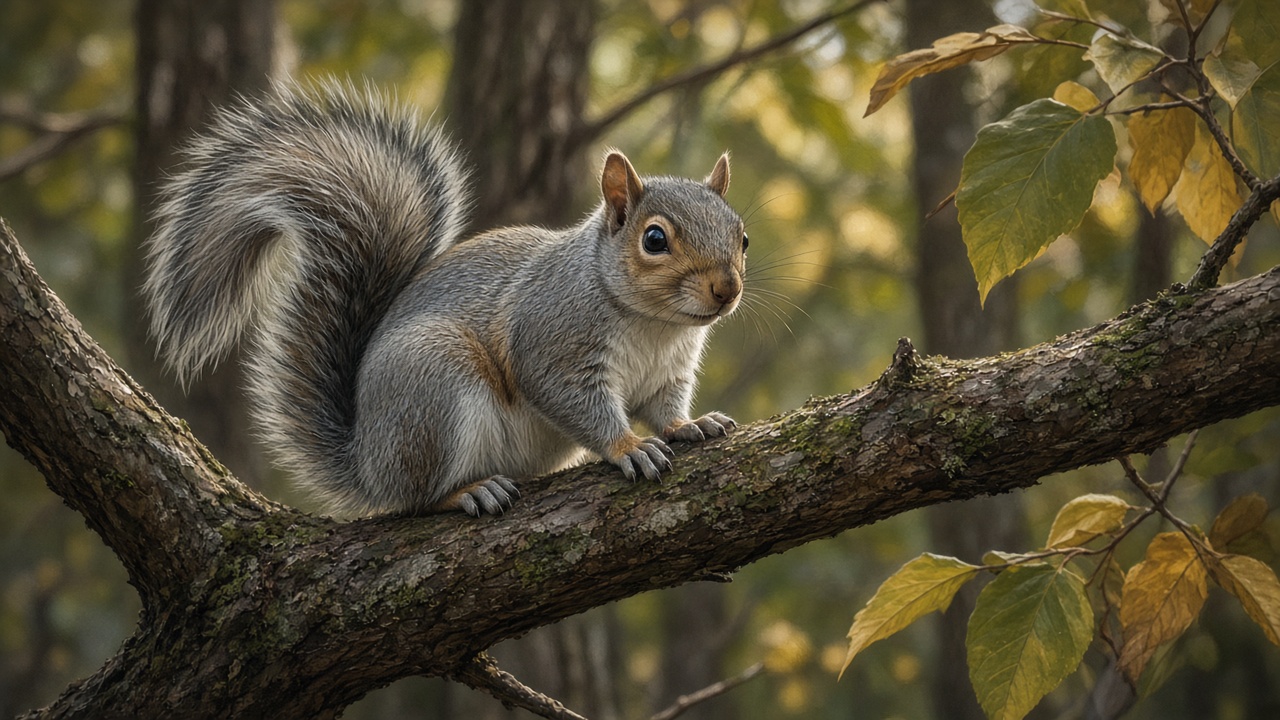
A medium-sized tree squirrel with no difference in size or colour between the sexes: 380 to 525 mm in total length, including a 150 to 250 mm tail, and 338 to 750 g (540 g on average). The back is grizzled dark to pale grey, sometimes with cinnamon tones; the ears are pale grey to white, the tail white to pale grey and the underparts grey to buff. Black (melanistic) animals are common in the north of the range, where they lose less heat in severe cold; albinos are rare.
It eats mainly nuts, flowers and buds of oaks, hickories, walnuts and beeches, plus conifer seeds, fungi, corn and wheat in winter, insects in summer, and occasionally eggs, nestlings or frogs. It buries food in many small scattered caches, found again by memory and smell. Diurnal, it is most active about two hours after sunrise and a few hours before sunset. It breeds from December to February and from May to June: two litters a year of 2 to 4 young after 44 days of gestation.
Habitats and range
Its native range runs from eastern Texas to Saskatchewan and east to the Atlantic coast. According to MDD it has been introduced to Britain, Ireland, Italy, Australia, South Africa and western North America. It prefers mature, continuous woodland over 40 hectares with a varied understorey; densities are highest where oaks and walnuts provide food that lasts through winter storage. It also lives in urban and suburban areas.
The countries where the species’ presence is established are shown in the tags on this sheet.
Field signs
It uses a permanent tree den and a nest of leaves and twigs wedged in a fork 9 to 14 m above the ground. Small buried caches, tail flicking and alarm calls that warn neighbours of a predator reveal its presence. In the breeding periods, several males follow a female, sometimes from 500 m away.
Conservation
For conservation status of Sciurus carolinensis, consult the current IUCN assessment and cross with national monitoring programmes in countries of documented presence. Never turn a global IUCN category into a local hunting rule. GBIF occurrences help situate distribution but remain effort-biased.
The IUCN lists it as Least Concern. Outside its native range it is considered very destructive in Great Britain, where its negative impact is ranked second only to the Norway rat. MDD notes that a proposed arrangement would move it to the genus Neosciurus, which it does not follow for now pending further study.
Limits
This sheet on the Eastern Gray Squirrel covers biology and ecology only; it publishes no hunting season, quota or authorisation.
Local densities and management plans are not covered here: they are a matter for the managers of each area.
Sources
Sources consulted for this sheet:
- IUCN Red List — species search (consulted 2026-11-02)
- ASM Mammal Diversity Database — Sciurus carolinensis (consulted 2026-11-02)
- GBIF — species search (consulted 2026-11-02)
- Animal Diversity Web — Sciurus carolinensis (eastern gray squirrel) (consulted 2026-11-04)
Conclusion
In short: use the scientific name Sciurus carolinensis to cross-check sources, confirm taxonomy and conservation status on the institutional portals listed above, and relate every field sign to the habitat where it was actually found.
Identification
Sciurus carolinensis
Écureuil gris · preferred
Ardilla gris · preferred
Eastern Gray Squirrel · preferred
Classification
Class : Mammalia
Order : Rodentia
Family : Sciuridae
Genus : Sciurus
Conservation
IUCN : LC
CITES : —
iucn · LC (global)
Habitat
Frequently asked questions
How do I recognise Eastern Gray Squirrel?
Use Sciurus carolinensis as the scientific anchor. A medium-sized tree squirrel with no difference in size or colour between the sexes: 380 to 525 mm in total length, including a 150 to 250 mm tail, and 338 to 750 g (540 g on average). The back is grizzled dark to pale grey, sometimes with cinnamon tones; the ears are pale grey t...
Where does Eastern Gray Squirrel typically live?
Its native range runs from eastern Texas to Saskatchewan and east to the Atlantic coast. According to MDD it has been introduced to Britain, Ireland, Italy, Australia, South Africa and western North America. It prefers mature, continuous woodland over 40 hectares with a varied understorey; densities are highest where oaks and walnuts provide food that lasts...
What field signs help confirm Eastern Gray Squirrel?
It uses a permanent tree den and a nest of leaves and twigs wedged in a fork 9 to 14 m above the ground. Small buried caches, tail flicking and alarm calls that warn neighbours of a predator reveal its presence. In the breeding periods, several males follow a female, sometimes from 500 m away.