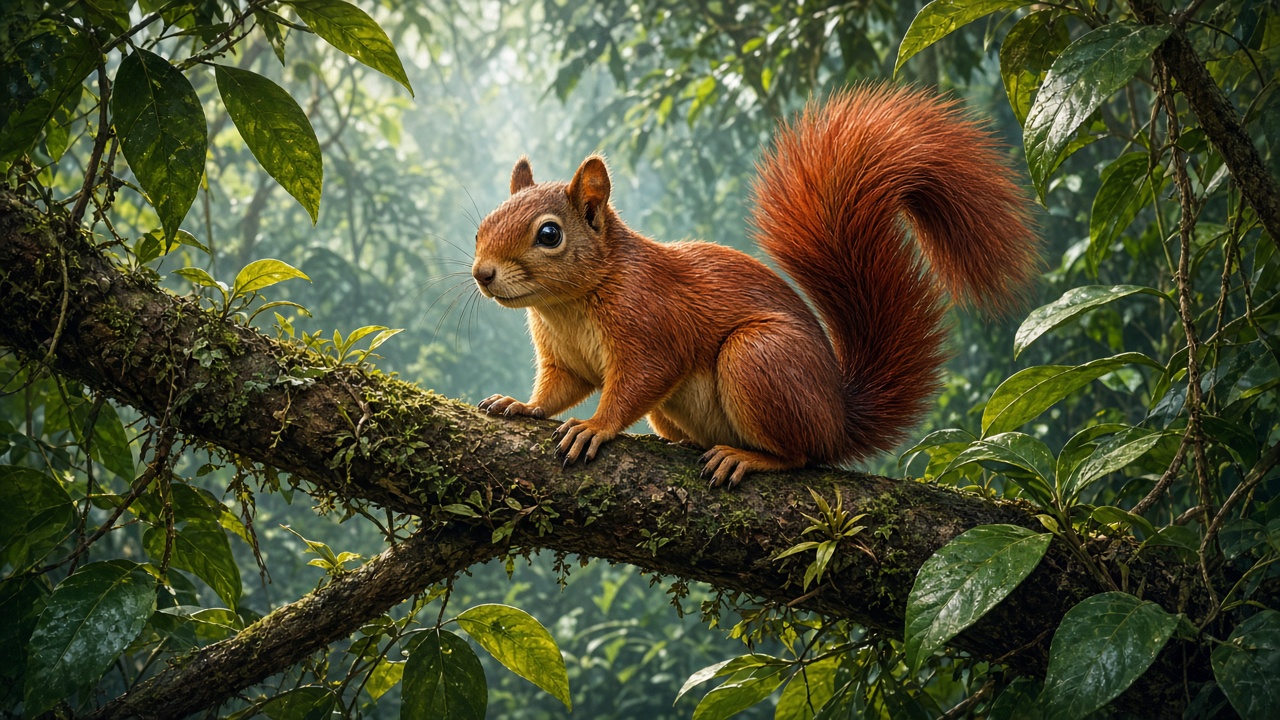
Red-tailed Squirrel (Sciurus granatensis): ecology sheet across its documented range — natural history and habitats, without hunting framing.
Seen in: Mexico
Overview
Red-tailed Squirrel (Sciurus granatensis) is an ecology sheet across its documented range: natural history and habitats, without any hunting framing.
Classification: order Rodentia, family Sciuridae, genus Sciurus. Common names: Red-tailed Squirrel in English, Écureuil à queue rousse in French, Ardilla de cola roja in Spanish.
Identification
The red-tailed squirrel is a medium-sized tree squirrel: 330 to 520 mm long, including a 140 to 280 mm tail, and 228 to 520 g. Its colour varies greatly between regions and habitats: the back is often dark orange but can be dull yellow flecked with black or entirely black, with a mid-dorsal stripe in some forms; the belly ranges from pure white to bright rusty orange. The bushy tail is dull yellowish-brown, with or without a black tip, and a yellowish-brown ring surrounds the eye. The sexes look alike; on Barro Colorado Island (Panama) females are slightly larger.
Diurnal and solitary, it spends almost two thirds of its day sitting still. About 65% of its diet is fruit, nuts and seeds – on Barro Colorado mainly Dipteryx panamensis, Astrocaryum, Scheelea zonensis and Gustavia superba – topped up with leaves, bark, fungi, flowers and small insects. Breeding runs from late December to October, with 2 to 3 litters a year of 1 or 2 young (rarely 3), born naked after less than two months of gestation. Capuchin monkeys (Cebus capucinus), boa constrictors, raptors and cats are among its predators.
Habitats and range
MDD lists it from Costa Rica, Panama, Colombia, Ecuador, Venezuela, Trinidad and Tobago and Margarita Island. It uses tropical moist and seasonal forests, often near water and mainly in the lower layers, as well as cropland close to settlements. It ranges from sea level to 3,000 m, although in Venezuela 93% of records are below 1,500 m. Average home ranges are about 1.5 ha for males and 0.65 ha for females.
The countries where the species’ presence is established are shown in the tags on this sheet.
Field signs
It forages mostly on the ground and then climbs to eat, and half the time it moves along trunks and large branches near the centre of the tree; it also visits crowns more than 30 m up. Usually silent, it gives a few short, hoarse sounds when alarmed, and grunts and squeals during chases. Two squirrels never eat in the same tree at once. Near villages, damage to mangoes, avocados, maize, coconuts or bananas reveals its presence.
Conservation
For conservation status of Sciurus granatensis, consult the current IUCN assessment and cross with national monitoring programmes in countries of documented presence. Never turn a global IUCN category into a local hunting rule. GBIF occurrences help situate distribution but remain effort-biased.
The IUCN lists it as Least Concern, and ADW describes stable populations despite being hunted for meat and to limit crop damage. It disperses the seeds of the trees whose fruit it eats. Taxonomically, MDD notes that a newly proposed arrangement would move S. granatensis, with richmondi as a synonym, to the genus Syntheosciurus; this arrangement is tentatively not followed.
Limits
This sheet on the Red-tailed Squirrel covers biology and ecology only; it publishes no hunting season, quota or authorisation.
Local densities and management plans are not covered here: they are a matter for the managers of each area.
Sources
Sources consulted for this sheet:
- IUCN Red List — species search (consulted 2026-11-02)
- ASM Mammal Diversity Database — Sciurus granatensis (consulted 2026-11-02)
- GBIF — species search (consulted 2026-11-02)
- Animal Diversity Web — Sciurus granatensis (red-tailed squirrel) (consulted 2026-11-04)
Conclusion
In short: use the scientific name Sciurus granatensis to cross-check sources, confirm taxonomy and conservation status on the institutional portals listed above, and relate every field sign to the habitat where it was actually found.
Identification
Sciurus granatensis
Red-tailed Squirrel · preferred
Classification
Class : Mammalia
Order : Rodentia
Family : Sciuridae
Genus : Sciurus
Conservation
IUCN : LC
CITES : —
iucn · LC (global)
Frequently asked questions
How do I recognise Red-tailed Squirrel?
Use Sciurus granatensis as the scientific anchor. The red-tailed squirrel is a medium-sized tree squirrel: 330 to 520 mm long, including a 140 to 280 mm tail, and 228 to 520 g. Its colour varies greatly between regions and habitats: the back is often dark orange but can be dull yellow flecked with black or entirely black, with a...
Where does Red-tailed Squirrel typically live?
MDD lists it from Costa Rica, Panama, Colombia, Ecuador, Venezuela, Trinidad and Tobago and Margarita Island. It uses tropical moist and seasonal forests, often near water and mainly in the lower layers, as well as cropland close to settlements. It ranges from sea level to 3,000 m, although in Venezuela 93% of records are below 1,500 m. Average home ranges a...
What field signs help confirm Red-tailed Squirrel?
It forages mostly on the ground and then climbs to eat, and half the time it moves along trunks and large branches near the centre of the tree; it also visits crowns more than 30 m up. Usually silent, it gives a few short, hoarse sounds when alarmed, and grunts and squeals during chases. Two squirrels never eat in the same tree at once. Near villages, damage...