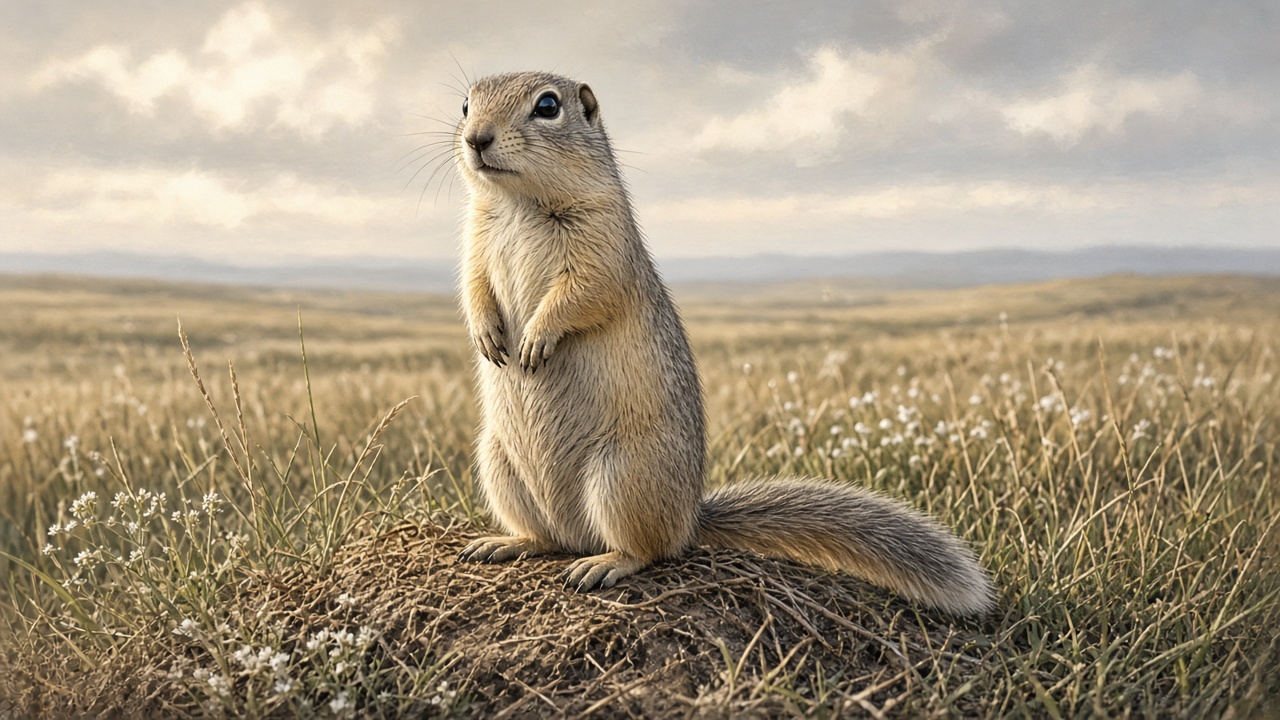
Richardson's Ground Squirrel
Urocitellus richardsoniiRichardson's Ground Squirrel (Urocitellus richardsonii): ecology sheet across its documented range — natural history and habitats, without hunting framing.
Seen in: United States
Overview
Richardson's Ground Squirrel (Urocitellus richardsonii) is an ecology sheet across its documented range: natural history and habitats, without any hunting framing.
Classification: order Rodentia, family Sciuridae, genus Urocitellus. Common names: Richardson's Ground Squirrel in English, Spermophile de Richardson in French, Ardilla terrestre de Richardson in Spanish.
Identification
A stout ground squirrel with short, dense fur: 277 to 306 mm long and 200 to 500 g depending on sex, age and season. The back is pinkish or cinnamon buff, dappled towards the rear, with pale underparts; the fronts of the forelegs, the neck and the sides of the head are a darker cinnamon buff, contrasting with a light eye ring. The tail is black above and cinnamon or clay below, edged with pinkish buff. Males are about 25% heavier than females but store less fat.
It hibernates: each animal spends only 3 to 3.5 months above ground, adult males going back underground as early as June and juveniles in September–October. Females mate 3 to 5 days after emerging, between mid-March and mid-April depending on the region; after a 22.5-day gestation, litters average 4.9 to 8.3 young, which come out of the burrow at about 29 days. Its diet is 90% plant matter (leaves, flowers, seeds, cereal grains), topped up with insects. American badgers, weasels, coyotes, hawks and great horned owls are its predators.
Habitats and range
MDD gives it on the northern Great Plains: southern Alberta, Saskatchewan and Manitoba (Canada), Montana, North Dakota, north-eastern South Dakota, western Minnesota and north-western Iowa (USA). It lives in grassland, fields, rolling hills and farmland, and thrives in pastures and ploughed fields; it places burrow entrances in short grass under 15 cm, preferably on raised ground.
The countries where the species’ presence is established are shown in the tags on this sheet.
Field signs
Colonies show up through their many burrow entrances, 142 to 162 per hectare in crops; tunnels run 4 to 15 m and reach 1 to 2 m deep. Diurnal, it emerges 95 to 130 minutes after sunrise. Its alarm calls are coded: chirps warn of a raptor and send animals running to their burrows, whistles warn of a ground predator and make them stand upright. Adults vanish underground from early summer.
Conservation
For conservation status of Urocitellus richardsonii, consult the current IUCN assessment and cross with national monitoring programmes in countries of documented presence. Never turn a global IUCN category into a local hunting rule. GBIF occurrences help situate distribution but remain effort-biased.
The IUCN lists it as Least Concern, given its wide range, abundance and lack of major threats; farming often benefits it. At high densities it is a crop and pasture pest, and it carries the tick Dermacentor andersoni and fleas that transmit plague. MDD notes its move from Spermophilus to Urocitellus (Helgen et al., 2009); ADW still describes it under the name Spermophilus richardsonii.
Limits
This sheet on the Richardson's Ground Squirrel covers biology and ecology only; it publishes no hunting season, quota or authorisation.
Local densities and management plans are not covered here: they are a matter for the managers of each area.
Sources
Sources consulted for this sheet:
- IUCN Red List — species search (consulted 2026-11-02)
- ASM Mammal Diversity Database — Urocitellus richardsonii (consulted 2026-11-02)
- GBIF — species search (consulted 2026-11-02)
- Animal Diversity Web — Spermophilus richardsonii (Richardson’s ground squirrel) (consulted 2026-11-04)
Conclusion
In short: use the scientific name Urocitellus richardsonii to cross-check sources, confirm taxonomy and conservation status on the institutional portals listed above, and relate every field sign to the habitat where it was actually found.
Identification
Urocitellus richardsonii
Richardson's Ground Squirrel · preferred
Spermophile de Richardson · preferred
Ardilla terrestre de Richardson · preferred
Spermophilus richardsonii
Classification
Class : Mammalia
Order : Rodentia
Family : Sciuridae
Genus : Urocitellus
Conservation
IUCN : LC
CITES : —
iucn · LC (global)
Habitat
Frequently asked questions
How do I recognise Richardson's Ground Squirrel?
Use Urocitellus richardsonii as the scientific anchor. A stout ground squirrel with short, dense fur: 277 to 306 mm long and 200 to 500 g depending on sex, age and season. The back is pinkish or cinnamon buff, dappled towards the rear, with pale underparts; the fronts of the forelegs, the neck and the sides of the head are a darker c...
Where does Richardson's Ground Squirrel typically live?
MDD gives it on the northern Great Plains: southern Alberta, Saskatchewan and Manitoba (Canada), Montana, North Dakota, north-eastern South Dakota, western Minnesota and north-western Iowa (USA). It lives in grassland, fields, rolling hills and farmland, and thrives in pastures and ploughed fields; it places burrow entrances in short grass under 15 cm, prefe...
What field signs help confirm Richardson's Ground Squirrel?
Colonies show up through their many burrow entrances, 142 to 162 per hectare in crops; tunnels run 4 to 15 m and reach 1 to 2 m deep. Diurnal, it emerges 95 to 130 minutes after sunrise. Its alarm calls are coded: chirps warn of a raptor and send animals running to their burrows, whistles warn of a ground predator and make them stand upright. Adults vanish u...