American Black Bear
Ursus americanusAmerican Black Bear (Ursus americanus): coexistence sheet across its documented range — presence, biology and prudence, without an invented hunting status.
Seen in: Canada · United States
Overview
American Black Bear (Ursus americanus) is a coexistence sheet across its documented range: presence, biology and prudence — not a hunting status claim.
Classification: order Carnivora, family Ursidae, genus Ursus. Common names: American Black Bear in English, Ours noir in French, Oso negro americano in Spanish.
Identification
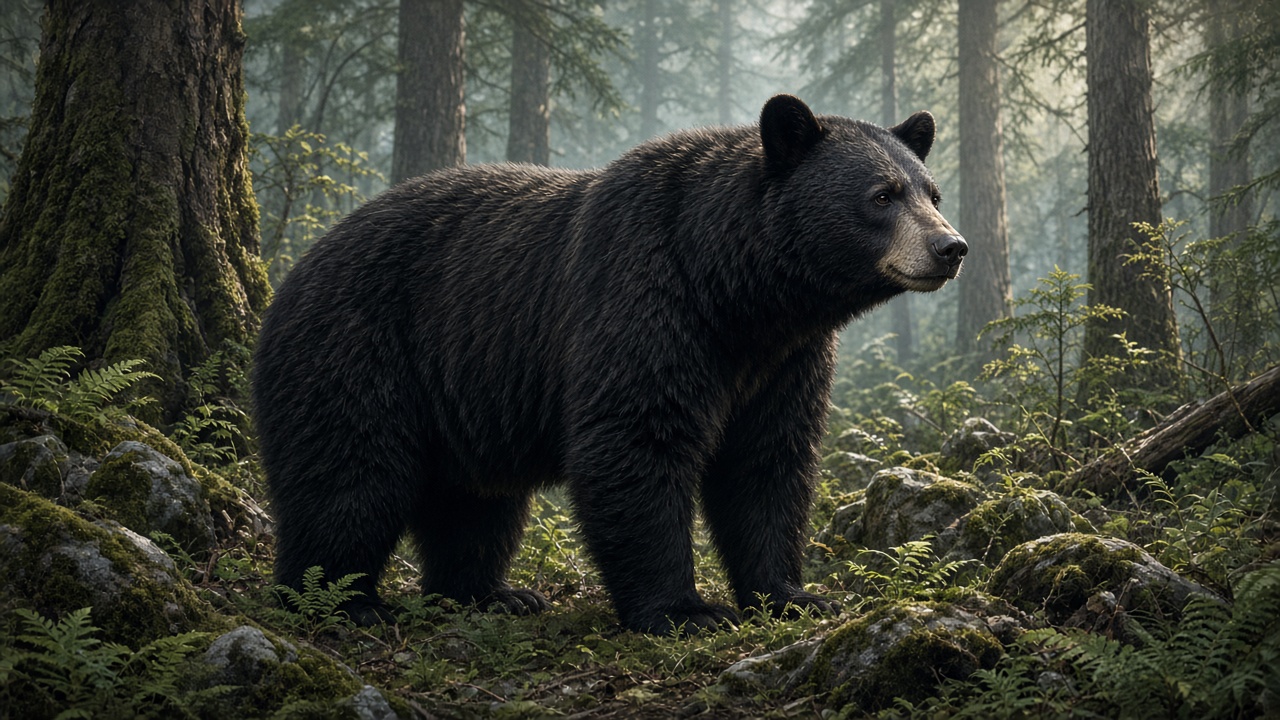
The American black bear is usually black, especially in eastern North America, with a pale muzzle and sometimes a white chest spot; western populations are more often brown, cinnamon or blonde, and some coastal populations in British Columbia and Alaska are creamy white or bluish grey. Males are 1.4 to 2 m long and weigh 47 to 409 kg, females 1.2 to 1.6 m and 39 to 236 kg; the tail is 8 to 14 cm. It differs from the brown bear in its longer, less furred ears, smaller shoulder hump and convex rather than concave profile.
An omnivore, it eats grasses and forbs in spring, fruit in summer and a mix of fruit, nuts and acorns in autumn; animal food is mostly colonial insects, beetles and carrion. Solitary, it is mainly crepuscular. Mating peaks from June to mid-July, with delayed implantation; 1 to 5 cubs, usually 2 or 3, are born in January or February in the den, weighing 200 to 450 g, and stay with their mother until about 17 months. Wolves and mountain lions may kill cubs, but most black bears that die are killed by humans.
Habitats and range
It ranges from northern Alaska east to Labrador and Newfoundland, across nearly all of Canada and much of the United States into central Mexico (Nayarit and Tamaulipas). Prime habitat combines rugged, inaccessible terrain, thick understorey and plenty of fruit and nuts. In the Southwest it uses wooded mountains between 900 and 3,000 m, chaparral and pinyon-juniper woodland; elsewhere, oak-hickory forest in the Appalachians, coastal swamps in the Southeast, mixed forest in the Northeast, Pacific coastal forest and spruce-fir forest in the Rocky Mountains.
The countries where the species’ presence is established are shown in the tags on this sheet.
Field signs
When resting it uses bed sites that are simple shallow depressions in the forest leaf litter. It scent-marks territory boundaries. Where human food or garbage is available it becomes diurnal along roadsides or nocturnal around campgrounds. Gatherings form where food is concentrated. A surprised female usually sends her cubs up a tree and then retreats or bluffs.
Conservation
For conservation status of Ursus americanus, consult the current IUCN assessment and cross with national monitoring programmes in countries of documented presence. Never turn a global IUCN category into a local hunting rule. GBIF occurrences help situate distribution but remain effort-biased.
The IUCN lists it as Least Concern and it is on CITES Appendix II. Pushed into heavily forested areas by hunting and agriculture, it remains numerous but faces regional threats from habitat destruction. More than 90% of deaths after 18 months of age are caused by humans: gunshots, trapping and road collisions. Bears that get used to food left within reach become a problem around camps and cabins.
Limits
This sheet on the American Black Bear covers presence and biology. A species being present in a country does not mean it may be hunted, and no season or quota is published here.
Local densities and management plans are not covered here: they are a matter for the managers of each area.
Sources
Sources consulted for this sheet:
- IUCN Red List — species search (consulted 2026-11-02)
- ASM Mammal Diversity Database — Ursus americanus (consulted 2026-11-02)
- GBIF — species search (consulted 2026-11-02)
- Animal Diversity Web — Ursus americanus (American black bear) (consulted 2026-11-04)
Conclusion
In short: use the scientific name Ursus americanus to cross-check sources, confirm taxonomy and conservation status on the institutional portals listed above, and relate every field sign to the habitat where it was actually found.
Identification
Ursus americanus
Ours noir · preferred
Oso negro americano · preferred
American Black Bear · preferred
Classification
Class : Mammalia
Order : Carnivora
Family : Ursidae
Genus : Ursus
Conservation
IUCN : LC
CITES : —
iucn · LC (global)
Habitat
Frequently asked questions
How do I recognise American Black Bear?
Use Ursus americanus as the scientific anchor. The American black bear is usually black, especially in eastern North America, with a pale muzzle and sometimes a white chest spot; western populations are more often brown, cinnamon or blonde, and some coastal populations in British Columbia and Alaska are creamy white or bluish...
Where does American Black Bear typically live?
It ranges from northern Alaska east to Labrador and Newfoundland, across nearly all of Canada and much of the United States into central Mexico (Nayarit and Tamaulipas). Prime habitat combines rugged, inaccessible terrain, thick understorey and plenty of fruit and nuts. In the Southwest it uses wooded mountains between 900 and 3,000 m, chaparral and pinyon-j...
What field signs help confirm American Black Bear?
When resting it uses bed sites that are simple shallow depressions in the forest leaf litter. It scent-marks territory boundaries. Where human food or garbage is available it becomes diurnal along roadsides or nocturnal around campgrounds. Gatherings form where food is concentrated. A surprised female usually sends her cubs up a tree and then retreats or blu...