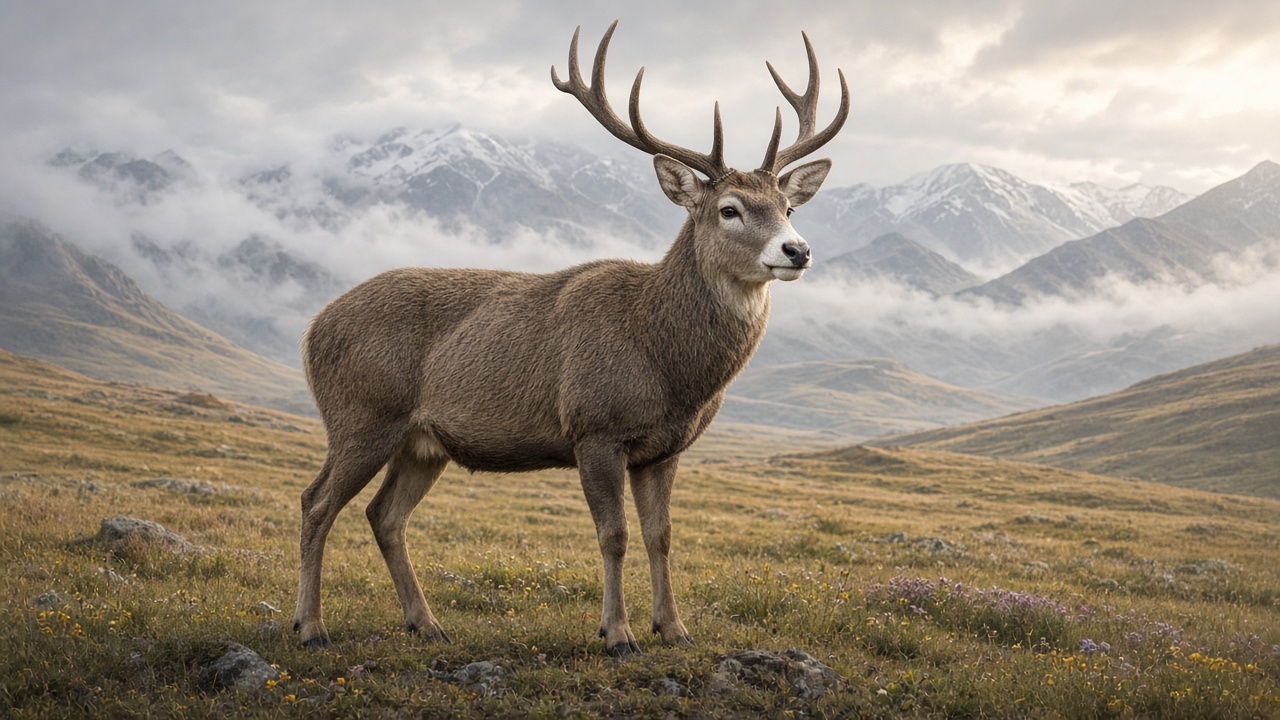
White-lipped Deer
Cervus albirostrisNo solid country presence documented yet.
White-lipped Deer (Cervus albirostris): biology, habitats and field signs across its documented range, hunting-context reading.
Overview
White-lipped Deer (Cervus albirostris) is presented here in a hunting-context reading across its documented range: biology, habitats and field signs useful to observers — without publishing season, quota or authorisation.
Classification: order Artiodactyla, family Cervidae, genus Cervus. Common names: White-lipped Deer in English, Cerf de Thorold in French, Ciervo de Thorold in Spanish.
Identification
A large deer of the Tibetan Plateau, Thorold’s deer gets its other name, white-lipped deer, from the pure white around the muzzle and on the throat. The thick, coarse coat is dark brown in summer and paler in winter, when it is twice as long; reversed hair forms a saddle-like patch in the middle of the back. The hooves are broad and rounded, suited to steep ground. Males carry flattened, forward-pointing antlers, often whitish, with five or six tines.
Males and females live in separate herds for most of the year and mix during the rut in October and November. Calves are born from May to late June, usually one per female, and stay with their mother for about ten months. The species grazes mainly on grasses and sedges (Stipa, Kobresia, Carex). Wolves and snow leopards are its main natural predators.
Habitats and range
Endemic to China (Gansu, Sichuan, eastern Tibet including Qinghai, northern Yunnan), Thorold’s deer uses high-altitude rhododendron and conifer forests and alpine meadows, roughly between 3,500 and 5,000 m, often in remote areas with little human presence. Its range is fragmented by rugged terrain and past hunting pressure.
The countries where the species’ presence is established are shown in the tags on this sheet.
Field signs
Active mostly by day, it is found through its herds on grassy slopes: groups of females and young, small groups of young males, and older males often alone. Tracks are broad and rounded, close to a cow’s. At a distance, the white muzzle and throat and the male’s flattened antlers are the best features.
Conservation
For conservation status of Cervus albirostris, consult the current IUCN assessment and cross with national monitoring programmes in countries of documented presence. Never turn a global IUCN category into a local hunting rule. GBIF occurrences help situate distribution but remain effort-biased.
The IUCN lists the species as Vulnerable. The threats described are poaching for meat and antlers (traditional medicine) and competition with domestic livestock; it is also farmed for its antlers. Its taxonomy has changed: MDD places it in Cervus (subgenus Przewalskium), other authors in the genus Przewalskium.
Limits
This sheet on the White-lipped Deer publishes no season, quota, hunting method or fee: those rules differ between countries and territories and must be checked in official texts. Being described here does not mean a species may be hunted.
Local densities and management plans are not covered here: they are a matter for the managers of each area.
Sources
Sources consulted for this sheet:
- IUCN Red List — species search (consulted 2026-11-02)
- ASM Mammal Diversity Database — Cervus albirostris (consulted 2026-11-02)
- GBIF — species search (consulted 2026-11-02)
- Animal Diversity Web — Przewalskium albirostris (white-lipped deer) (consulted 2026-11-04)
Conclusion
In short: use the scientific name Cervus albirostris to cross-check sources, confirm taxonomy and conservation status on the institutional portals listed above, and relate every field sign to the habitat where it was actually found.
Identification
Cervus albirostris
White-lipped Deer · preferred
Thorold's Deer
Przewalskium albirostris
Classification
Class : Mammalia
Order : Artiodactyla
Family : Cervidae
Genus : Cervus
Conservation
IUCN : VU
CITES : —
iucn · VU (global)
Habitat
Frequently asked questions
How do I recognise White-lipped Deer?
Use Cervus albirostris as the scientific anchor. A large deer of the Tibetan Plateau, Thorold’s deer gets its other name, white-lipped deer, from the pure white around the muzzle and on the throat. The thick, coarse coat is dark brown in summer and paler in winter, when it is twice as long; reversed hair forms a saddle-like pat...
Where does White-lipped Deer typically live?
Endemic to China (Gansu, Sichuan, eastern Tibet including Qinghai, northern Yunnan), Thorold’s deer uses high-altitude rhododendron and conifer forests and alpine meadows, roughly between 3,500 and 5,000 m, often in remote areas with little human presence. Its range is fragmented by rugged terrain and past hunting pressure.
What field signs help confirm White-lipped Deer?
Active mostly by day, it is found through its herds on grassy slopes: groups of females and young, small groups of young males, and older males often alone. Tracks are broad and rounded, close to a cow’s. At a distance, the white muzzle and throat and the male’s flattened antlers are the best features.