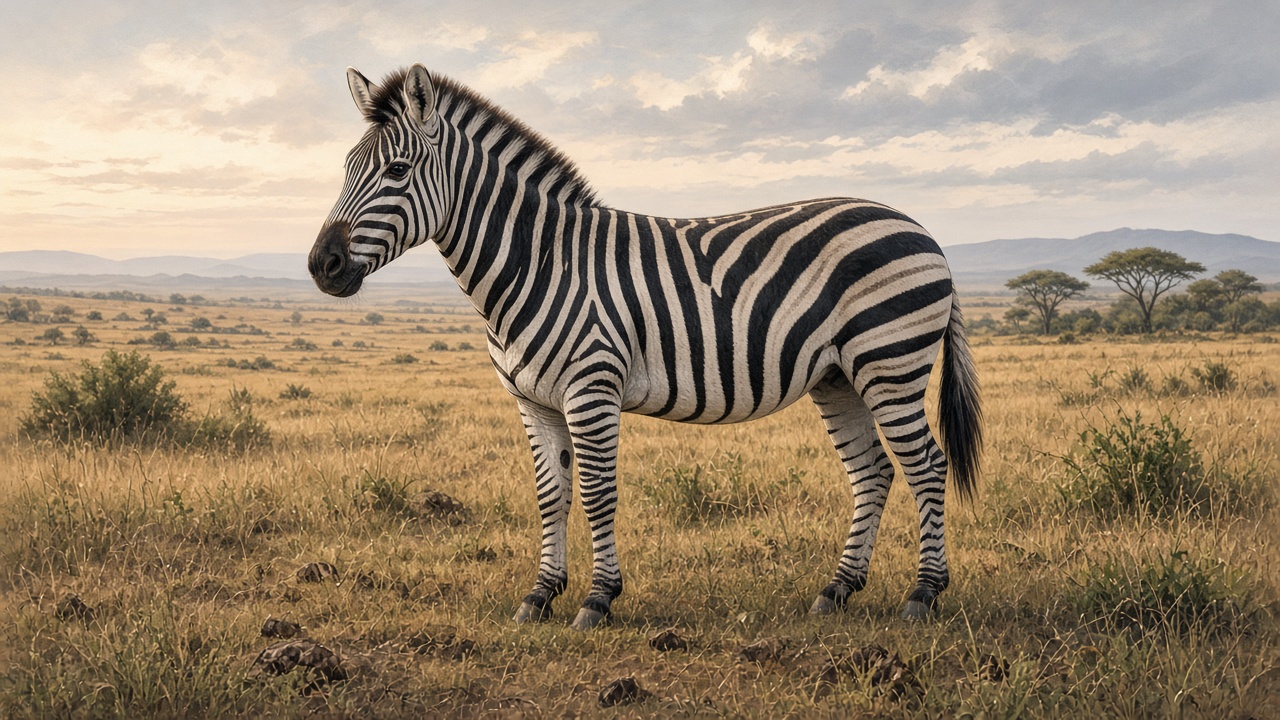
Plains Zebra
Equus quaggaPlains Zebra (Equus quagga): coexistence sheet across its documented range — presence, biology and prudence, without an invented hunting status.
Seen in: Namibia · South Africa
Overview
Plains Zebra (Equus quagga) is a coexistence sheet across its documented range: presence, biology and prudence — not a hunting status claim.
Classification: order Perissodactyla, family Equidae, genus Equus. Common names: Plains Zebra in English, Zèbre de plaine in French, Cebra común in Spanish.
Identification
The plains zebra has broad black and white stripes, vertical on the neck and forequarters and increasingly horizontal towards the flanks and rump, meeting under the belly; mountain and Grevy’s zebras have narrower, closer stripes and no belly stripes. Brownish shadow stripes often lie between the black ones; in the south of the range, stripes fade on the hindquarters, legs and belly. It measures 217 to 246 cm, 110 to 145 cm at the shoulder, and 175 to 385 kg; males are only slightly larger.
It mainly grazes short grasses, whose stems and sheaths make up 90% of its diet. It lives in permanent harems of one stallion, 1 to 6 mares and their young; young males form bachelor groups. Foals can be born in any month, with a peak in the rainy season; after 360 to 396 days of gestation a single foal is born, standing within 10 to 15 minutes. Lions, spotted hyenas, African wild dogs, cheetahs, leopards and Nile crocodiles are its predators.
Habitats and range
It lives in East and southern Africa: from southern Ethiopia and South Sudan to Kenya and Tanzania, where densities are highest, and on to Angola, Namibia, Botswana, Zimbabwe, Mozambique and north-eastern South Africa (MDD). It uses open savanna, grassland, woodland and scrub, sometimes hills and mountains up to 4,400 m, and avoids dense forest, desert and wetlands.
The countries where the species’ presence is established are shown in the tags on this sheet.
Field signs
Active by day, a harem moves in single file, the dominant mare in front and the stallion at the rear. Its high-pitched alarm call, a repeated two-syllable “kwa-hi”, signals a predator. Groups travel up to 13 km a day between resting areas in tall grass and short-grass grazing; several harems join into large herds during migrations, as in the Serengeti-Mara alongside wildebeest.
Conservation
For conservation status of Equus quagga, consult the current IUCN assessment and cross with national monitoring programmes in countries of documented presence. Never turn a global IUCN category into a local hunting rule. GBIF occurrences help situate distribution but remain effort-biased.
The IUCN lists it as Near Threatened (MDD). Numbers have fallen in recent decades, especially in southern Africa, through habitat loss, migration routes blocked by spreading agriculture, and poaching for meat and skins. MDD includes burchellii in Equus quagga: the quagga, extinct since the 19th century, was a form of this species.
Limits
This sheet on the Plains Zebra covers presence and biology. A species being present in a country does not mean it may be hunted, and no season or quota is published here.
Local densities and management plans are not covered here: they are a matter for the managers of each area.
Sources
Sources consulted for this sheet:
- IUCN Red List — species search (consulted 2026-11-02)
- ASM Mammal Diversity Database — Equus quagga (consulted 2026-11-02)
- GBIF — species search (consulted 2026-11-02)
- Animal Diversity Web — Equus burchellii (Burchell’s zebra, synonym of Equus quagga) (consulted 2026-11-04)
Conclusion
In short: use the scientific name Equus quagga to cross-check sources, confirm taxonomy and conservation status on the institutional portals listed above, and relate every field sign to the habitat where it was actually found.
Identification
Equus quagga
Plains Zebra · preferred
Zèbre de plaine · preferred
Cebra común · preferred
Common Zebra
Painted Quagga
Burchell's Zebra
Chapman's Zebra
Crawshay's Zebra
Damara Zebra
Grant's Zebra
Quagga
Zambezi Zebra
Classification
Class : Mammalia
Order : Perissodactyla
Family : Equidae
Genus : Equus
Conservation
IUCN : NT
CITES : —
iucn · NT (global)
Habitat
Frequently asked questions
How do I recognise Plains Zebra?
Use Equus quagga as the scientific anchor. The plains zebra has broad black and white stripes, vertical on the neck and forequarters and increasingly horizontal towards the flanks and rump, meeting under the belly; mountain and Grevy’s zebras have narrower, closer stripes and no belly stripes. Brownish shadow stripes ofte...
Where does Plains Zebra typically live?
It lives in East and southern Africa: from southern Ethiopia and South Sudan to Kenya and Tanzania, where densities are highest, and on to Angola, Namibia, Botswana, Zimbabwe, Mozambique and north-eastern South Africa (MDD). It uses open savanna, grassland, woodland and scrub, sometimes hills and mountains up to 4,400 m, and avoids dense forest, desert and w...
What field signs help confirm Plains Zebra?
Active by day, a harem moves in single file, the dominant mare in front and the stallion at the rear. Its high-pitched alarm call, a repeated two-syllable “kwa-hi”, signals a predator. Groups travel up to 13 km a day between resting areas in tall grass and short-grass grazing; several harems join into large herds during migrations, as in the Serengeti-Mara a...