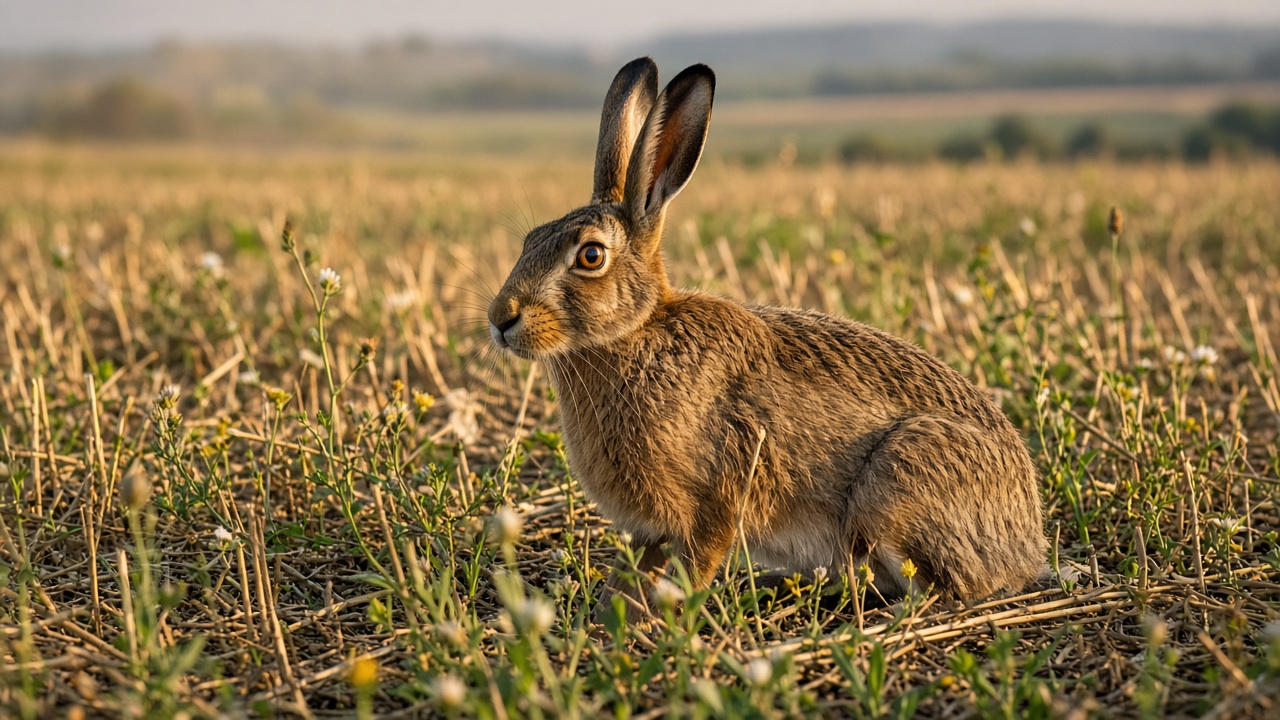
European Hare
Lepus europaeusEuropean Hare (Lepus europaeus): biology, habitats and field signs across its documented range, hunting-context reading.
Seen in: Argentina · Australia · Austria · Belgium · Bulgaria
Overview
European Hare (Lepus europaeus) is presented here in a hunting-context reading across its documented range: biology, habitats and field signs useful to observers — without publishing season, quota or authorisation.
Classification: order Lagomorpha, family Leporidae, genus Lepus. Common names: European Hare in English, Lièvre d'Europe in French, Liebre europea in Spanish.
Identification
The European hare weighs 3 to 5 kg and measures 60 to 75 cm in total length, 68 cm on average. Its long ears, 9.4 to 10.2 cm from the notch, are black-tipped and greyish white inside; the hind foot is 14 to 16 cm long. The coat is yellowish-brown to greyish-brown, the belly greyish white and the face brown with eye rings. The tail, 7 to 11 cm long, is black above and white below. In winter it does not turn white but becomes slightly greyer. There is no noticeable difference between the sexes.
A herbivore, it eats grasses, herbs and field crops in summer, and twigs, buds and the bark of shrubs, small trees and young fruit trees in winter. It re-ingests its soft green droppings. Two or three hares eat as much as one sheep. Breeding runs from January–February to midsummer, with two or more litters; after 30 to 42 days of gestation, 1 to 8 leverets are born, 3 to 5 on average, already covered in long, silky fur. The mother spreads them out to reduce predation and makes the rounds to nurse; they are weaned at about a month. Predators include red foxes, wolves, wildcats, larger hawks and owls.
Habitats and range
MDD lists it in open woodland, steppe and sub-desert, from southern Sweden and Finland to Britain and throughout Europe – except Iberia south of the Cantabrian Mountains and the Ebro, and Italy south of Siena – to the western Siberian lowlands, and south to northern Israel, Syria, Iraq and western Iran. It has been introduced to Ireland, North and South America, Australia and New Zealand. It prefers open fields and pastures bordered by hedgerows and woodlots, often near crops.
The countries where the species’ presence is established are shown in the tags on this sheet.
Field signs
By day it crouches in a form, a shallow depression in grass, weeds or a bush, often with its back showing. It feeds mostly at night, between 7 p.m. and 7 a.m., and stays active all year. When disturbed it runs very fast, up to about 60 km/h in a straight line, dodging sharply, and it will swim if needed. Usually quiet, it gives low grunts; the doe calls her leverets with a guttural sound, and a hare that is hurt or caught gives a shrill scream.
Conservation
For conservation status of Lepus europaeus, consult the current IUCN assessment, then cross with French monitoring programmes when they exist (OFB portal and related publications). Never turn a global IUCN category into a departmental hunting rule. GBIF occurrences help situate documented distribution but remain effort-biased.
The IUCN lists it as Least Concern, and ADW describes it as widespread throughout Europe. Outbreaks of increased mortality there have been linked to European Brown Hare Syndrome, which combines acute hepatosis, enteritis, nephrosis, jaundice and internal haemorrhage. Where it has been introduced, notably in Argentina and Australia, its rapid breeding makes it a crop pest, especially in young apple orchards. MDD gives no particular taxonomic note.
Limits
This sheet on the European Hare publishes no season, quota, hunting method or fee: those rules differ between countries and territories and must be checked in official texts. Being described here does not mean a species may be hunted.
Local densities and management plans are not covered here: they are a matter for the managers of each area.
Sources
Sources consulted for this sheet:
- IUCN Red List — species search (consulted 2026-11-01)
- ASM Mammal Diversity Database — Lepus europaeus (consulted 2026-11-01)
- GBIF — species search (consulted 2026-11-01)
- Animal Diversity Web — Lepus europaeus (European hare) (consulted 2026-11-05)
Conclusion
In short: use the scientific name Lepus europaeus to cross-check sources, confirm taxonomy and conservation status on the institutional portals listed above, and relate every field sign to the habitat where it was actually found.
Identification
Lepus europaeus
European Hare · preferred
Lièvre d'Europe · preferred
Liebre europea · preferred
Brown Hare
European Brown Hare
Classification
Class : Mammalia
Order : Lagomorpha
Family : Leporidae
Genus : Lepus
Conservation
IUCN : LC
CITES : —
iucn · LC (global)
Habitat
Practices
Frequently asked questions
How do I recognise European Hare?
Use Lepus europaeus as the scientific anchor. The European hare weighs 3 to 5 kg and measures 60 to 75 cm in total length, 68 cm on average. Its long ears, 9.4 to 10.2 cm from the notch, are black-tipped and greyish white inside; the hind foot is 14 to 16 cm long. The coat is yellowish-brown to greyish-brown, the belly greyi...
Where does European Hare typically live?
MDD lists it in open woodland, steppe and sub-desert, from southern Sweden and Finland to Britain and throughout Europe – except Iberia south of the Cantabrian Mountains and the Ebro, and Italy south of Siena – to the western Siberian lowlands, and south to northern Israel, Syria, Iraq and western Iran. It has been introduced to Ireland, North and South Amer...
What field signs help confirm European Hare?
By day it crouches in a form, a shallow depression in grass, weeds or a bush, often with its back showing. It feeds mostly at night, between 7 p.m. and 7 a.m., and stays active all year. When disturbed it runs very fast, up to about 60 km/h in a straight line, dodging sharply, and it will swim if needed. Usually quiet, it gives low grunts; the doe calls her...