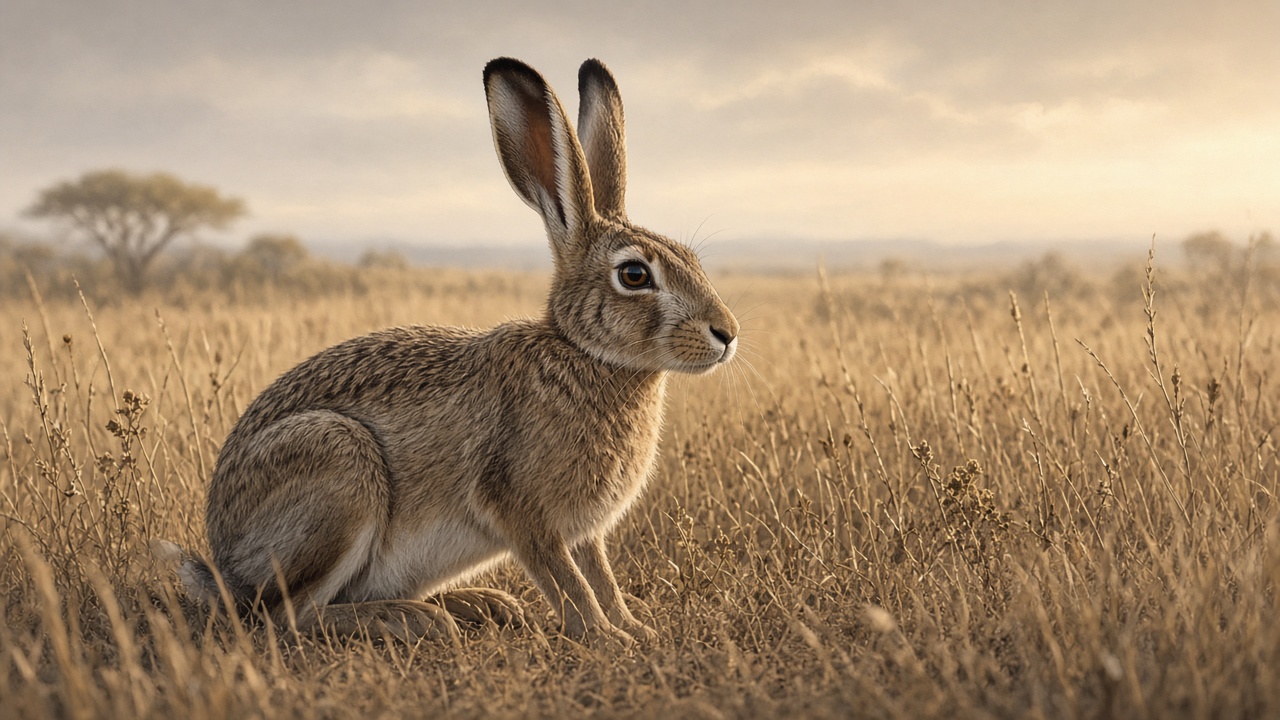
African Savanna Hare
Lepus microtisAfrican Savanna Hare (Lepus microtis): biology, habitats and field signs across its documented range, hunting-context reading.
Seen in: Namibia · South Africa
Overview
African Savanna Hare (Lepus microtis) is presented here in a hunting-context reading across its documented range: biology, habitats and field signs useful to observers — without publishing season, quota or authorisation.
Classification: order Lagomorpha, family Leporidae, genus Lepus. Common names: African Savanna Hare in English, Lièvre des savanes in French, Liebre de sabana africana in Spanish.
Identification
A medium-sized hare (41 to 58 cm, 1.5 to 3 kg) with thick, coarse fur: greyish-brown back, white belly and a russet tinge on the chest, flanks, legs and nape. The ears are black-tipped and the tail is black above and white below. It looks very like the Cape hare, which shares much of its range; the reliable feature is a deep groove on the incisors, visible only in the hand or on a skull.
Solitary and strictly nocturnal, it relies on camouflage and then on running, up to 70 km/h, with sudden sideways leaps that break its scent trail. When chased, it takes refuge in an aardvark or warthog burrow. It breeds all year round with several litters; leverets are born in the open with their eyes open and are weaned at about one month. It eats mainly grasses, plus herbs, roots, bark and fallen fruit.
Habitats and range
It ranges across sub-Saharan Africa, from the Atlantic coast (Senegal, Guinea, Sierra Leone) through the Sahel to Sudan and western Ethiopia, then south through East Africa to Botswana, Namibia and north-eastern South Africa, with an isolated population in western Algeria (Beni Abbès). It prefers scrubby grassland within woodland, cultivation mosaics and stony wooded steppe.
The countries where the species’ presence is established are shown in the tags on this sheet.
Field signs
Rarely seen by day, it is mostly found at night with a lamp, on tracks and along field edges. Dry round daytime pellets, grazed grass and gnawed bark show its presence. A flushed hare that runs in a zigzag and then leaps sideways matches its escape behaviour.
Conservation
For conservation status of Lepus microtis, consult the current IUCN assessment and cross with national monitoring programmes in countries of documented presence. Never turn a global IUCN category into a local hunting rule. GBIF occurrences help situate distribution but remain effort-biased.
A widespread species, not threatened according to ADW; the IUCN assesses it under the name Lepus victoriae (Least Concern), which is why MDD shows it as not evaluated under Lepus microtis. Its valid name has changed several times (saxatilis, crawshayi, whytei, victoriae, microtis).
Limits
This sheet on the African Savanna Hare publishes no season, quota, hunting method or fee: those rules differ between countries and territories and must be checked in official texts. Being described here does not mean a species may be hunted.
Local densities and management plans are not covered here: they are a matter for the managers of each area.
Sources
Sources consulted for this sheet:
- IUCN Red List — species search (consulted 2026-11-02)
- ASM Mammal Diversity Database — Lepus microtis (consulted 2026-11-02)
- GBIF — species search (consulted 2026-11-02)
- Animal Diversity Web — Lepus microtis (African savanna hare) (consulted 2026-11-04)
Conclusion
In short: use the scientific name Lepus microtis to cross-check sources, confirm taxonomy and conservation status on the institutional portals listed above, and relate every field sign to the habitat where it was actually found.
Identification
Lepus microtis
African Savanna Hare · preferred
Lepus victoriae
Classification
Class : Mammalia
Order : Lagomorpha
Family : Leporidae
Genus : Lepus
Conservation
IUCN : LC
CITES : —
iucn · LC (global)
Habitat
Frequently asked questions
How do I recognise African Savanna Hare?
Use Lepus microtis as the scientific anchor. A medium-sized hare (41 to 58 cm, 1.5 to 3 kg) with thick, coarse fur: greyish-brown back, white belly and a russet tinge on the chest, flanks, legs and nape. The ears are black-tipped and the tail is black above and white below. It looks very like the Cape hare, which shares muc...
Where does African Savanna Hare typically live?
It ranges across sub-Saharan Africa, from the Atlantic coast (Senegal, Guinea, Sierra Leone) through the Sahel to Sudan and western Ethiopia, then south through East Africa to Botswana, Namibia and north-eastern South Africa, with an isolated population in western Algeria (Beni Abbès). It prefers scrubby grassland within woodland, cultivation mosaics and sto...
What field signs help confirm African Savanna Hare?
Rarely seen by day, it is mostly found at night with a lamp, on tracks and along field edges. Dry round daytime pellets, grazed grass and gnawed bark show its presence. A flushed hare that runs in a zigzag and then leaps sideways matches its escape behaviour.