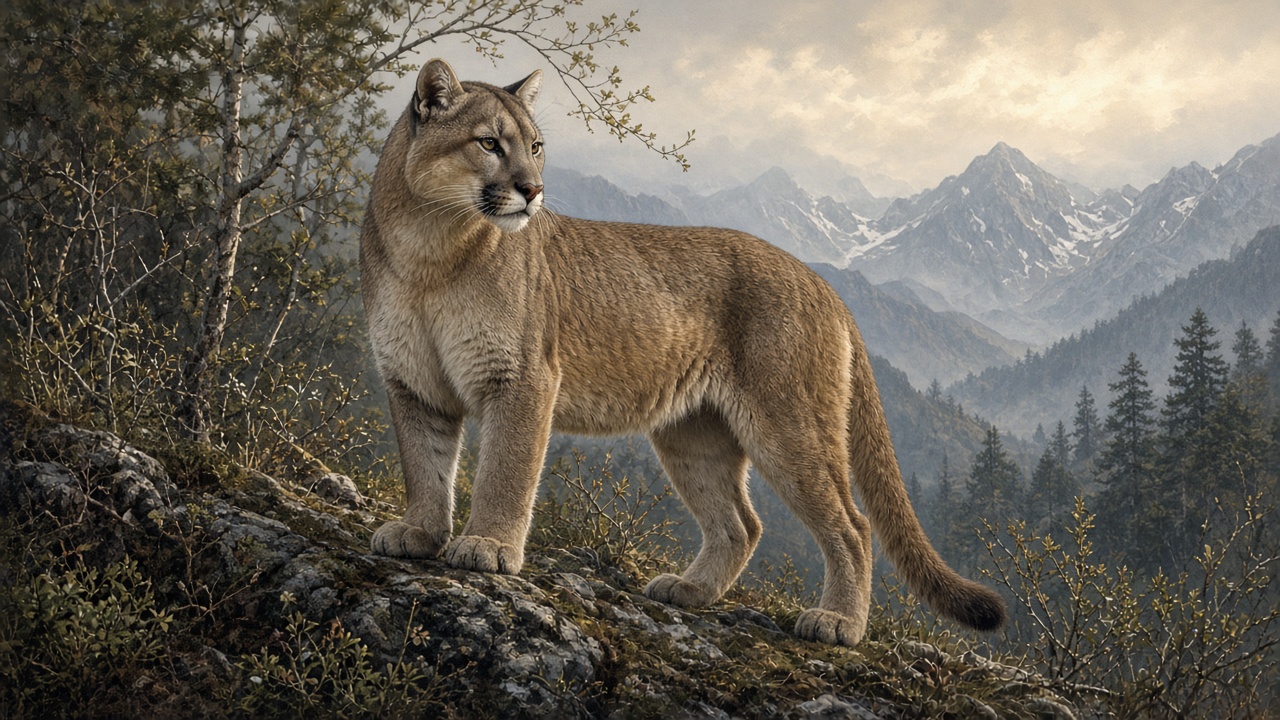
Puma (Puma concolor): coexistence sheet across its documented range — presence, biology and prudence, without an invented hunting status.
Seen in: Brazil · United States
Overview
Puma (Puma concolor) is a coexistence sheet across its documented range: presence, biology and prudence — not a hunting status claim.
Classification: order Carnivora, family Felidae, genus Puma. Common names: Puma in English, Puma in French, Puma in Spanish.
Identification
A large, slender cat with a short, coarse coat, the puma is yellowish-brown to greyish-brown above and pale buff below, with a whitish throat and chest. The pink nose is edged in black down to the lips; the muzzle stripes, the backs of the ears and the tail tip are black. The long, cylindrical tail is about a third of the total length. Males measure 102 to 154 cm in head and body (tail 68 to 96 cm) and weigh 36 to 120 kg; females 86 to 131 cm (tail 63 to 79 cm) and 29 to 64 kg.
Solitary except when mating and raising young, and mainly nocturnal, it hunts chiefly ungulates (moose, elk, deer, caribou) but also squirrels, beavers, porcupines, raccoons, rabbits, birds and even snails or fish. It stalks quietly, leaps onto the back and bites below the base of the skull; it takes about 48 ungulates a year. Breeding occurs year-round, mostly from December to March in the north; after 82 to 96 days, 1 to 6 cubs are born, staying with their mother for 15 months on average.
Habitats and range
MDD gives it from Canada to Argentina and Chile, through the United States, Mexico, Central and South America. According to ADW it once had the largest range of any American land mammal, from south-eastern Alaska to southern Argentina and Chile; it was wiped out in eastern North America except for the Florida panther, but is spreading again in the western United States, into suburban California. It uses montane conifer forest, lowland tropical forest, grassland, dry brush country and swamps wherever there is cover and prey.
The countries where the species’ presence is established are shown in the tags on this sheet.
Field signs
It marks its territory with urine or scats left on scrapes by trees. It drags large prey up to 350 m and buries it under leaves and debris, returning each night. It hisses, growls, purrs, yowls and screams; young call their mother with chirping whistles. Secretive, it generally avoids people but sometimes attacks them, usually children or small adults alone at dawn, dusk or night.
Conservation
For conservation status of Puma concolor, consult the current IUCN assessment and cross with national monitoring programmes in countries of documented presence. Never turn a global IUCN category into a local hunting rule. GBIF occurrences help situate distribution but remain effort-biased.
The IUCN lists it as Least Concern. Some subspecies are on CITES Appendix I, the rest on Appendix II. In the United States, the Florida panther (P. c. coryi) and P. c. costaricensis are considered endangered; two eastern populations (schorgeri and couguar) are extinct. In eastern North America outside Florida, sightings more likely involve escaped captive animals.
Limits
This sheet on the Puma covers presence and biology. A species being present in a country does not mean it may be hunted, and no season or quota is published here.
Local densities and management plans are not covered here: they are a matter for the managers of each area.
Sources
Sources consulted for this sheet:
- IUCN Red List — species search (consulted 2026-11-02)
- ASM Mammal Diversity Database — Puma concolor (consulted 2026-11-02)
- GBIF — species search (consulted 2026-11-02)
- Animal Diversity Web — Puma concolor (cougar) (consulted 2026-11-04)
Conclusion
In short: use the scientific name Puma concolor to cross-check sources, confirm taxonomy and conservation status on the institutional portals listed above, and relate every field sign to the habitat where it was actually found.
Identification
Puma concolor
Puma · preferred
Puma · preferred
Puma · preferred
Cougar
Mountain Lion
Catamount
Panther
Florida Panther
Classification
Class : Mammalia
Order : Carnivora
Family : Felidae
Genus : Puma
Conservation
IUCN : LC
CITES : —
iucn · LC (global)
Habitat
Frequently asked questions
How do I recognise Puma?
Use Puma concolor as the scientific anchor. A large, slender cat with a short, coarse coat, the puma is yellowish-brown to greyish-brown above and pale buff below, with a whitish throat and chest. The pink nose is edged in black down to the lips; the muzzle stripes, the backs of the ears and the tail tip are black. The lon...
Where does Puma typically live?
MDD gives it from Canada to Argentina and Chile, through the United States, Mexico, Central and South America. According to ADW it once had the largest range of any American land mammal, from south-eastern Alaska to southern Argentina and Chile; it was wiped out in eastern North America except for the Florida panther, but is spreading again in the western Un...
What field signs help confirm Puma?
It marks its territory with urine or scats left on scrapes by trees. It drags large prey up to 350 m and buries it under leaves and debris, returning each night. It hisses, growls, purrs, yowls and screams; young call their mother with chirping whistles. Secretive, it generally avoids people but sometimes attacks them, usually children or small adults alone...