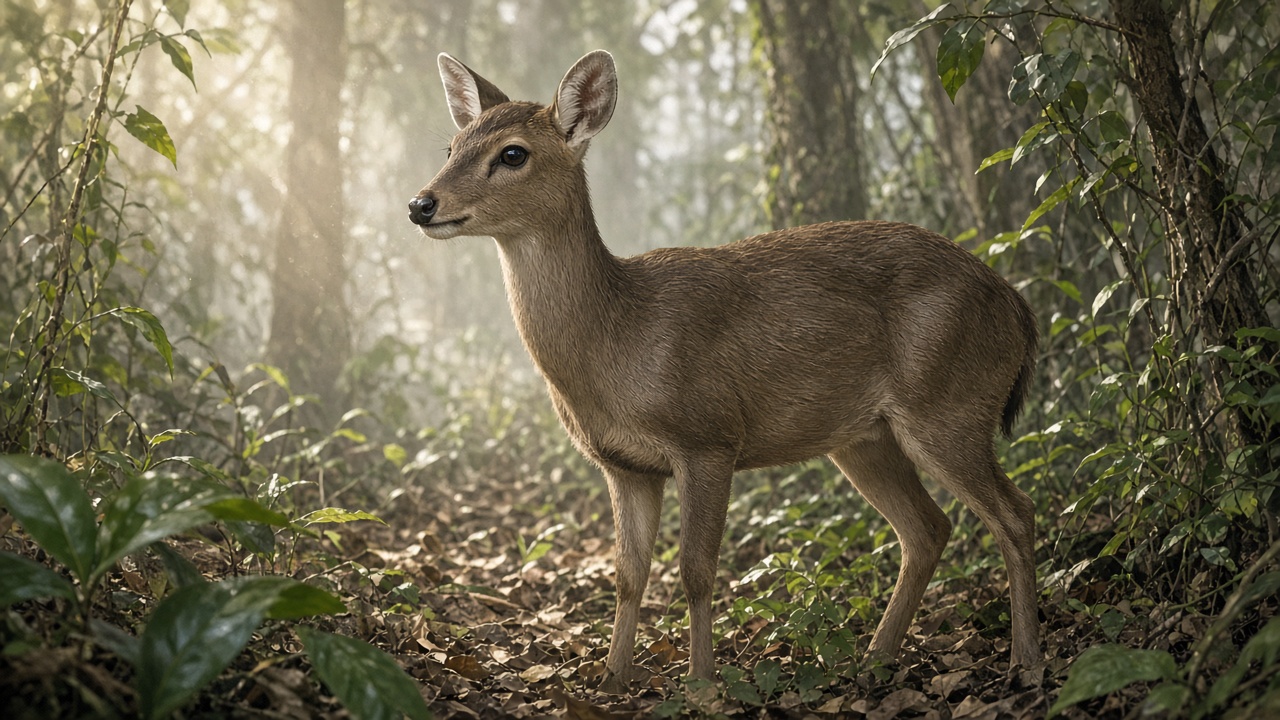
Southern Brown Brocket
Subulo gouazoubiraSouthern Brown Brocket (Subulo gouazoubira): biology, habitats and field signs across its documented range, hunting-context reading.
Seen in: Argentina · Brazil
Overview
Southern Brown Brocket (Subulo gouazoubira) is presented here in a hunting-context reading across its documented range: biology, habitats and field signs useful to observers — without publishing season, quota or authorisation.
Classification: order Artiodactyla, family Cervidae, genus Subulo. Common names: Southern Brown Brocket in English, Daguet gris in French, Corzuela parda in Spanish.
Identification
A small deer 85 to 105 cm long and about 65 cm at the shoulder, the gray brocket weighs 8 to 25 kg, 15.6 kg on average. Its coat ranges from greyish-brown to reddish-brown, paler on the flanks, and the underside of the tail is white. Males carry simple, unbranched spike antlers 7 to 10 cm long. Slightly smaller than the red brocket (Mazama americana), it differs in its straighter back, which gives it a more typical deer-like outline.
Mainly a fruit eater, in the wet season (November to February) it seeks the soft, fleshy fruit of shrubs, and in the dry season the dry, tough fruit of Ziziphus and Caesalpinia; in the Chaco it also eats cactus and bromeliad fruit, succulent leaves and roots to meet its water needs. Breeding appears continuous: spotted fawns are seen all year, and a single young (rarely twins) is born after about eight months of gestation in captivity. Ocelots, jaguars, pumas, large raptors and domestic dogs prey on it.
Habitats and range
MDD’s distribution text also names countries in northern South America, but its country list keeps Argentina, Bolivia, Brazil, Paraguay and Uruguay, since the species formerly included Mazama nemorivaga. It uses open habitats such as the thorn scrub of the Chaco and savannas, as well as swamps and the edges of secondary vegetation and transitional forest, including very dry areas.
The countries where the species’ presence is established are shown in the tags on this sheet.
Field signs
Solitary and rarely seen in threes, it stays in dense cover by day and comes out into the open at night to forage. It marks its range with urine, droppings, forehead rubbing and thrashing of vegetation; females and young mark mostly in the core of their range, while males more often mark outside it. While young, the fawn lies hidden in grass, much like a white-tailed deer fawn.
Conservation
For conservation status of Subulo gouazoubira, consult the current IUCN assessment and cross with national monitoring programmes in countries of documented presence. Never turn a global IUCN category into a local hunting rule. GBIF occurrences help situate distribution but remain effort-biased.
ADW gives it as Least Concern; MDD shows it as not evaluated under its current name. Intensive hunting has caused a local decline in the central Chaco, and habitat destruction threatens some populations. Long known as Mazama gouazoubira, it was moved to the genus Subulo, resurrected in 2023 with the designation of a neotype; MDD includes superciliaris, which Groves and Grubb considered distinct.
Limits
This sheet on the Southern Brown Brocket publishes no season, quota, hunting method or fee: those rules differ between countries and territories and must be checked in official texts. Being described here does not mean a species may be hunted.
Local densities and management plans are not covered here: they are a matter for the managers of each area.
Sources
Sources consulted for this sheet:
- IUCN Red List — species search (consulted 2026-11-02)
- ASM Mammal Diversity Database — Subulo gouazoubira (consulted 2026-11-02)
- GBIF — species search (consulted 2026-11-02)
- Animal Diversity Web — Mazama gouazoubira (South American brown brocket) (consulted 2026-11-04)
Conclusion
In short: use the scientific name Subulo gouazoubira to cross-check sources, confirm taxonomy and conservation status on the institutional portals listed above, and relate every field sign to the habitat where it was actually found.
Identification
Subulo gouazoubira
Daguet gris · preferred
Corzuela parda · preferred
Southern Brown Brocket · preferred
Brown Brocket
Gray Brocket
Common Brown Brocket
Mazama gouazoubira
Classification
Class : Mammalia
Order : Artiodactyla
Family : Cervidae
Genus : Subulo
Conservation
IUCN : LC
CITES : —
iucn · LC (global)
Frequently asked questions
How do I recognise Southern Brown Brocket?
Use Subulo gouazoubira as the scientific anchor. A small deer 85 to 105 cm long and about 65 cm at the shoulder, the gray brocket weighs 8 to 25 kg, 15.6 kg on average. Its coat ranges from greyish-brown to reddish-brown, paler on the flanks, and the underside of the tail is white. Males carry simple, unbranched spike antlers 7...
Where does Southern Brown Brocket typically live?
MDD’s distribution text also names countries in northern South America, but its country list keeps Argentina, Bolivia, Brazil, Paraguay and Uruguay, since the species formerly included Mazama nemorivaga. It uses open habitats such as the thorn scrub of the Chaco and savannas, as well as swamps and the edges of secondary vegetation and transitional forest, in...
What field signs help confirm Southern Brown Brocket?
Solitary and rarely seen in threes, it stays in dense cover by day and comes out into the open at night to forage. It marks its range with urine, droppings, forehead rubbing and thrashing of vegetation; females and young mark mostly in the core of their range, while males more often mark outside it. While young, the fawn lies hidden in grass, much like a whi...