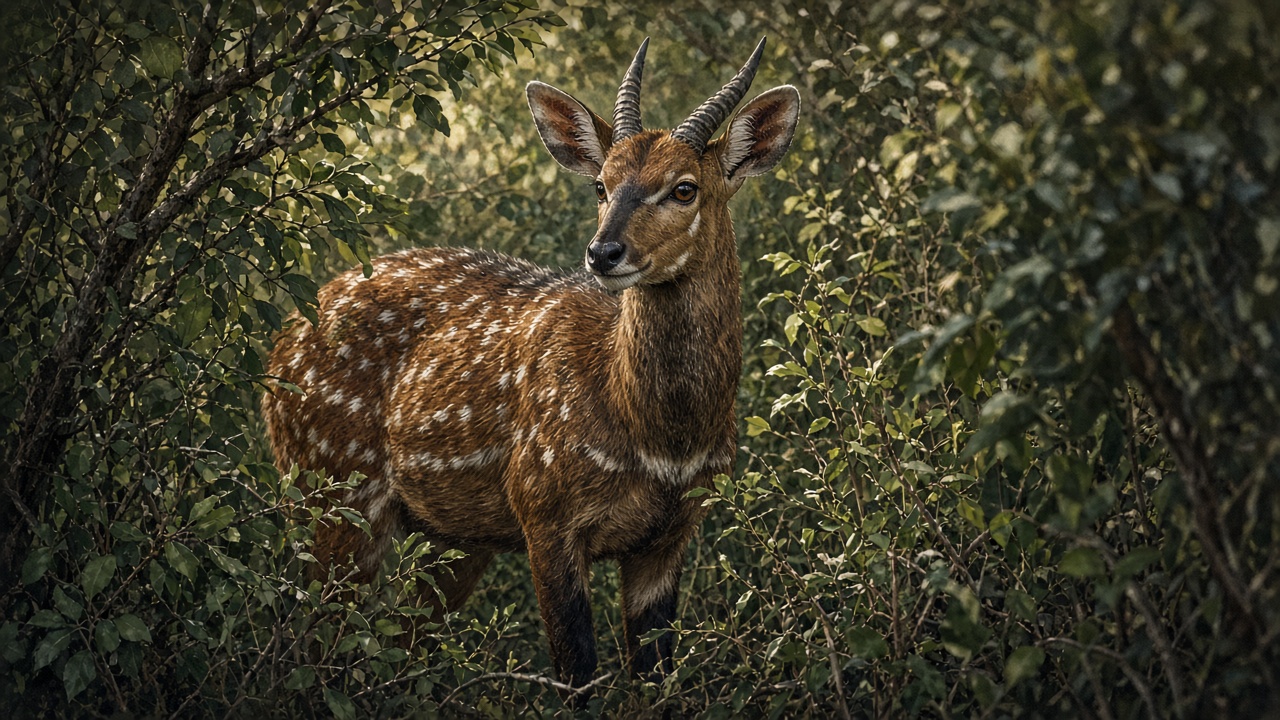
Northern Bushbuck
Tragelaphus scriptusNo solid country presence documented yet.
Northern Bushbuck (Tragelaphus scriptus): coexistence sheet across its documented range — presence, biology and prudence, without an invented hunting status.
Overview
Northern Bushbuck (Tragelaphus scriptus) is a coexistence sheet across its documented range: presence, biology and prudence — not a hunting status claim.
Classification: order Artiodactyla, family Bovidae, genus Tragelaphus. Common names: Northern Bushbuck in English, Guib harnaché in French, Antílope de cinta in Spanish.
Identification
A medium-sized antelope with clear sexual dimorphism: males weigh 40 to 80 kg and stand 70 to 100 cm at the shoulder, females 25 to 60 kg and 65 to 85 cm. Only males have horns, which usually make a single spiral turn and stay fairly straight and parallel, up to half a metre long. Females are a lighter brown than males. Both sexes carry white spots and stripes whose pattern varies geographically; MDD lists Harnessed Bushbuck among its other common names.
A browser, it eats herbs and the leaves, twigs and flowers of many plant species, and occasionally fresh grass. Young can be born at any time of year, with a peak in the rainy season in arid regions. Gestation lasts only about 180 days, so a female can raise more than one calf a year; the single calf, of about 4 kg, stays hidden in the undergrowth for up to four months while its mother returns to nurse it. Sexual maturity comes at one year, but males’ horns only reach full size at about three years.
Habitats and range
According to MDD, the northern bushbuck ranges from Senegal and southern Mauritania across the Sahel to Ethiopia, and south to Angola and the southern Democratic Republic of the Congo. It lives wherever there is enough cover to hide in, almost regardless of altitude or aridity: forest edges and brushy thickets along rivers and streams, from which it moves at night into more open areas to forage.
The countries where the species’ presence is established are shown in the tags on this sheet.
Field signs
Mainly nocturnal, sometimes active at dawn or dusk, it spends the day in dense thickets, often near water, and never strays far from cover. It is usually seen alone or in small groups of females with young; as it is not territorial, several may live close together in good habitat. A very capable swimmer, it also lives on the outskirts of towns, where it damages gardens.
Conservation
For conservation status of Tragelaphus scriptus, consult the current IUCN assessment and cross with national monitoring programmes in countries of documented presence. Never turn a global IUCN category into a local hunting rule. GBIF occurrences help situate distribution but remain effort-biased.
The IUCN lists it as Least Concern (MDD, ADW); it coexists with people better than many other species. ADW notes that it is often bitten by tsetse flies, which can pass nagana to cattle. MDD includes phaleratus, bor and decula but keeps T. sylvaticus separate, even though a recent study proposed merging the two; the ADW account covers bushbuck in the broad sense, before that split.
Limits
This sheet on the Northern Bushbuck covers presence and biology. A species being present in a country does not mean it may be hunted, and no season or quota is published here.
Local densities and management plans are not covered here: they are a matter for the managers of each area.
Sources
Sources consulted for this sheet:
- IUCN Red List — species search (consulted 2026-11-02)
- ASM Mammal Diversity Database — Tragelaphus scriptus (consulted 2026-11-02)
- GBIF — species search (consulted 2026-11-02)
- Animal Diversity Web — Tragelaphus scriptus (bushbuck) (consulted 2026-11-04)
Conclusion
In short: use the scientific name Tragelaphus scriptus to cross-check sources, confirm taxonomy and conservation status on the institutional portals listed above, and relate every field sign to the habitat where it was actually found.
Identification
Tragelaphus scriptus
Guib harnaché · preferred
Antílope de cinta · preferred
Northern Bushbuck · preferred
Western Bushbuck
Harnessed Bushbuck
Harnessed Antelope
Central Bushbuck
Nile Bushbuck
Lake Tana Bushbuck
Senegal Bushbuck
Kabinda Bushbuck
Abyssinian Bushbuck
Kewel
Classification
Class : Mammalia
Order : Artiodactyla
Family : Bovidae
Genus : Tragelaphus
Conservation
IUCN : LC
CITES : —
iucn · LC (global)
Frequently asked questions
How do I recognise Northern Bushbuck?
Use Tragelaphus scriptus as the scientific anchor. A medium-sized antelope with clear sexual dimorphism: males weigh 40 to 80 kg and stand 70 to 100 cm at the shoulder, females 25 to 60 kg and 65 to 85 cm. Only males have horns, which usually make a single spiral turn and stay fairly straight and parallel, up to half a metre long...
Where does Northern Bushbuck typically live?
According to MDD, the northern bushbuck ranges from Senegal and southern Mauritania across the Sahel to Ethiopia, and south to Angola and the southern Democratic Republic of the Congo. It lives wherever there is enough cover to hide in, almost regardless of altitude or aridity: forest edges and brushy thickets along rivers and streams, from which it moves at...
What field signs help confirm Northern Bushbuck?
Mainly nocturnal, sometimes active at dawn or dusk, it spends the day in dense thickets, often near water, and never strays far from cover. It is usually seen alone or in small groups of females with young; as it is not territorial, several may live close together in good habitat. A very capable swimmer, it also lives on the outskirts of towns, where it dama...