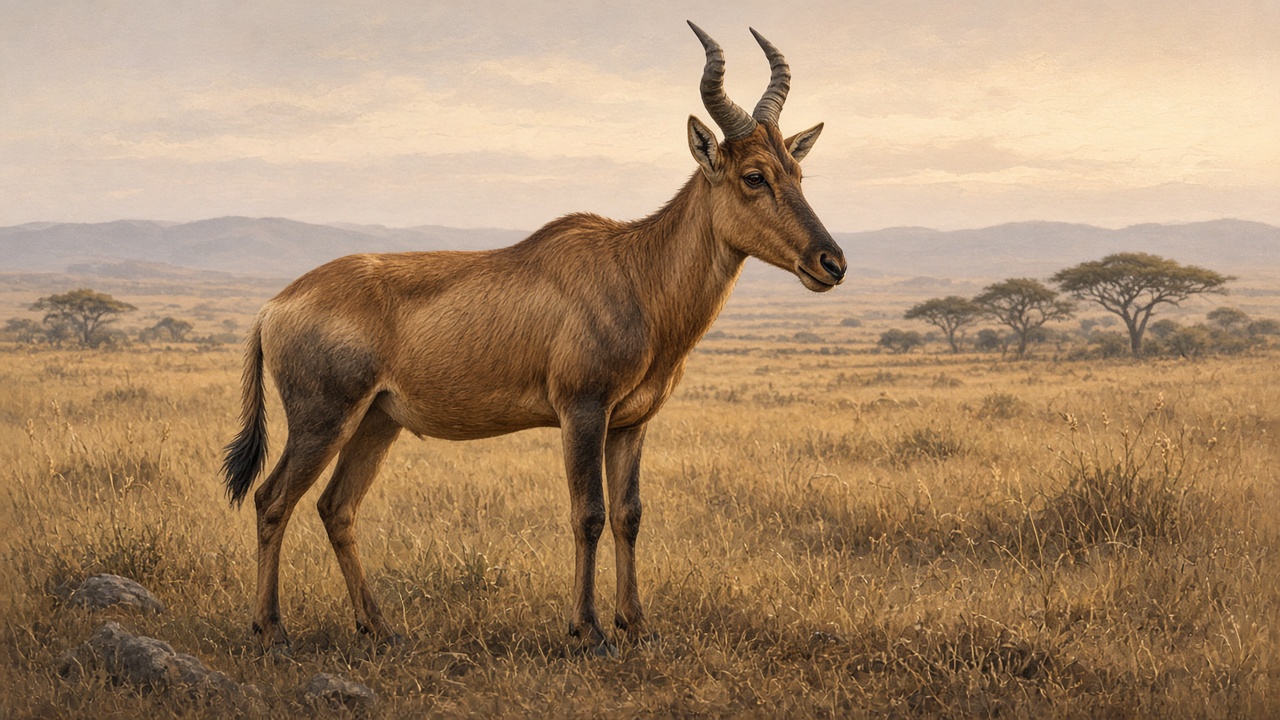
Hartebeest
Alcelaphus buselaphusHartebeest (Alcelaphus buselaphus): coexistence sheet across its documented range — presence, biology and prudence, without an invented hunting status.
Seen in: Namibia · South Africa
Overview
Hartebeest (Alcelaphus buselaphus) is a coexistence sheet across its documented range: presence, biology and prudence — not a hunting status claim.
Classification: order Artiodactyla, family Bovidae, genus Alcelaphus. Common names: Hartebeest in English, Bubale roux in French, Alcélafo común in Spanish.
Identification
The hartebeest is a large antelope 1.5 to 2.45 m long, 1.1 to 1.5 m at the shoulder and 75 to 200 kg, with a tufted tail of 30 to 70 cm. The back slopes steeply down to the rear, the legs are long and the muzzle long and narrow, with large glands below the eyes. The fine hair, about 25 mm long, is paler on most of the rump, the chest and parts of the face. Both sexes carry horns 45 to 70 cm long rising from a single pedicle. Subspecies differ in coat colour, from pale brown to brownish grey, and in horn shape.
An almost pure grass-eater, with grass making up over 95% of its diet in the wet season and never less than 80%, it copes with poor-quality food, and its long muzzle helps it crop tough, dry grasses. Herds of up to 300 animals include territorial males, non-territorial males, groups of young males and groups of females with young. Birth peaks vary by region: October–November in South Africa, December to February in Ethiopia. After 214 to 242 days the female gives birth to a single calf away from the herd in scrub, leaving it hidden there for a few weeks.
Habitats and range
MDD describes a vast, fragmented range: extinct in North Africa (Morocco, Algeria, Tunisia, marginally Libya), it occurs in West and Central Africa from Senegal to Ethiopia, in East Africa (Kenya, Tanzania, Uganda) and in southern Africa (Angola, Botswana, Namibia, South Africa, Zambia, Malawi, Mozambique, Zimbabwe). It lives in savanna and grassland, tolerates tall grass and enters woodland and scrub more than other alcelaphines. It does not migrate, but severe drought can shift a population.
The countries where the species’ presence is established are shown in the tags on this sheet.
Field signs
Conspicuous and sedentary, a herd may post a sentinel. Territorial males prefer open ground on plateaus or ridges and deposit droppings on established dung piles before any fight. When alarmed, hartebeest snort to warn one another and gallop off in single file at up to 70 to 80 km/h, making sudden right-angle turns.
Conservation
For conservation status of Alcelaphus buselaphus, consult the current IUCN assessment and cross with national monitoring programmes in countries of documented presence. Never turn a global IUCN category into a local hunting rule. GBIF occurrences help situate distribution but remain effort-biased.
The IUCN lists the species as Least Concern, but Swayne’s hartebeest (A. b. swaynei) and the Tora hartebeest (A. b. tora) are endangered, with small and declining populations. Declines are attributed to the spread of cattle, habitat destruction and hunting; it has probably suffered the greatest range contraction of any African ruminant. MDD includes caama, cokii, lelwel, lichtensteinii, major, swaynei and tora, which other authors treat as separate.
Limits
This sheet on the Hartebeest covers presence and biology. A species being present in a country does not mean it may be hunted, and no season or quota is published here.
Local densities and management plans are not covered here: they are a matter for the managers of each area.
Sources
Sources consulted for this sheet:
- IUCN Red List — species search (consulted 2026-11-02)
- ASM Mammal Diversity Database — Alcelaphus buselaphus (consulted 2026-11-02)
- GBIF — species search (consulted 2026-11-02)
- Animal Diversity Web — Alcelaphus buselaphus (hartebeest) (consulted 2026-11-04)
Conclusion
In short: use the scientific name Alcelaphus buselaphus to cross-check sources, confirm taxonomy and conservation status on the institutional portals listed above, and relate every field sign to the habitat where it was actually found.
Identification
Alcelaphus buselaphus
Hartebeest · preferred
Bubale roux · preferred
Alcélafo común · preferred
Red Hartebeest
Lelwel Hartebeest
Western Hartebeest
Coke's Hartebeest
Swayne's Hartebeest
Tora Hartebeest
Kongoni
Kanki
Korkay
Bubal Hartebeest
Lichtenstein's Hartebeest
Classification
Class : Mammalia
Order : Artiodactyla
Family : Bovidae
Genus : Alcelaphus
Conservation
IUCN : LC
CITES : —
iucn · LC (global)
Habitat
Frequently asked questions
How do I recognise Hartebeest?
Use Alcelaphus buselaphus as the scientific anchor. The hartebeest is a large antelope 1.5 to 2.45 m long, 1.1 to 1.5 m at the shoulder and 75 to 200 kg, with a tufted tail of 30 to 70 cm. The back slopes steeply down to the rear, the legs are long and the muzzle long and narrow, with large glands below the eyes. The fine hair, ab...
Where does Hartebeest typically live?
MDD describes a vast, fragmented range: extinct in North Africa (Morocco, Algeria, Tunisia, marginally Libya), it occurs in West and Central Africa from Senegal to Ethiopia, in East Africa (Kenya, Tanzania, Uganda) and in southern Africa (Angola, Botswana, Namibia, South Africa, Zambia, Malawi, Mozambique, Zimbabwe). It lives in savanna and grassland, tolera...
What field signs help confirm Hartebeest?
Conspicuous and sedentary, a herd may post a sentinel. Territorial males prefer open ground on plateaus or ridges and deposit droppings on established dung piles before any fight. When alarmed, hartebeest snort to warn one another and gallop off in single file at up to 70 to 80 km/h, making sudden right-angle turns.