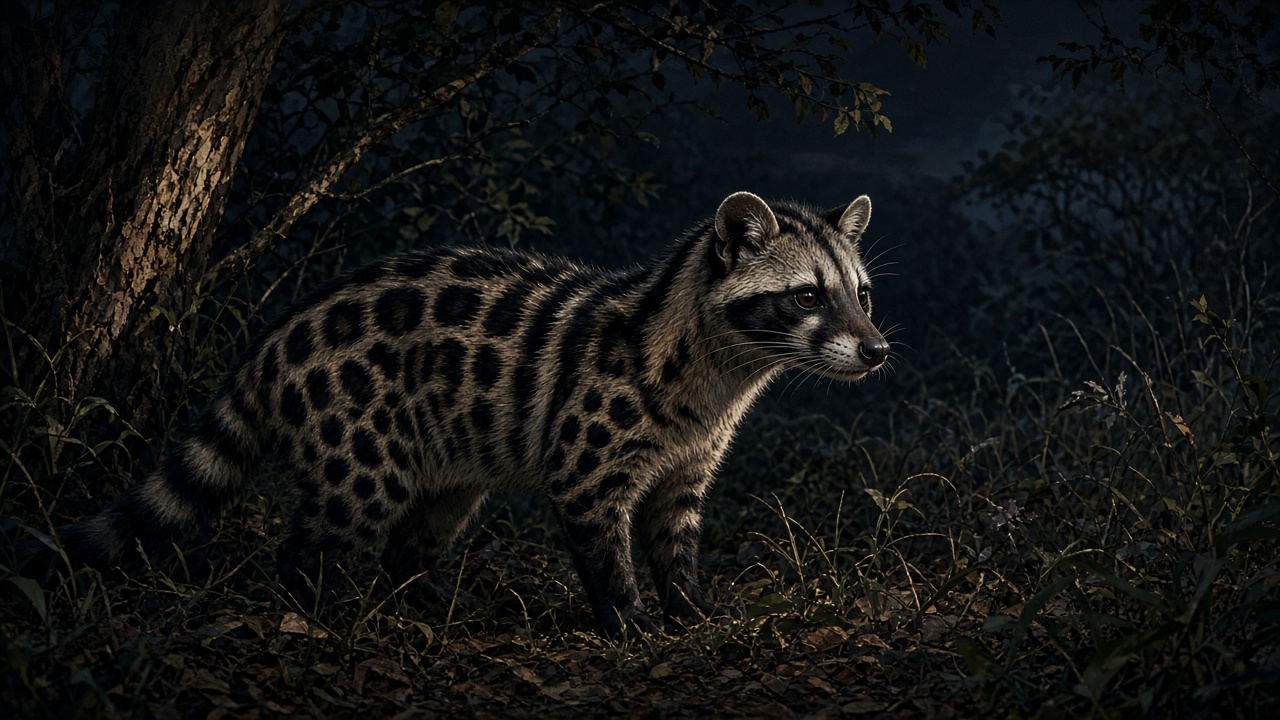
African Civet
Civettictis civettaAfrican Civet (Civettictis civetta): coexistence sheet across its documented range — presence, biology and prudence, without an invented hunting status.
Seen in: Namibia · South Africa
Overview
African Civet (Civettictis civetta) is a coexistence sheet across its documented range: presence, biology and prudence — not a hunting status claim.
Classification: order Carnivora, family Viverridae, genus Civettictis. Common names: African Civet in English, Civette d'Afrique in French, Civeta africana in Spanish.
Identification
A large viverrid of 12 to 15 kg, the African civet measures 61 to 91 cm long plus a 43 to 61 cm tail. Its heavy hindquarters and low-slung head make it easy to recognise. A short mane, 2.5 to 10 cm long, runs down the back and stands erect when the animal is excited or scared, making it look larger. A dark, raccoon-like face mask and white neck stripes stand out on a silver or cream body marked with brownish-black spots and bands. Each foot has five digits with long, non-retractable claws.
Omnivorous, it eats mainly wild fruit, carrion, rodents, insects (crickets, grasshoppers, beetles, termites), eggs, reptiles and birds, and tolerates items that are toxic or distasteful to most mammals, such as Strychnos fruit, millipedes and highly decayed carrion. It overpowers prey with its teeth rather than its paws. Breeding occurs all year in West Africa, from March to October in Kenya and Tanzania and from August to January in southern Africa; litters have 1 to 4 young, with two or three litters a year.
Habitats and range
MDD records it in some forty countries of sub-Saharan Africa, from Senegal and Mauritania to Ethiopia, Djibouti and Somalia, and south to South Africa, Namibia and Botswana. It lives in both forest and open country, provided there is tall grass or thicket for daytime cover, and usually stays near permanent water; it avoids arid regions but follows the river systems that reach into them in Niger, Mali and Chad.
The countries where the species’ presence is established are shown in the tags on this sheet.
Field signs
Nocturnal, it is most active from one or two hours before sunset until about midnight, and is sometimes seen in the morning or afternoon on cloudy days. It leaves droppings in latrines laced with anal gland secretions and marks objects by pressing its perineal glands against them. Its most frequent call is a “ha ha ha” contact sound; it also growls, cough-spits and screams. By day it sleeps in dense grass in thickets.
Conservation
For conservation status of Civettictis civetta, consult the current IUCN assessment and cross with national monitoring programmes in countries of documented presence. Never turn a global IUCN category into a local hunting rule. GBIF occurrences help situate distribution but remain effort-biased.
The IUCN lists it as Least Concern (MDD, ADW). It was long kept in captivity, often cruelly, for a musky secretion of its perineal glands used, highly diluted, in perfume; in 1988 more than 2,700 captive civets were still producing this musk in Ethiopia. It is also unpopular with farmers, as it raids henhouses and sometimes kills lambs.
Limits
This sheet on the African Civet covers presence and biology. A species being present in a country does not mean it may be hunted, and no season or quota is published here.
Local densities and management plans are not covered here: they are a matter for the managers of each area.
Sources
Sources consulted for this sheet:
- IUCN Red List — species search (consulted 2026-11-02)
- ASM Mammal Diversity Database — Civettictis civetta (consulted 2026-11-02)
- GBIF — species search (consulted 2026-11-02)
- Animal Diversity Web — Civettictis civetta (African civet) (consulted 2026-11-04)
Conclusion
In short: use the scientific name Civettictis civetta to cross-check sources, confirm taxonomy and conservation status on the institutional portals listed above, and relate every field sign to the habitat where it was actually found.
Identification
Civettictis civetta
African Civet · preferred
Civette d'Afrique · preferred
Civeta africana · preferred
Classification
Class : Mammalia
Order : Carnivora
Family : Viverridae
Genus : Civettictis
Conservation
IUCN : LC
CITES : —
iucn · LC (global)
Frequently asked questions
How do I recognise African Civet?
Use Civettictis civetta as the scientific anchor. A large viverrid of 12 to 15 kg, the African civet measures 61 to 91 cm long plus a 43 to 61 cm tail. Its heavy hindquarters and low-slung head make it easy to recognise. A short mane, 2.5 to 10 cm long, runs down the back and stands erect when the animal is excited or scared, ma...
Where does African Civet typically live?
MDD records it in some forty countries of sub-Saharan Africa, from Senegal and Mauritania to Ethiopia, Djibouti and Somalia, and south to South Africa, Namibia and Botswana. It lives in both forest and open country, provided there is tall grass or thicket for daytime cover, and usually stays near permanent water; it avoids arid regions but follows the river...
What field signs help confirm African Civet?
Nocturnal, it is most active from one or two hours before sunset until about midnight, and is sometimes seen in the morning or afternoon on cloudy days. It leaves droppings in latrines laced with anal gland secretions and marks objects by pressing its perineal glands against them. Its most frequent call is a “ha ha ha” contact sound; it also growls, cough-sp...